
Lift Springs
- Product
- Qty in Cart
- Quantity
- Price
- Subtotal
-


ICON 23-24 Toyota Sequoia TRD 2 in. Dual Rate Spring Kit- (Rear) - 51216
ICON
$435.95Will these springs fit my vehicle?ICON Spring Kits require precise confirmation of fitment with your specific vehicle model and year to ensure proper installation and performance.What is the expected...$435.95 -


ICON 2024+ Tacoma .5in Lift Overland Rear Coil Spring Kit - 51215
ICON
$339.95What is the expected lift height of these ICON springs?These ICON Spring Kits provide a modest increase in ground clearance, specifically designed for heavier Tacoma builds to enhance capability.Are...$339.95 -

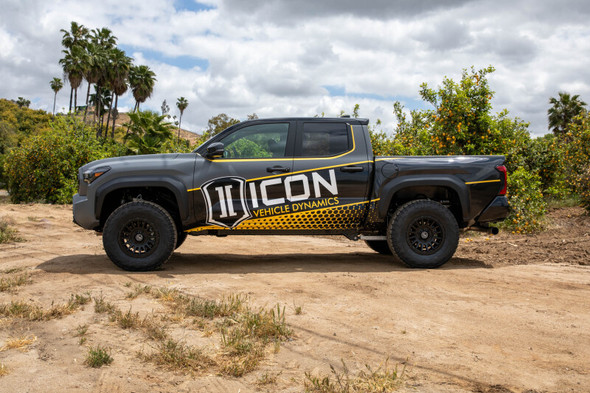
ICON 2024+ Tacoma .5in Lift Triple Rate Rear Coil Spring Kit - 51213
ICON
$370.55Will these lift springs fit my vehicle?Confirm exact fitment for your specific Toyota Tacoma before ordering, as these lift springs are designed for precise vehicle compatibility.How difficult is it...$370.55 -


ICON 2023+ Toyota Sequoia 3in Dual Rate Rear Spring Kit - 51212
ICON
$418.51Are ICO Spring Kits compatible with my 2023 Toyota Sequoia?ICON Spring Kits are engineered to precisely fit all 2023 to 2025 Toyota Sequoia models, ensuring seamless integration and performance.What...$418.51 -


ICON 22-23 Toyota Tundra 1.25in Lift Triple Rate Rear Coil Spring Kit - 51211
ICON
$406.52Who manufactures ICON Lift Springs?ICON Vehicle Dynamics manufactures these premium lift springs, engineered for enhanced vehicle performance and durability.How do I choose the right coil spring rate...$406.52 -


ICON 22-23 Toyota Tundra .5in Lift Triple Rate Rear Coil Spring Kit - 51210
ICON
$383.63How much lift do ICON Spring Kits provide?ICON Spring Kits provide a modest increase in ground clearance, enhancing capability without drastically altering your vehicle's profile.Are ICON Spring Kits...$383.63 -


ICON 22-23 Toyota Tundra Rear 3.5 Coil Spring Kit - 51013
ICON
$451.21What is the intended fitment for ICO Spring Kits?ICON Spring Kits are engineered specifically to fit 2022-2024 Toyota Tundra models, ensuring precise compatibility and performance upgrades.Is...$451.21 -


ICON 2020+ Jeep Gladiator JT 1.5in Rear Multi Rate Spring Kit - 22066
ICON
$274.63Do ICON Lift Springs come with installation instructions?ICON Lift Springs include comprehensive instructions, though professional installation is strongly recommended for optimal performance and...$274.63 -
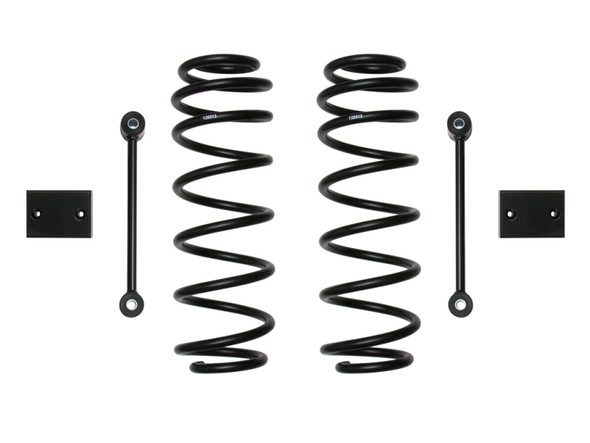

ICON 2018+ Jeep Wrangler JL 2.5in Rear Dual Rate Spring Kit - 22026
ICON
$360.74Will these lift springs fit my specific vehicle make and model?ICON Spring Kits require fitment confirmation for your vehicle make and model to ensure proper installation and performance.Are these...$360.74 -
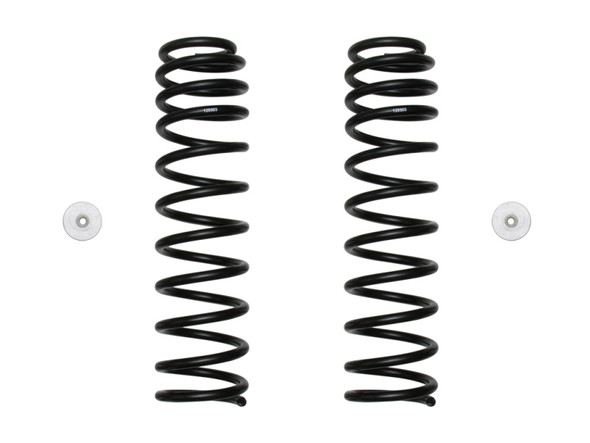

ICON 2018+ Jeep Wrangler JL / 2020+ Jeep Gladiator JT 2.5in Front Dual Rate Spring Kit - 22025
ICON
$274.63What vehicles do ICON Spring Kits fit?ICON Spring Kits are designed for specific vehicle fitment, so confirm your exact model year and trim for proper installation and optimal performance.Can I...$274.63 -


ICON 2014+ Ram 2500 .5in Rear Performance Spring Kit - 214206
ICON
$530.32What is the lift provided by ICO Spring Kits?ICON Spring Kits deliver a half-inch rear lift, enhancing your Ram 2500's stance and tire clearance with precision engineering.Do ICO Spring Kits fit my...$530.32 -
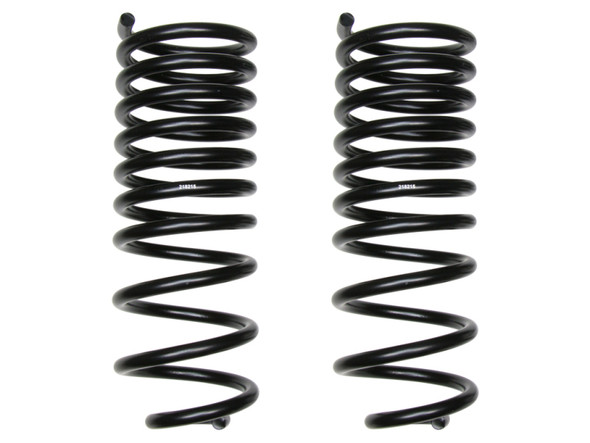

ICON 2014+ Ram 2500 2in Rear Performance Spring Kit - 214202
ICON
$497.01What is the primary benefit of ICON lift springs?ICON lift springs deliver a smoother ride over bumps with a lighter initial spring rate, significantly improving comfort for daily driving.Are ICON...$497.01
Lift springs are purpose-engineered coil or leaf spring assemblies that increase a vehicle's ride height by delivering greater free length and higher spring rates than factory units, enabling additional suspension travel, improved ground clearance, and enhanced load-handling capability. Motor Sport Mayhem stocks 170 lift spring solutions spanning entry-level leveling hardware through full-race-spec progressive-wound coils, priced from $1.14 to $13,544.00 across 109 brands.
\n\nOur Top Picks for Lift Springs
\nEach product below was hand-selected by our performance specialists based on engineering quality, real-world suspension performance, and verified customer results across street, off-road, and competition applications.
\n\nAEM IND Strut Bars
\nAEM Induction | $346.99
\nStrut tower bracing that ties chassis geometry directly to your suspension upgrade, preventing flex that undermines lift spring performance gains.
\n- \n
- Precision-machined mounting points maintain alignment tolerances when spring rates increase with a lift \n
AFE Coilover Systems
\naFe | $3,729.00
\nSingle-adjustable coilover platform engineered for the street-to-track transition where ride height precision and damper tuning must work together.
\n- \n
- Featherlight construction reduces unsprung mass without sacrificing structural rigidity under sustained load \n
ALF Wireless Air Control Systems
\nAir Lift | $1,363.99
\nWireless air management that lets you adjust ride height and spring rate on demand without any mechanical intervention at the vehicle.
\n- \n
- EZ-mount tank integration simplifies installation in applications where space alongside traditional lift hardware is limited \n
ABR Steering Racks
\nAll Balls Racing | $209.62
\nA reinforced steering rack is a critical pairing with any lift spring installation where increased ride height changes steering geometry and load paths.
\n- \n
- Built to withstand the elevated bumpsteer and steering load increases that accompany lift spring height gains on utility vehicles \n
PA Alta Adjustable Control Arms
\nAlta | $339.15
\nAdjustable rear control arms that allow proper alignment correction after ride height changes, preserving handling geometry that lift springs alone cannot maintain.
\n- \n
- Camber and toe adjustability ensures tire contact patch integrity is preserved when spring free length increases alter suspension geometry \n
ANT Micro-Start Tire Inflator
\nAntigravity Batteries | $24.99
\nA compact, always-ready tire inflator for aired-down off-road recovery — an essential trail tool whenever lift springs are doing real-world terrain work.
\n- \n
- Pairs directly with existing Antigravity jump-start systems for a single compact recovery kit on lifted vehicles \n
ARB BP51 Coilovers
\nARB | $4,580.69
\nBypass-style coilover technology that delivers independent compression and rebound control across the full lift travel range on full-size truck platforms.
\n- \n
- Internal bypass design prevents shock fade under sustained off-road loads where conventional coilovers lose damping consistency \n
ART Coils
\nArtec Industries | $351.99
\nFabricated frame coil buckets that provide a solid, weld-in mounting platform for larger-diameter lift springs where factory perches lack adequate load capacity.
\n- \n
- OEM bumpstop retention ensures progressive travel limiting is maintained after coil spring diameter or rate changes \n
AST 5100 Series Coilovers
\nAST | $4,554.00
\nCompetition-grade coilover hardware with externally adjustable damping that allows fine-tuning of spring rate interaction across variable circuit conditions.
\n- \n
- Five-way rebound adjustment lets engineers match damper response precisely to the progressive spring rate curve of competition lift coils \n
AWE Chassis Bars
\nAWE Tuning | $435.00
\nDrivetrain stabilization hardware that reduces powertrain movement amplified by stiffer lift spring rates, keeping driveline angles consistent under acceleration.
\n- \n
- Polyurethane mount construction provides the compliance balance needed when higher spring rates transmit more chassis vibration into the drivetrain \n
How to Choose the Right Lift Springs
\nThe single biggest mistake buyers make when selecting lift springs is treating free length and spring rate as independent variables — they are not. A longer spring that delivers the target ride height but runs a rate that's too soft for the vehicle's sprung weight will cycle through its travel too quickly, overstressing the damper and producing handling that deteriorates under load. Conversely, an overly stiff lift spring that never reaches mid-travel under normal driving conditions transfers road inputs directly into the chassis and reduces actual suspension articulation, which defeats the entire purpose of the lift in off-road or rough-road applications. Quality lift springs are cold-wound from high-tensile chromium-silicon or chromium-vanadium steel with a minimum tensile strength of 1800 MPa; anything wound from lower-grade carbon spring steel will set — meaning the free length permanently shortens under sustained load — within the first 10,000 miles.
\n\nKey Specifications
\nSpring rate is expressed in pounds per inch (lb/in) or Newtons per millimeter (N/mm) and must be matched to the corner weight of the vehicle plus any anticipated payload increase that the lift application is intended to support. A progressive-rate lift spring — one with variable coil spacing that produces a rising rate curve — is generally preferable for mixed on-road and off-road use because it rides softly over small inputs while resisting bottoming under large suspension excursions. Linear-rate springs are easier to tune with matched damper valving, making them the correct choice for competition and track applications where predictable spring behavior matters more than comfort compliance.
\n\nFree length and installed length are both critical measurements. Free length is the unloaded coil height; installed length is what the spring compresses to under static vehicle weight. The difference between these two values determines your working travel — how much suspension movement you actually have before the spring reaches coil bind. A spring that binds before the damper reaches full compression is a structural failure waiting to happen, and it is the most common engineering error in improperly specified lift kits. Always confirm that the selected spring's installed length provides at least 2 inches of clearance above coil bind at maximum compression.
\n\nWire diameter and coil diameter determine both structural capacity and the physical fitment envelope. Larger wire diameters increase load capacity but add weight and require wider coil perches. Most factory coil perches accept springs up to roughly 3.0-inch inner diameter on passenger applications; off-road truck platforms often accommodate 3.5-inch or larger inner diameters when paired with fabricated coil buckets. Powder coat or electrostatic paint finish on the coil body is not cosmetic — it is the primary corrosion barrier, and any lift spring without adequate protective coating will begin surface-oxidizing within two seasons in road-salt environments, accelerating fatigue crack initiation at the end coils.
\n\nSeat-to-seat preload affects how the spring behaves at ride height. Too little preload and the spring can unseat at full droop, creating a sudden loss of spring force and dangerous handling behavior. The correct preload for most street lift applications is between 0.5 and 1.0 inches of compression at full droop; race and off-road applications with remote reservoir shocks and struts often specify higher preload values to maintain positive spring contact through articulation extremes. Always verify preload specification against the damper manufacturer's travel specs, not just the spring catalog data.
\n\nLift Spring Rate vs. Vehicle Weight Reference Guide
\n| Vehicle Corner Weight (lbs) | \nRecommended Spring Rate — Street/Comfort (lb/in) | \nRecommended Spring Rate — Off-Road/Trail (lb/in) | \nRecommended Spring Rate — Competition (lb/in) | \n
|---|---|---|---|
| 600–800 lbs | \n150–200 | \n180–240 | \n250–350 | \n
| 800–1,000 lbs | \n200–280 | \n250–320 | \n320–450 | \n
| 1,000–1,300 lbs | \n275–375 | \n325–425 | \n450–600 | \n
| 1,300–1,600 lbs | \n375–500 | \n450–575 | \n600–800 | \n
| 1,600–2,000 lbs | \n500–650 | \n575–750 | \n800–1,100 | \n
| 2,000+ lbs (heavy truck/expedition) | \n650–900 | \n750–1,100 | \n1,100–1,600+ | \n
Price Guide
\nEntry ($1.14–$200): This tier covers individual replacement coils, leveling hardware, and single-axle lift components suited to mild height correction on daily-driven vehicles where maximum articulation and rate tuning are not priorities. Steel quality is functional but typically lower-grade carbon alloy; expect moderate spring set over time on heavier platforms. Correct application — not necessarily the cheapest part — is what separates a successful budget lift from a suspension that degrades handling.
\nMid-range ($200–$1,500): The majority of serious street performance, overlanding, and weekend off-road builds land here, where chromium-silicon spring steel, quality powder coat, and engineered rate curves become standard. This price band supports matched coilover assemblies, air-assist systems, and progressively wound lift springs that work with proper coilover platforms without requiring competition-level damper valving to perform correctly.
\nPremium ($1,500–$13,544.00): Full coilover systems with integrated lift springs, remote reservoir dampers, bypass technology, and wireless air management live in this tier — hardware where every component is engineered as a system rather than assembled from individual parts. This price point is justified for vehicles operating under sustained high-load conditions: professional off-road competition, heavy-duty expedition builds carrying significant payload, or track programs where spring-damper calibration directly affects lap time. The cost reflects not just materials but the engineering validation and dyno-tested valving that separates race-ready hardware from performance-adjacent parts.
\n\nWho Is This For?
\nLift springs serve a wider range of builders than most suspension categories — from weekend trail runners to full competition off-road racers to road course setups requiring precise ride height management — and the usage data reflects that breadth directly.
\n\nRacing Competition — 8.1/10
\nLift springs score highest in racing competition applications because controlled ride height and predictable spring rate behavior are non-negotiable when lap times depend on repeatable chassis balance. Competition builds require springs with tight rate tolerances — typically ±2% — and zero set characteristics under repeated high-load cycling. The combination of high spring rate, matched progressive curves, and verified free-length consistency allows race engineers to dial damper valving precisely without chasing a spring that changes behavior over a race weekend.
\n\nTrack / Autocross — 8.0/10
\nAt 8.0/10, track and autocross use reinforces that lift springs in this context are about ride height optimization and rate selection rather than raw height increase — autocross in particular demands low center of gravity paired with enough suspension travel to maintain tire contact through transition. Stiffer lift springs here work in concert with upgraded shocks and struts and often require alignment correction through adjustable control arms to recover camber curves altered by the height change.
\n\nStreet Performance — 7.7/10
\nStreet performance and weekend off-roading are tied at 7.7/10, which accurately reflects that lift springs on the street are doing dual work: managing increased ride height for clearance or aesthetics while still maintaining a compliant enough ride for daily road conditions. Progressive-rate springs perform best here because they soften initial compliance without sacrificing body control at speed. Proper spring rate selection relative to corner weight is especially important in street builds because an over-sprung street lift will transmit more road noise and vibration than the stock suspension it replaced.
\n\nWeekend Off-Roading — 7.7/10
\nWeekend off-road use demands lift springs that can handle both the highway miles to get to the trail and the sustained articulation demands once on it — a combination that rewards progressive-rate designs and quality coil materials over raw spring stiffness. Lifted suspension geometry introduces bumpsteer and changes to driveshaft angle that must be addressed through supporting hardware; bushing kits and corrective control arms are frequently required alongside the springs themselves to maintain safe handling at elevated ride heights.
\n\nOverlanding / Expedition — 7.2/10
\nExpedition builds score 7.2/10 because the application introduces a variable that pure off-road racing ignores: sustained heavy payload over long distances on variable terrain. Lift springs for expedition use must be rated to handle both the unladen curb weight and fully loaded gross vehicle weight without excessive sag, which means spring rates trend higher than equivalent trail-only setups. Air-assist and auxiliary air spring systems that work alongside primary lift coils are particularly valuable in this segment because they allow load-rated adjustment without requiring a different spring for loaded versus unloaded configurations.
\n\nTrusted Lift Springs Brands We Carry
\nThe brands that consistently lead in lift spring performance share one characteristic: they engineer spring rates from measured vehicle data rather than adapting generic rates to fit application. Bilstein brings OEM-supplier precision to its spring specifications, with tolerances validated against the same chassis data used by vehicle manufacturers. Eibach is an industry benchmark for cold-winding technology and rate consistency, producing springs to ±2.5% rate tolerance that professional racing teams specify by name. Skyjacker has built its reputation specifically in truck and SUV lift applications, with suspension geometry correction built into the spring design rather than left as an afterthought. H&R applies European motorsport engineering to its spring lineup, with a race heritage that transfers directly into street and track lift spring accuracy. FOX integrates spring selection into complete damper system engineering, ensuring rate curves are validated against shock valving rather than treated independently. ICON targets the premium truck and off-road segment with fully tested coilover spring systems where spring rate, travel, and damping are calibrated as a single engineered assembly rather than component combinations.
\n\nFrequently Asked Questions
\n\nAre aftermarket control arms actually worth installing alongside a lift spring upgrade?
\nYes — and in most cases they are not optional, they are necessary. When a lift spring increases ride height by 2 inches or more, the factory control arm geometry produces significant changes in camber curve, caster, and bumpsteer that the original arms were never designed to accommodate. Aftermarket control arms with adjustable length or corrected geometry angles restore the suspension's intended arc through travel, preventing accelerated tire wear and handling instability. The lift spring itself provides the height; the control arms ensure the rest of the suspension still behaves as engineered at that new height. Skipping control arm correction to save money on a lift build is the most common cause of premature ball joint and bushing failure in lifted vehicles.
\n\nHow do aftermarket control arms compare to OEM in terms of quality and durability?
\nQuality aftermarket control arms from established manufacturers are routinely stronger than OEM stampings because they are purpose-built for the load conditions that modified suspension geometry creates, rather than optimized purely for factory ride quality and cost targets. Most premium aftermarket arms use DOM steel tubing or billet aluminum construction with wall thicknesses and cross-sections that exceed factory specifications. The critical difference is in the joint hardware: quality aftermarket arms use heavy-duty ball joints and polyurethane or spherical rod-end bushings rated for higher articulation loads, whereas OEM arms often use rubber-isolated joints designed for NVH suppression rather than strength. That said, low-cost aftermarket arms manufactured without proper material certification or joint load testing can fail below factory strength levels — brand selection and not just "aftermarket versus OEM" is what determines the outcome.
\n\nAre adjustable sway bars worth the cost when running lift springs?
\nAdjustable sway bars become significantly more valuable once lift springs change ride height because the sway bar's effective roll stiffness contribution changes with suspension geometry — what was a correctly balanced factory setup can become either oversteer-inducing or understeer-prone after a height change. An adjustable bar lets you dial in roll stiffness independently at front and rear to rebalance the chassis without changing spring rates. For street-use lifted vehicles, reducing rear bar stiffness to recover articulation compliance is often the correct adjustment; for track and performance applications, increasing front stiffness to control the body roll that higher-rate lift springs introduce at raised ride heights is the more common calibration. Fixed-rate aftermarket bars require you to get the rate right once; adjustable bars let you tune it for different loads, tire pressures, and track conditions.
\n\nAre aftermarket bump stops worth running with lift springs?
\nAftermarket bump stops are not optional on any lift build where suspension travel has increased beyond the factory range — they are the final mechanical limit that prevents coil bind, shock bottoming, and chassis contact from causing structural damage. Standard OEM foam bump stops compress linearly and are sized for the factory travel envelope; when a lift spring adds 2–4 inches of travel, those same stops allow the suspension to reach positions the factory chassis was never designed to withstand. Progressive-rate aftermarket bump stops — typically polyurethane or microcellular foam — provide a rising resistance curve that slows the suspension progressively before hard contact, dramatically reducing impact loads on frame mounts, shock shafts, and spring perches. The cost of quality bump stops is a fraction of the cost of repairing a bent shock shaft or cracked frame mount that results from running without them at extended travel.
\n\nAre aFe suspension products genuinely engineered for performance, or are they primarily a marketing brand?
\naFe Control products are engineered hardware with a legitimate race development background — the Pfadt series coilover systems in particular were developed through active motorsport programs with dyno-validated damper curves rather than adapted from generic platforms. Their suspension products are manufactured to specific material and tolerance standards, and the brand has invested in application-specific engineering data rather than producing universal-fit parts that require significant customer modification. That said, aFe is primarily an air intake brand that expanded into suspension, which means their suspension line is narrower and more application-specific than dedicated suspension specialists like Bilstein or Eibach. Where aFe suspension products exist for your specific application, they are legitimate performance hardware; the catalog depth simply does not match brands whose entire engineering focus is suspension.
\n\nBuilding something specific? Our performance specialists can help you select the right Lift Springs for your application — street, track, or full race build.
\n\n" } ```