
2-Stroke Silencers
- Product
- Qty in Cart
- Quantity
- Price
- Subtotal
-

FMF Racing Beta 125RR 2018 Turbinecore 2 Spark Arrestor Silencer - 025235
FMF Racing
MSRP: $229.99$191.64The Turbinecore 2 is low maintenance, lightweight and retains power with the exclusive "Turbine Dampening System". This top-notch product features a straight through spark arrestor canister and...MSRP: $229.99$191.64 -

FMF Racing KTM 50SX 2009-15 Turbinecore 2 Spark Arrestor Silencer - 025167
FMF Racing
MSRP: $229.99$191.64The Turbinecore 2 is low maintenance, lightweight and retains power with the exclusive "Turbine Dampening System". This top-notch product features a straight through spark arrestor canister and...MSRP: $229.99$191.64 -

FMF Racing Suzuki RM80 89-01/RM85 02-25 Turbinecore 2 Spark Arrestor Silencer - 023010
FMF Racing
MSRP: $229.99$191.64The Turbinecore 2 is low maintenance, lightweight and retains power with the exclusive "Turbine Dampening System". This top-notch product features a straight through spark arrestor canister and...MSRP: $229.99$191.64 -

FMF Racing Kawasaki KX125 2003-07 Turbinecore 2 Spark Arrestor Silencer - 022021
FMF Racing
MSRP: $229.99$191.64The Turbinecore 2 is low maintenance, lightweight and retains power with the exclusive "Turbine Dampening System". This top-notch product features a straight through spark arrestor canister and...MSRP: $229.99$191.64 -

FMF Racing Yamaha YZ125 00-01 Powercore 2 Shorty Silencer - 020268
FMF Racing
MSRP: $199.99$166.64Shorter inner core length and aluminum canister. Finely tuned bolt-on silencer that maximizes bottom-end and mid-RPM. An excellent choice for tight tracks and Supercross tracks.This Part...MSRP: $199.99$166.64 -

FMF Racing Kawasaki KX250 1999-02 Powercore 2 Shorty Silencer - 020237
FMF Racing
MSRP: $199.99$166.64Shorter inner core length and aluminum canister. Finely tuned bolt-on silencer that maximizes bottom-end and mid-RPM. An excellent choice for tight tracks and Supercross tracks.This Part...MSRP: $199.99$166.64 -
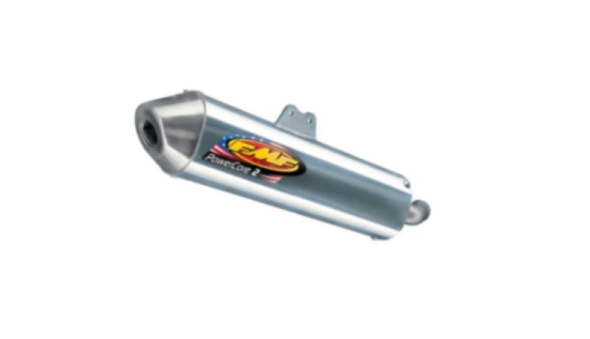
FMF Racing Honda TRX250R 86-89 Powercore 2 Silencer - 020211
FMF Racing
MSRP: $199.99$166.64The most popular 2-Stroke silencer in the FMF arsenal. Balances power enhancements into a lightweight extruded aluminum oval canister design. Equipped with a "Performance Flow" end cap and...MSRP: $199.99$166.64 -

FMF Racing Honda CR80 1996-02/CR85 1903-07 Powercore 2 Shorty Silencer - 021019
FMF Racing
MSRP: $199.99$166.64What is the main benefit of the FMF Powercore 2 Shorty Silencer for my 2-stroke dirt bike?The FMF Powercore 2 Shorty Silencer maximizes bottom-end and mid-RPM power, delivering explosive acceleration...MSRP: $199.99$166.64 -

FMF Racing Beta X-Trainer 23-25 Turbinecore 2 Spark Arrestor Silencer - 025298
FMF Racing
MSRP: $229.99$191.64What is the Turbine Dampening System?The FMF Turbine Dampening System is an exclusive design within this 2-stroke silencer for reduced sound output without compromising exhaust gas velocity.Can I...MSRP: $229.99$191.64 -

FMF Racing KTM 250/300XC-W 2017-19 Powercore 2 Silencer - 025281
FMF Racing
MSRP: $199.99$166.64How does the FMF Powercore 2 silencer affect my bike's performance?FMF's Powercore 2 silencer enhances your 2-stroke's performance by achieving a lighter bike for improved handling and agility on the...MSRP: $199.99$166.64 -

FMF Racing KTM250SX 19-22/250-300XC/XCWTPI 20-23/HQTC250 19-22/TE/X250i-300 20-23 Ti PC 2.1 Silencer - 025264
FMF Racing
MSRP: $449.99$374.95FMF Racing KTM250SX 19-22/250-300XC/XCWTPI 20-23/HQTC250 19-22/TE/X250i-300 20-23 Ti PC 2.1 SilencerLarger diameter canister for more tunability and increased packing lifeEngineered to assault modern...MSRP: $449.99$374.95 -
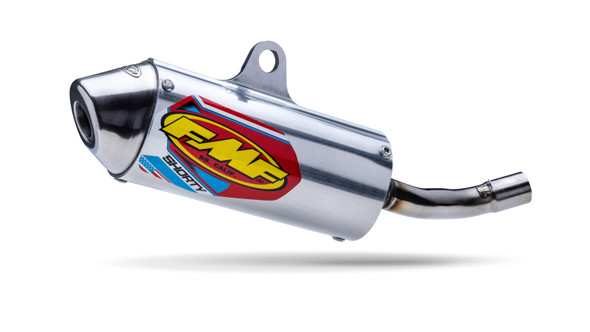
FMF Racing KTM 125/150SX 2019-22/HQV TC125 2019-22/Gas Gas MC125 2021-23 Powercore 2 Silencer - 025258
FMF Racing
MSRP: $199.99$166.64Is FMF 2-Stroke Powercore 2 Silencers compatible with my bike?Confirm fitment with your specific vehicle before purchase; professional installation is recommended for optimal integration of these...MSRP: $199.99$166.64
A 2-stroke silencer is the final exhaust component on a 2-stroke engine that reduces noise output while managing back-pressure to protect mid-range and top-end power delivery — the wrong silencer will kill powerband width just as effectively as a damaged reed valve. Motor Sport Mayhem stocks 89 silencers across 64 brands, from budget repacking kits to full titanium race systems, covering everything from trail riding to closed-course competition.
Our Top Picks for 2-Stroke Silencers
Each of these units was selected based on documented performance gains, material quality, and proven real-world results across street, trail, and race applications.
AFE Exhaust Cat Back
aFe | $2593.00
Mandrel-bent stainless construction with stepped diameter tubing delivers measurable flow improvements over restrictive factory systems.
- 304 stainless steel with black ceramic finish resists corrosion and high-cycle thermal fatigue
AKR Slip-On Line - Titanium
Akrapovic | $5768.53
Full titanium construction cuts significant unsprung and rotational mass while delivering race-validated sound character and flow efficiency.
- Aerospace-grade titanium baffling survives sustained high-RPM race use where steel systems crack
AMS Downpipes
AMS | $2249.95
Large-diameter mandrel-bent tubing eliminates the primary exhaust restriction point on turbocharged applications for immediate spool improvement.
- Precision TIG-welded flanges eliminate exhaust leaks that rob boost and distort silencer tuning
ATS Exhaust Manifolds
ATS Diesel | $894.99
Pulse-flow manifold geometry preserves exhaust gas velocity to the turbo inlet, directly reducing lag and improving silencer system efficiency downstream.
- Cast construction handles repeated thermal cycling without the cracking common in stamped OEM units
AWE Cat-Back SwitchPath
AWE Tuning | $3895.00
SwitchPath valve technology lets the driver toggle between a quiet cruising tone and an open race note without changing hardware or tune.
- Dual-mode silencer operation makes this viable for both street compliance and track day performance
GBE Torque Tube Systems
Banks Power | $569.00
Torque-tube exhaust routing optimizes scavenging pulses across the RPM range to broaden usable power and reduce silencer heat soak.
- Engineered tube-length tuning specifically targets low-to-mid RPM torque rather than peak power only
BBK Full Header & Cat
BBK | $1499.99
Long-tube primary headers with a high-flow catted mid-pipe create the ideal exhaust gas velocity profile to maximize downstream silencer scavenging efficiency.
- Silver ceramic coating reduces radiant heat and extends silencer packing life in tight engine bays
BDD Exhaust Brakes
BD Diesel | $1685.95
An exhaust brake creates controlled back-pressure upstream of the silencer to provide engine braking without service brake wear on long descents.
- Air-compressor actuation provides precise valve control versus cable or vacuum systems that degrade over time
BIG EXO Aluminum ATV Dual Full System
Big Gun | $944.22
Dual aluminum silencer canisters on a full-system ATV exhaust reduce total weight while increasing exhaust gas exit area for improved power across the rev range.
- Aluminum canister construction saves meaningful weight versus steel while surviving ATV-specific impact and vibration loads
BKM Exhaust Bungs B
BikeMaster | $12.99
Replacing degraded muffler packing restores noise suppression and corrects the lean exhaust note that burned-out packing causes in 2-stroke silencers.
- High-temperature packing material is the lowest-cost maintenance item that directly extends silencer service life
How to Choose the Right 2-Stroke Silencers
The core decision in selecting a 2-stroke silencer comes down to three variables that most buyers get wrong: core diameter relative to your engine's displacement, packing density matched to your operating RPM range, and canister material chosen for the application's weight and heat exposure requirements. A silencer that is too large in diameter drops exhaust gas velocity and kills mid-range torque; one that is too restrictive raises cylinder back-pressure above the point where the expansion chamber can properly resonate, collapsing top-end power. The difference between a quality unit and a cheap one often lives in how precisely the baffle geometry is machined — tolerances of even 1–2mm in the core tube diameter measurably shift peak power RPM. Spark arrestor compliance is a separate specification layer that matters for trail and forest riding; a silencer rated for closed-course competition will not pass USFS or BLM spark arrestor standards without modification or a certified insert.
Key Specifications
Core tube diameter is the primary flow specification on any 2-stroke silencer. For engines below 125cc, a 28–32mm core is typical; 250cc motocross applications generally run 32–38mm; and larger-displacement 2-strokes such as 500cc open-class machines need 38–42mm cores to avoid restriction at peak power RPM. Going wider than the pipe diameter exiting your expansion chamber introduces a step that disrupts pulse tuning and creates turbulence rather than laminar flow through the silencer body.
Packing material quality separates long-service silencers from those that need rebuilding every few hours. High-silica fiberglass packing rated to 1100°F is the baseline for serious use; standard fiberglass packing burns out rapidly above sustained 8,000 RPM operation. Some competition silencers use stainless steel wool in combination with packing to prevent blow-out on high-flow applications — this adds back-pressure but significantly extends service intervals. Regardless of material, any silencer used in competition should have packing inspected and replaced at regular intervals as a scheduled maintenance item, not a reactive one.
Canister material choice carries real weight and durability implications. Aluminum canisters are the lightest option and handle moderate heat well, but dent easily from roost and rock strikes — acceptable for closed-course racing, marginal for aggressive trail riding. Carbon fiber silencers are found at the premium end of the market and offer the best weight-to-strength ratio, but they are sensitive to direct impact and require careful mounting. Stainless steel canisters are the heaviest and most durable, suited to enduro and off-road applications where the silencer is exposed to sustained mechanical abuse.
Mounting hardware and flange interface tolerances matter more on 2-stroke applications than on 4-stroke because expansion chambers flex slightly under thermal cycling. Slip-joint connections need a proper spring or clamp system that allows axial movement without leaking; a leaking joint between the pipe and silencer introduces unmetered air that disrupts the resonant pressure wave and produces an audible lean surge at specific RPM points. Always verify the flange OD of your expansion chamber outlet before ordering — the nominal sizes listed in manufacturer specs frequently differ by 1–2mm between brands.
2-Stroke Silencer Core Diameter & Displacement Reference
| Engine Displacement | Recommended Core Diameter | Typical Application | Notes |
|---|---|---|---|
| 50–80cc | 22–28mm | Mini moto, youth MX | Smaller core preserves high-RPM velocity critical to small-bore powerband |
| 85–125cc | 28–32mm | Schoolboy MX, trail | Balance between flow and back-pressure for broad powerband |
| 150–200cc | 32–35mm | Trail, enduro, MX | Step-up core reduces restriction as displacement and flow volume increase |
| 250–300cc | 35–38mm | 250MX, 300 enduro | Peak flow demand at top-RPM requires full 38mm on race-spec builds |
| 360–500cc | 38–42mm | Open class, vintage MX | Oversizing beyond 42mm causes velocity drop and mid-range torque loss |
| 500cc+ (big bore) | 42–48mm | Vintage, specialty builds | Verify against expansion chamber outlet OD before ordering |
Price Guide
Entry ($3.99–$300): This tier covers repacking kits, replacement packing material, mounting hardware, and budget replacement silencer canisters for recreational trail use. You are not buying optimized baffle geometry or precision core dimensions here — you are buying function restoration. Perfectly appropriate for a trail machine that sees moderate use and does not need peak powerband optimization.
Mid-range ($300–$700): The majority of serious motocross and enduro riders land in this range. You start getting purpose-built baffle geometry, higher-grade packing material, precision-machined core tubes, and displacement-specific designs that genuinely move peak power RPM and broaden the powerband compared to stock. This is where brand-engineered designs from established performance exhaust manufacturers live, and it represents the best dollar-per-performance-gain tier for most applications.
Premium ($700–$11,935.89): Titanium canisters, full carbon fiber construction, CNC-machined billet end caps, FIM-homologated spark arrestor cores, and silencers validated on factory race programs define this tier. The weight savings on a titanium silencer versus steel can exceed 1.5 kg — meaningful on a competition machine where every 100g matters. This tier is justified for competitive amateur and professional racing; for recreational use, the performance delta over a quality mid-range unit does not warrant the cost premium.
Who Is This For?
2-stroke silencers serve a wide spectrum of riders and builders, from weekend trail riders maintaining stock-spec machines to full-race teams chasing tenths — the usage data below reflects where this category actually delivers measurable value.
Street Performance — 7.9/10
Scoring 7.9 out of 10 for street performance applications reflects how directly a properly matched silencer affects usable power delivery in real riding conditions. On a street-legal 2-stroke, silencer back-pressure tuning directly influences where peak torque sits in the RPM range — a silencer biased toward low back-pressure raises peak power RPM, which is counterproductive for traffic and commuting use. Street-focused silencers use denser packing and tighter core geometry to shift the powerband downward while remaining within noise regulations.
Engine Performance — 7.9/10
Engine performance also scores 7.9, and for 2-stroke applications this is not coincidental — the silencer is an active participant in the engine's tuned exhaust system, not a passive noise device. The expansion chamber and silencer together form a resonant system; changing the silencer's internal volume and core restriction alters where the pressure wave returns to the cylinder, directly shifting peak power RPM by 500–1,500 RPM in either direction. Builders who understand this use silencer selection as a tuning tool rather than a compliance item.
Exhaust Note / Sound — 7.7/10
A 7.7 sound score reflects genuine demand for controlled exhaust note in this category, particularly for riders who compete at noise-sensitive tracks with static or drive-by dB limits. The relationship between packing density and sound output is direct — denser, fresh packing absorbs higher-frequency content and reduces measured dB without the back-pressure penalty of a physically restrictive silencer. Riders in sound-limited series should verify their silencer's tested dB rating at a specific RPM point, as static and full-throttle measurements differ significantly.
Easy DIY Install — 7.8/10
Scoring 7.8 for DIY installation reflects the reality that 2-stroke silencer service — including full replacement and repacking — is genuinely accessible without specialist tooling. Most silencers connect via slip-joint or single-bolt flange and can be swapped in under 20 minutes with basic hand tools. Repacking is more involved but still within DIY capability: the process requires disassembly, packing removal, installation of new material at the correct density, and reassembly — something any mechanically capable rider can execute in a single shop session.
Racing Competition — 7.6/10
A 7.6 competition score is accurate for a category where homologation rules, series-specific sound limits, and class-legal spark arrestor requirements all constrain silencer selection. AMA, FIM, and local sanctioning bodies each maintain specific silencer certification lists and maximum dB thresholds that must be verified before race day — an illegal silencer results in immediate disqualification regardless of performance. Within legal constraints, competition-spec silencers use optimized core geometry and lightweight materials to maximize power delivery while passing technical inspection.
Trusted 2-Stroke Silencers Brands We Carry
The brands that define this category earned their positions through documented dyno results and race-validated designs rather than marketing. FMF Racing has built 2-stroke exhaust systems from its California facility since 1973, with silencer geometries developed directly from AMA and world championship race programs — their packing specifications and core dimensions are among the most thoroughly validated in the industry. Akrapovic brings aerospace-grade titanium fabrication and FIM factory team supply relationships that translate directly into street and competition silencer construction quality. Big Gun focuses on powersports-specific applications with displacement-matched designs validated for ATV and off-road use, where silencer durability under mechanical abuse is as important as flow numbers. BikeMaster covers the maintenance and rebuild tier with high-temperature packing materials and hardware that keep existing silencers performing correctly between full replacements. aFe applies mandrel-bend precision and 304 stainless construction standards across a broad range of exhaust applications, with silencer designs engineered for measurable flow improvement over factory units. AWE Tuning pushes the engineering envelope on valve-controlled silencer systems that deliver variable acoustic and flow characteristics from a single hardware installation.
Frequently Asked Questions
Are aftermarket exhaust tips worth it on a 2-stroke?
On a 2-stroke, the term "exhaust tip" refers to the silencer outlet end cap, and its geometry does affect measured back-pressure and sound character — but only marginally compared to the core tube diameter and packing condition. A larger outlet opening reduces exit restriction and can add 1–3% to top-end flow, but this gain evaporates immediately if the packing is degraded or the core diameter is mismatched to displacement. For most riders, money spent on fresh packing and a correctly sized core delivers more measurable performance than an outlet tip upgrade alone. Where tip geometry genuinely matters is in sound-limited competition, where a diffuser-style tip can reduce measured dB at the microphone position without altering internal flow characteristics.
Are aftermarket intake manifolds worth it for 2-stroke performance?
On a 2-stroke engine, the intake manifold — or reed cage and intake boot assembly — directly affects charge delivery velocity and reed valve response, both of which interact with exhaust scavenging timing to determine where peak power sits. A properly matched intake with a larger bore or smoother internal geometry increases charge volume at high RPM but can hurt low-RPM throttle response if oversized relative to displacement and porting spec. The exhaust silencer and intake must be tuned as a system — changing one without considering the other shifts the resonant tuning point and can move peak power into an unusable RPM range. For serious performance work, intake and engine component upgrades should be evaluated on a dyno with the silencer already installed and confirmed correct for the application.
Are Akrapovic exhausts worth the money for 2-stroke applications?
Akrapovic systems justify their price point through three concrete factors: titanium construction that cuts silencer weight by 40–60% versus steel equivalents, manufacturing tolerances held to within 0.5mm that preserve the resonant tuning relationship between the expansion chamber and silencer, and direct development from factory race programs where marginal performance gains have measurable championship implications. The premium is not for branding — it reflects material cost, CNC machining time, and validated dyno data that cheaper silencers simply do not have behind them. For competitive racing where weight and peak power are primary concerns, the cost-per-performance calculation favors Akrapovic. For recreational trail riding, a quality mid-range silencer from an established powersports brand delivers 85–90% of the performance at 30–40% of the cost.
Are axle-back exhausts relevant to 2-stroke silencer selection?
Axle-back exhaust is a 4-stroke automotive term that does not apply to 2-stroke powersports applications — on a 2-stroke, the equivalent concept is a slip-on silencer that replaces only the canister while retaining the expansion chamber. Slip-on 2-stroke silencers are the most common upgrade path because they change back-pressure and sound character without requiring a new pipe, and they are reversible for events where stock equipment is mandated. The performance ceiling of a slip-on is lower than a full system because the expansion chamber geometry — which does the primary resonant tuning work — remains stock. If peak power is the goal and budget allows, a full system with matched pipe and silencer outperforms a slip-on canister on the same machine every time. For sound reduction and moderate powerband refinement, a slip-on silencer is a cost-effective and practical upgrade.
Are BBK headers made in the USA and are they stainless steel?
BBK Performance manufactures its headers in the United States using domestic fabrication processes, which is a meaningful distinction in a category where imported headers frequently use inconsistent wall thicknesses and non-standard flange face tolerances. Material construction varies by product line — BBK offers both mild steel with ceramic coating and full 304 stainless steel options depending on application and price point, and the stainless versions use 16-gauge tubing that provides adequate thermal cycling durability for street and occasional track use. The ceramic coating on mild steel headers functions as a thermal barrier that reduces underhood temperatures and extends header life, but it is not equivalent to solid stainless in corrosion resistance over a multi-year service life in wet climates. For any header application, verifying the specific material grade listed in the product specification rather than assuming based on finish appearance is the correct approach. You can explore the full range of exhaust, mufflers, and tips to compare header and silencer system options across brands.
Building something specific? Our performance specialists can help you select the right 2-Stroke Silencers for your application — street, track, or full race build.