
Batteries
- Product
- Qty in Cart
- Quantity
- Price
- Subtotal
-
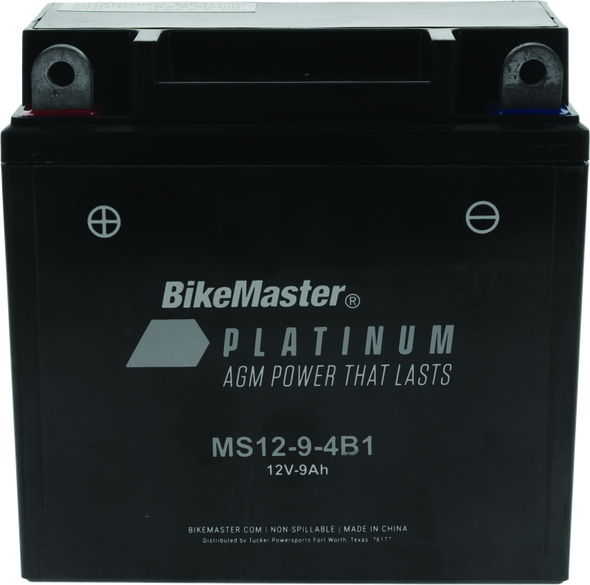
BikeMaster AGM Battery - MS12-9-4B1 - 780743
BikeMaster
$52.99What are the main benefits of a BKM AGM battery?BKM AGM batteries offer maintenance-free operation and a non-spillable design, ensuring leak-proof protection and eliminating electrolyte top-ups for...$52.99 -

BikeMaster AGM Battery - MS12-12A-4A1 - 780703
BikeMaster
$70.99What is an AGM battery?AGM batteries utilize absorbed glass mat technology, featuring a valve-regulated design for enhanced safety and superior performance over standard wet cell batteries.Are...$70.99 -

BikeMaster TruGel Battery - MG20L-BS - 780526
BikeMaster
$101.99The TruGel Battery by BikeMaster® is a gel electrolyte powersports battery with a life span twice that of a wet battery. Able to resist vibration and impacts that damage regular wet batteries, it can...$101.99 -
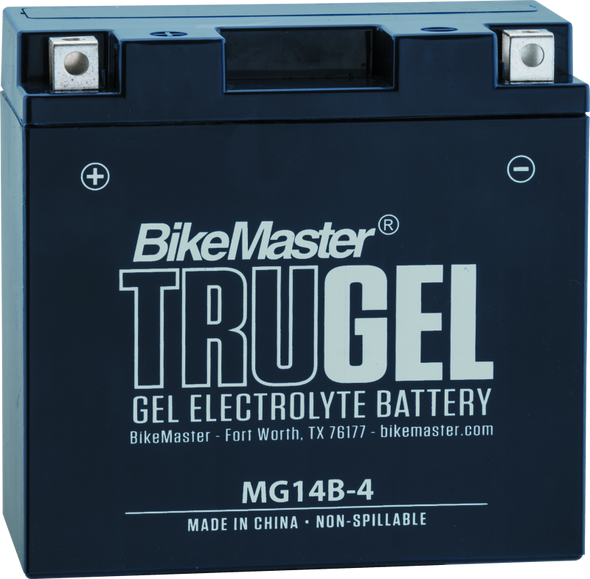
BikeMaster TruGel Battery - MG14B-4 - 780512
BikeMaster
$84.99Is this battery compatible with my motorcycle?Confirm your vehicle's fitment details to ensure precise compatibility for this BKM Batteries TruGel powersports battery.How long does this battery...$84.99 -

BikeMaster TruGel Battery - MG12-BS - 780508
BikeMaster
$63.99Is the BikeMaster TruGel battery maintenance-free?Yes, BikeMaster TruGel batteries are maintenance-free, eliminating the need for fluid top-offs and simplifying your powersports battery experience...$63.99 -
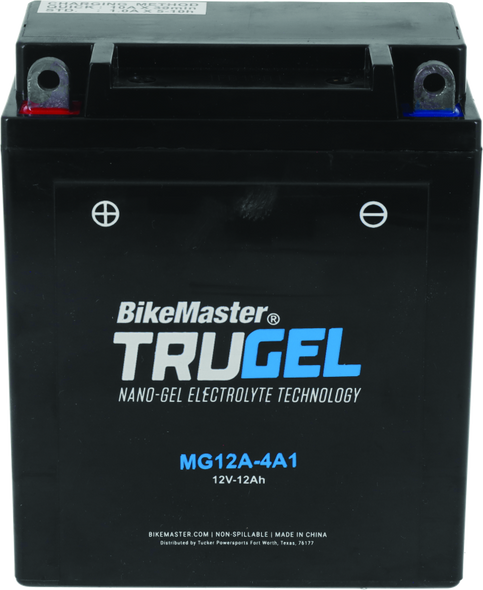
BikeMaster TruGel Battery - MG12A-4A1 - 780503
BikeMaster
$67.99How do I know if the TruGel battery will fit my motorcycle?Confirm fitment with your specific vehicle's make, model, and year to ensure precise compatibility for optimal battery performance.Can the...$67.99 -

Yuasa YTX14H Maintenance Free AGM 12-Volt Battery - YUAM7RH4H
Yuasa Battery
$99.81Is the YSA Maintenance Free Battery suitable for daily driving?YSA Maintenance Free Batteries excel in daily driving, offering an 8/10 usage score for unmatched convenience and reliability.What is...$99.81 -

Yuasa YTX14AH Maintenance Free AGM 12-Volt Battery - YUAM72H4A
Yuasa Battery
MSRP: $159.95$101.07What makes the YSA Maintenance Free Battery different from other batteries?The YSA Battery distinguishes itself with advanced lead-calcium technology, holding specific gravity over three times longer...MSRP: $159.95$101.07 -
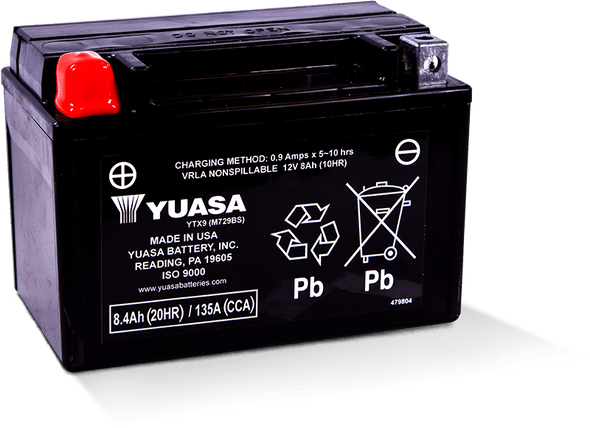
Yuasa YTX9 Maintenance Free AGM 12-Volt Battery - YUAM729BSTWN
Yuasa Battery
$90.96Advanced lead-calcium technology holds its specific gravity more than 3 times longer than conventional lead antimony batteriesAdvanced lead-calcium technology holds its specific gravity more than 3...$90.96 -

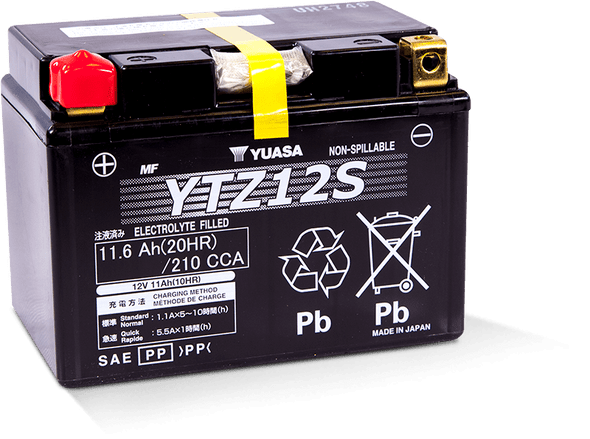
Yuasa YTZ12S Maintenance Free AGM 12-Volt Battery - YUAM7212A
Yuasa Battery
MSRP: $235.95$149.10How often should I check the water level in my Yuasa battery?The YSA Maintenance Free Battery, utilizing AGM separators, completely eliminates the need to ever add water for hassle-free operation...MSRP: $235.95$149.10 -


Yuasa GYZ16HL High Performance Maintenance Free AGM 12-Volt Battery - YUAM716GHL
Yuasa Battery
MSRP: $193.95$122.56What is the expected lifespan of a YSA Maintenance Free Battery?This YSA Maintenance Free Battery offers an extended service life due to its advanced lead-calcium technology and superior grid designs...MSRP: $193.95$122.56 -


Yuasa YTX20L Maintenance Free AGM 12-Volt Battery - YUAM420BS
Yuasa Battery
MSRP: $161.95$102.34Is this battery suitable for my specific vehicle model?Confirm fitment with your vehicle's specifications before purchase to ensure optimal compatibility and performance of this battery.How difficult...MSRP: $161.95$102.34
Performance batteries are the foundation of every reliable build — from featherweight lithium race cells that save 20+ pounds over OEM to dual-battery expedition setups capable of running full accessory loads for days without engine input. Motor Sport Mayhem stocks 223 batteries, chargers, maintainers, and accessories across 28 brands, spanning $0.99 to $3,333.85, built for every application from daily street use to full competition builds.
Our Top Picks for Batteries
Each of these products was selected based on verified performance data, real-world application fit, and value across the full range of builds we see on and off the track.
ANT AG 49 Restart Battery - Lithium
Antigravity Batteries | $1,349.99
A full-size Group 49 lithium cell with integrated Re-Start technology that automatically recovers a dead battery before it leaves you stranded.
- Lithium iron phosphate chemistry delivers massive weight savings over comparably rated AGM with significantly higher cranking output per pound
AM Battery Accessories
AutoMeter | $103.31
An 800A peak emergency jump starter with a compact lithium pack that fits in a glove box and delivers reliable cranking power without another vehicle present.
- Rated 800 amps peak output — enough to start most gasoline performance engines from a dead stop in cold conditions
BTN Battery Charger
Battery Tender | $739.95
A 10-bank selectable 6V/12V charger built for shops and serious collectors who need to maintain an entire fleet on a single unit simultaneously.
- Individual 4A channels per bank with selectable voltage means mixed battery types can be maintained simultaneously without cross-contamination of charge profiles
BKM Batteries - Lithium
BikeMaster | $304.99
BikeMaster's second-generation lithium ion platform delivers a significant weight reduction over conventional lead-acid with improved cold cranking performance across the discharge curve.
- Lithium 2.0 chemistry maintains a flatter voltage curve through discharge, preventing voltage sag that can trigger ECU faults on modern fuel-injected platforms
BKC Battery Accessories
Bikers Choice | $45.99
A period-correct ribbed battery side cover that restores OEM appearance while protecting the battery from road debris and abrasion on classic FL-series applications.
- Direct OEM replacement fit eliminates the gap fitment issues common with generic covers on vintage Big Twin builds
COBB Battery Tie Down
COBB | $75.00
A stealth black billet battery tie-down that secures the battery against lateral movement under hard cornering loads where factory plastic tabs are known to flex or fail.
- CNC-machined construction provides a rigid contact point that won't crack or fatigue under repeated thermal cycling and track stress
CTEK Chargers - D250
CTEK | $569.99
The D250SE is a multi-stage DC-DC charger engineered for dual-battery overlanding systems, pulling charge from an alternator or solar input and conditioning it properly for a secondary AGM or lithium auxiliary battery.
- Accepts input from 11.5–23V, making it compatible with both standard 12V alternators and 24V systems without modification
CUS Battery Tie Downs
Cusco | $76.50
Cusco's billet aluminum battery tie-down adds a hard mount point for the battery tray in high-lateral-G track applications where OEM retention is insufficient.
- Anodized aluminum construction resists corrosion from battery acid vapor and underhood heat cycles better than bare steel hardware
FSG Heat Trollers
FIRSTGEAR | $134.99
A single-channel PWM heat controller that manages 12V heated gear draw, protecting the battery and charging system from sustained overcurrent on long cold-weather rides.
- Remote-adjustable output prevents the unregulated full-load draw that can deplete a motorcycle battery below safe recovery voltage on extended tours
FR Alternator Kits
Ford Racing | $447.80
A complete alternator kit engineered for high-output applications where the factory charging system cannot keep pace with upgraded electrical loads and high-RPM track use.
- Designed as a direct bracket-in replacement for Boss 302 platforms, eliminating the fabrication hours typically required to fit a higher-output alternator
How to Choose the Right Battery
The single biggest buying mistake in this category is selecting a battery by price or physical size alone without matching chemistry, cold cranking amps (CCA), reserve capacity (RC), and charge profile to the actual application. A lithium iron phosphate cell in a cold-climate daily driver without a compatible charger will fail inside one season. An undersized AGM in a high-accessory overlanding rig will sulfate from chronic partial-state-of-charge cycling. Chemistry selection and charger compatibility are not optional considerations — they define how long any battery lasts.
Key Specifications
Chemistry and Cold Cranking Amps: Lead-acid AGM remains the most forgiving chemistry for general use — it tolerates a wider range of charger types, recovers better from deep discharge than flooded cells, and performs predictably in cold temperatures down to approximately -40°F depending on capacity. Lithium iron phosphate (LiFePO4) cells offer superior energy density (roughly 3–4x more usable capacity per pound), a flatter discharge curve, and significantly longer cycle life (2,000+ cycles vs. 200–500 for AGM), but require a lithium-compatible charger and a battery management system (BMS) to prevent cell damage from over-discharge or charging below freezing. CCA ratings should be matched to engine displacement and compression ratio — high-compression performance engines require substantially higher CCA than the factory minimum spec to crank reliably after heat soak.
Reserve Capacity and Dual-Battery Systems: Reserve capacity (RC) measures how many minutes a fully charged battery can sustain a 25-amp draw before dropping below 10.5V — a more meaningful number than amp-hours for vehicles with heavy accessory loads. Overlanding and expedition builds running refrigerators, lighting arrays, winches, and communications equipment should size the auxiliary battery's RC to cover the expected overnight draw plus a 30% buffer. Dual-battery systems require either an isolator or a DC-DC charger between the start battery and auxiliary battery — a simple relay-based isolator protects the start battery from drain but does not optimize charge delivery to the auxiliary, while a multi-stage DC-DC charger like those in CTEK's D-series properly conditions and completes the charge cycle on the secondary cell.
Physical Fitment and Retention: BCI group size determines the physical footprint, but terminal placement (top-post vs. side-post, positive terminal left or right) determines whether a battery actually fits a given tray and cable routing without modification. On track and competition builds, battery retention is a safety-critical specification — loose batteries become projectile hazards under impact, and many sanctioning bodies mandate steel or aluminum tie-downs with specific torque ratings. Billet aluminum tie-downs and proper battery boxes eliminate the flex common in OEM plastic retention hardware under high-G cornering loads.
Charger Compatibility: This is where most battery failures originate. AGM batteries require a charger that detects battery type and limits absorption voltage to approximately 14.4–14.7V — pushing 15V+ (typical for flooded-cell chargers) accelerates plate corrosion and kills AGM cells prematurely. Lithium cells need a charger that stops at full charge without float cycling, since continuous float voltage degrades lithium chemistry over time. Multi-stage smart chargers with selectable chemistry profiles eliminate this guesswork and pay for themselves by extending battery life well beyond single-season replacement cycles.
Battery Chemistry and Application Reference Guide
| Chemistry | Typical CCA Range | Cycle Life | Best Application |
|---|---|---|---|
| Flooded Lead-Acid (Conventional) | 150–600 CCA | 150–250 cycles | Budget street, low-electrical-demand applications |
| AGM (Absorbent Glass Mat) | 200–900+ CCA | 300–500 cycles | Daily driver, moderate accessory load, mild performance builds |
| Gel Cell | 100–500 CCA | 500–800 cycles | Deep cycle auxiliary, sensitive electronics, marine/powersport |
| LiFePO4 (Lithium Iron Phosphate) | 200–1500+ CCA equivalent | 1,500–3,000+ cycles | Motorsport weight reduction, overlanding auxiliary, high-demand performance |
| Lithium NMC (Nickel Manganese Cobalt) | 300–2000+ CCA equivalent | 500–1,000 cycles | Extreme weight-saving race applications, short-duration cranking only |
| EFB (Enhanced Flooded Battery) | 300–700 CCA | 250–400 cycles | Start-stop OEM replacement, light hybrid support systems |
Price Guide
Entry ($0.99–$100): This range covers replacement flooded and conventional AGM cells for low-demand applications, battery accessories like terminal covers and side covers, and basic trickle maintainers — appropriate for riders and drivers who need to keep a single seasonal vehicle topped off without complex charge management.
Mid-range ($100–$500): The majority of serious enthusiasts land here, covering quality AGM cells, entry-level lithium motorcycle and powersport batteries, smart multi-stage chargers with chemistry selection, and dual-battery management hardware — the tier where proper charger-to-battery chemistry matching starts to make a significant difference in service life.
Premium ($500–$3,333.85): Full-size lithium car batteries with integrated battery management and restart technology, high-output multi-bank commercial chargers, REDARC dual-battery and power management systems for expedition builds, and complete alternator upgrade kits justify the investment for competition builds, professional shops maintaining large fleets, and overlanding setups where electrical reliability is non-negotiable hundreds of miles from the nearest town.
Who Is This For?
Battery and charging system upgrades serve a wider range of builds than almost any other category — from a weeknight autocross car chasing weight reduction to a fully loaded overland rig running a refrigerator, compressor, and lighting rig through a two-week backcountry expedition.
Weekend Off-Roading — 7.3/10
Off-road use scores highest in the matrix for good reason: deep-cycle auxiliary batteries, isolators, and DC-DC chargers are standard equipment on any rig running a winch, onboard air, and lighting simultaneously. The combination of sustained high-current draws from a winch and long idle periods while airing down or obstacle negotiating creates exactly the partial-charge cycling that destroys conventional batteries quickly. Purpose-built dual-battery systems with proper charge management address this directly.
Overlanding / Expedition — 7.2/10
Expedition builds demand the most from battery systems because the vehicle is simultaneously the power source, refrigeration unit, communications hub, and shelter — sometimes for weeks without reliable shore power. High-capacity auxiliary batteries, solar-input DC-DC chargers, and battery monitors that track state of charge in real time are not optional on serious expedition rigs. Weight matters less here than reserve capacity and reliability in remote environments where failure is a serious safety issue.
Street Performance — 7.1/10
Street performance applications benefit primarily from lightweight lithium cells that reduce unsprung and rotating mass without compromising electrical reliability for modern engine management systems, data loggers, and upgraded audio or accessory loads. The challenge in street performance is matching a lithium battery to a vehicle's charging system voltage output — some older or lightly modified alternators don't fully recharge a lithium cell before the car reaches operating temperature, requiring attention to minimum charge voltage thresholds.
Daily Driving Comfort — 7.1/10
Daily drivers benefit most from smart maintenance chargers that keep the battery at peak charge during storage periods and AGM replacements that offer longer service life and lower self-discharge than conventional flooded cells. Start-stop systems found on many modern platforms are particularly hard on batteries and specifically require EFB or AGM-rated cells — installing a standard flooded replacement in a start-stop application will result in premature failure within one to two seasons.
Racing Competition — 6.6/10
Competition applications prioritize CCA-per-pound above all other specifications — a lithium cell that saves 25–30 pounds over an equivalent AGM while delivering the same or greater cranking output is a straightforward performance gain in any class where weight matters. Sanctioning body rules on battery relocation, containment, and terminal protection also drive purchases of racing-specific battery boxes and tie-downs, particularly in classes that mandate battery relocation to the interior or trunk.
Trusted Battery Brands We Carry
The brands in this category earned their positions through engineering credibility, not marketing spend. Antigravity Batteries pioneered lithium motorsport batteries in North America with integrated BMS and restart technology that set the standard for safe lithium use on the street. Yuasa Battery has supplied OEM powersport batteries to major manufacturers for decades, with sealed AGM construction engineered to exact factory specifications and discharge characteristics. CTEK developed the multi-stage smart charging algorithm now used as a reference standard by battery manufacturers globally, with products validated through OEM partnerships with major automotive brands. REDARC builds dual-battery management and DC-DC charging systems purpose-engineered for the specific thermal and vibration demands of expedition off-roading in the Australian outback — one of the harshest proving grounds on earth. Odyssey Battery uses pure lead thin-plate technology that delivers higher CCA density than conventional AGM and withstands deeper discharge cycles, making it a trusted choice for high-demand performance and powersport builds. Battery Tender remains the benchmark for long-term maintenance charging, with a product range spanning single-cell trickle maintainers to commercial multi-bank systems used in dealerships and race shops worldwide.
Frequently Asked Questions
Are battery boxes actually necessary on a performance build?
On any vehicle where the battery has been relocated from the factory position — especially trunk or interior relocations common in track builds — a proper battery box is required both for safety and by most sanctioning body rules. A loose battery under impact becomes a high-mass projectile and, in the case of a lead-acid cell, a spill hazard for corrosive electrolyte. Even in OEM locations, a sealed battery box provides meaningful protection against vibration-induced terminal wear and limits the spread of hydrogen gas emitted during charging. Polypropylene or aluminum battery boxes with vent fittings are the correct specification for any relocated installation.
Are battery isolators safe, and do they work correctly?
Diode-based battery isolators are fundamentally safe and have been used in dual-battery setups for decades, but they introduce a voltage drop of approximately 0.6–0.7V across the diode that prevents the auxiliary battery from reaching full charge state from the alternator alone. This chronic undercharge condition accelerates sulfation in lead-acid cells and can trigger BMS protection shutdowns in lithium auxiliaries. Modern relay-based isolators (also called VSR — voltage sensing relays) eliminate the voltage drop by using a direct relay connection that closes when alternator output is detected, though they lack the precision charge management of a dedicated DC-DC charger. For any build with significant auxiliary electrical demand, a multi-stage DC-DC charger is the technically correct solution over a simple isolator.
Are CTEK chargers actually worth the price over cheaper alternatives?
CTEK chargers justify their cost through multi-stage charge algorithms that include a desulfation step, bulk charge, absorption, and a float/maintenance phase that keeps batteries at peak charge without overcharging — a process that measurably extends battery service life compared to unregulated or single-stage chargers. Independent testing consistently shows AGM batteries maintained on quality multi-stage chargers lasting 30–50% longer than identical cells on basic trickle chargers. CTEK units also include temperature compensation circuitry that adjusts charge voltage based on ambient temperature, a critical feature for batteries stored in unheated garages in cold climates where fixed-voltage chargers will undercharge a cold battery.
Are Chinese LiFePO4 batteries safe, and how do you evaluate them?
LiFePO4 chemistry is inherently more thermally stable than lithium NMC or lithium cobalt oxide — it does not enter thermal runaway as readily — but the safety of any lithium cell ultimately depends on the quality of the battery management system (BMS), cell matching, and manufacturing consistency, not the country of origin alone. The differentiating factors to evaluate are: UL or CE certification from an accredited testing body, published BMS overcharge and over-discharge cutoff voltages, cell-level balancing capability, and whether the manufacturer provides warranty support. Generic cells with no published BMS specifications and no third-party certification should be treated with caution regardless of price point, as an inadequate BMS cannot prevent cell damage from charging at temperatures below freezing or from sustained over-discharge.
Can a CTEK D250SA charge a lithium auxiliary battery?
Yes — the D250SA includes a lithium charge mode specifically designed for LiFePO4 auxiliary batteries, delivering a charge profile that terminates at the correct absorption voltage without floating, which is essential for long-term lithium health. The unit accepts input from a 12V alternator or solar panel and outputs a regulated multi-stage charge to the auxiliary battery, functioning as a proper DC-DC charger rather than a pass-through isolator. When pairing the D250SA with a lithium auxiliary, confirm the lithium selection is active rather than the AGM profile — applying an AGM float voltage continuously to a lithium cell will degrade cell capacity over time even though it won't cause an immediate failure.
Building something specific? Our performance specialists can help you select the right Batteries for your application — street, track, or full race build.