
Clutch Discs
- Product
- Qty in Cart
- Quantity
- Price
- Subtotal
-

EBC 2002 KTM 250 EXC Racing (250cc) CK Series Clutch Kit - CK5612
EBC Powersports
MSRP: $172.03$163.43Will EBC CK Series Clutch Kits fit my 2007 KTM 450 EXC?EBC CK Series Clutch Kits are engineered to specifically fit your 2007 KTM 450 EXC, ensuring a precise match for optimal performance.How...MSRP: $172.03$163.43 -

EBC 2007 Triumph Bonneville/Bonneville Black (865cc) CK Series Clutch Kit - CK5608
EBC Powersports
$96.29What is the expected lifespan of an EBC CK Series Clutch Kit?EBC CK Series Clutch Kits, featuring controlled stack height and durable friction plates, are designed for extended longevity, preventing...$96.29 -

EBC 2017 Husqvarna TC 65 (65cc) CK Series Clutch Kit - CK5594
EBC Powersports
MSRP: $56.81$53.97Are EBC CK Series Clutch Kits compatible with my specific motorcycle model?EBC CK Series Clutch Kits require confirming fitment with your exact vehicle model before purchase for guaranteed...MSRP: $56.81$53.97 -

EBC 2010 Kawasaki KLX 125 (125cc) CK Series Clutch Kit - CK4522
EBC Powersports
MSRP: $93.72$89.04What are the benefits of using an EBC CK Series Clutch Kit?EBC CK Series Clutch Kits offer consistent engagement and superior grip, delivering reliable power transfer for enhanced driving control.How...MSRP: $93.72$89.04 -

EBC 2020 Kawasaki KLX 230 (230cc) CK Series Clutch Kit - CK4514
EBC Powersports
$96.29What makes EBC CK Series Clutch Kits different from stock clutch kits?EBC CK Series Clutch Kits feature unique alloy particle impregnated clutch facings that prevent burn-up or slippage, delivering...$96.29 -

EBC 82-98 Kawasaki KH 125 K2-K10 (125cc) CK Series Clutch Kit - CK4438
EBC Powersports
MSRP: $70.28$66.76Will these clutch discs fit my motorcycle?Confirm fitment with your specific vehicle's make, model, and year before purchasing these EBC CK Series clutch discs for optimal compatibility.How difficult...MSRP: $70.28$66.76 -

EBC 2011 Kawasaki EJ 800 ABF/ACF W Solid Front Disc (800cc) CK Series Clutch Kit - CK4435
EBC Powersports
MSRP: $132.08$125.48What is the purpose of the alloy particles in EBC CK Series clutch discs?EBC CK Series clutch discs feature unique alloy particle impregnated facings that prevent burn-up and slippage for superior...MSRP: $132.08$125.48 -

EBC 2015 Kawasaki 650 Vulcan S EN 650 (650cc) CK Series Clutch Kit - CK4424
EBC Powersports
MSRP: $108.22$102.81What is the EBC CK Series Clutch Kit?EBC CK Series Clutch Kits are performance-engineered clutch disc replacements designed to restore factory-fresh engagement and smooth power transfer for your...MSRP: $108.22$102.81 -

EBC 1977 Kawasaki Z 1000 A (1000cc) CK Series Clutch Kit - CK4409
EBC Powersports
MSRP: $129.75$123.26Are EBC CK Series Clutch Kits a direct replacement for my stock clutch discs?EBC CK Series Clutch Kits are engineered as direct replacements, meticulously matching original equipment dimensions for a...MSRP: $129.75$123.26 -
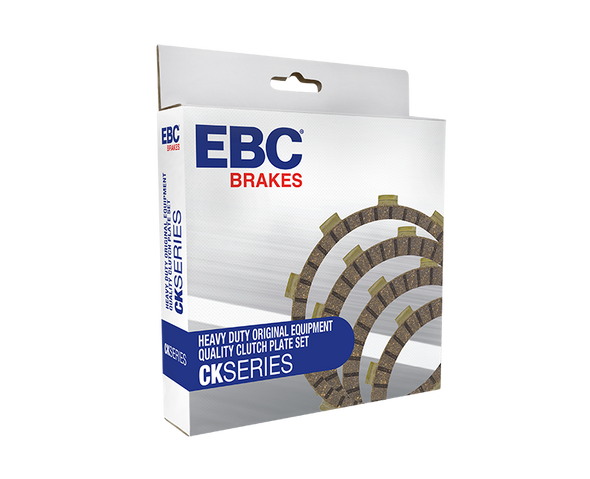
EBC 06-09 Suzuki M 1800 R VZR M R Intruder (1800cc) CK Series Clutch Kit - CK3457
EBC Powersports
MSRP: $189.75$180.26What is the general lifespan of EBC CK Series clutch kits?EBC CK Series clutch kits offer extended clutch life due to superior grip and heat resistance, preventing burn up or slippage for ultimate...MSRP: $189.75$180.26 -

EBC 11-21 Suzuki GSXR 600 (600cc) CK Series Clutch Kit - CK3456
EBC Powersports
MSRP: $128.33$121.92How do I know if the EBC CK Series Clutch Kit is compatible with my vehicle?Confirm fitment using our vehicle selector to ensure a precise, direct-fit installation for your specific motorcycle model...MSRP: $128.33$121.92 -

EBC 04-05 Kawasaki KLV 1000 LV (1000cc) CK Series Clutch Kit - CK3443
EBC Powersports
MSRP: $166.44$158.12Will the EBC CK Series Clutch Kit fit my 2005 Suzuki DL1000 V-Strom?EBC CK Series Clutch Kits are engineered to fit your 2005 Suzuki DL1000 V-Strom, ensuring precise mechanical compatibility.Is...MSRP: $166.44$158.12
Clutch discs are the friction interface between your flywheel and pressure plate — the single component that determines how effectively engine torque transfers to the drivetrain under load, and how quickly that connection degrades under heat and slip cycles. Motor Sport Mayhem stocks 222 clutch discs across 92 brands, ranging from daily-driver organic units to full-race ceramic and multi-disc assemblies rated beyond 1,000 ft-lbs of torque.
Our Top Picks for Clutch Discs
Every product below was hand-selected based on verified performance credentials, friction material engineering, and real-world results across street, track, and competition builds.
ACT Mod-Twin Kits
ACT | $2,104.00
A purpose-built twin-disc race system engineered for 895 ft-lbs torque capacity using a sprung mono drive hub for shock absorption between shifts.
- HD race-spec friction material with dual-disc clamping for extreme torque loads — not a street compromise
AON Clutch – Twin – 7.25in
Action Clutch | $1,377.45
A 7.25-inch twin-disc race clutch paired with a chromoly flywheel for reduced rotational mass and faster rev response under competition conditions.
- Chromoly flywheel inclusion reduces total rotating mass while the twin-disc design distributes clamping load for longevity at peak power
AMS Master Cylinder Conversion
AMS | $494.95
A hydraulic clutch master cylinder conversion that restores accurate pedal feel and consistent actuation force when running high-clamp aftermarket clutch disc assemblies.
- Properly matched master cylinder bore diameter is critical when upgrading clutch disc clamp load — this conversion addresses that directly
BBK Clutch Cable & Fwall Adjt
BBK | $169.99
An adjustable clutch cable and firewall adjuster kit that precisely sets clutch disc engagement point after an aftermarket disc and pressure plate install.
- Mechanical cable adjustment is essential for dialing in consistent engagement height when clutch disc thickness deviates from OEM spec
ATS Flex Plates
ATS Diesel | $804.99
A billet SFI-certified flexplate engineered to handle extreme torque spikes that accompany high-clamp clutch disc upgrades in high-output applications.
- SFI 29.3 certification confirms the flexplate is rated for the increased torsional shock loads generated by aggressive clutch disc engagement
ARB Air Locker Kits
ARB | $2,604.95
A pneumatically actuated locking differential system that works in direct combination with clutch-based drivetrain components to maximize traction delivery off-road.
- Air locker engagement relies on precise clutch-side torque management — pairing with properly spec'd drivetrain clutch components is critical for system reliability
ART Easy Link Kit
Artec Industries | $1,484.99
A geometry-adjustable three-link suspension kit that controls axle wrap under hard clutch engagement — a critical factor when upgrading to high-clamp disc assemblies in off-road builds.
- Proper triangulated link geometry prevents axle housing rotation under the torque spikes generated by aggressive clutch disc engagement at launch
AFE Diff/Trans/Oil Covers
aFe | $430.00
A machined billet transmission pan that increases fluid capacity and thermal management for automatics running clutch pack upgrades under sustained load.
- Increased fluid volume directly lowers clutch pack operating temperature in automatic transmissions, extending friction material life
ABR Prop Shafts
All Balls Racing | $790.35
A heavy-duty prop shaft engineered to handle the torque spike transmitted through the drivetrain when a high-grip clutch disc hooks up under load in UTV applications.
- Upgraded prop shaft integrity is a prerequisite when clutch disc grip levels exceed OEM drivetrain torque ratings in off-road and powersports builds
GBE Diff Covers
Banks Power | $425.00
A finned differential cover that dissipates gear oil heat generated by the repeated torque loading cycles that follow aggressive clutch disc engagement under performance driving conditions.
- Thermal management at the differential is directly linked to clutch disc durability — excessive diff heat cycles back into the drivetrain and accelerates friction material wear
How to Choose the Right Clutch Discs
The clutch disc is where the entire drivetrain contract is written and enforced — the friction material, hub damping design, and disc diameter collectively determine torque capacity, engagement character, heat resistance, and service life. The most common failure mode in under-spec'd clutch discs is heat-induced glazing of the friction material, which produces slip under load without any visible wear, making torque capacity selection the single most important decision in this purchase. Certified torque capacity ratings, friction material compound, hub spring configuration, and disc diameter are the four specifications that must align with your application before anything else.
Key Specifications
Friction Material: Organic (non-asbestos organic, or NAO) compounds offer progressive engagement and low pedal effort, making them the correct choice for street and light performance use — but they thermal-degrade rapidly above 400°F operating temperature. Ceramic and cerametallic compounds tolerate sustained temperatures above 700°F and are the standard for drag racing and circuit work, but they operate with a narrower engagement window and require a break-in procedure to seat the material evenly. Sintered metallic is the most aggressive compound — used in purpose-built race applications where engagement smoothness is irrelevant and torque capacity is the only metric that matters.
Hub Design and Damping: The hub is the mechanical interface between the disc and the transmission input shaft — its design directly affects how torque shock is transmitted to the gearbox. Sprung hub designs use torsional springs to absorb engagement shock, which protects synchronizers and input shaft bearings during aggressive launches. Solid or rigid hubs transfer torque shock directly to the gearbox, which is acceptable in purpose-built race transmissions designed for that loading but will accelerate wear in street transmissions. When selecting a disc for a build that retains a stock or lightly modified gearbox, a sprung or multi-spring hub is always the correct specification.
Disc Diameter and Clamp Load Matching: Clutch disc diameter must be matched to the pressure plate and flywheel dimensions — oversizing or undersizing the disc creates uneven clamping load distribution, which causes hot spots and premature friction material failure. Higher-diameter discs increase torque capacity through a larger friction surface area, while multi-disc setups (twin or triple) multiply torque capacity within the same housing diameter. Always verify that disc diameter, spline count, and spline diameter match the transmission input shaft specification before ordering — these are non-negotiable fitment parameters.
Surface Finish and Quality Indicators: Consistent friction material thickness tolerance (typically ±0.1mm across the disc face) is a direct indicator of manufacturing quality and determines whether the disc seats evenly during break-in. Look for SFI certification on race-spec discs used in sanctioned competition — this is not a marketing claim but a tested structural standard. For drivetrain builds running elevated torque output, verify the disc's rated torque capacity includes a safety margin above your engine's peak torque — a minimum 20% overhead is the industry-standard conservative specification.
Clutch Disc Friction Material Selection Guide by Application
| Application | Recommended Material | Max Continuous Temp | Engagement Character |
|---|---|---|---|
| Daily Street / Mild Performance | Organic (NAO) | ~400°F | Progressive, smooth |
| Street Performance / Occasional Track | Sprung Ceramic Hybrid | ~550°F | Slightly firmer, still streetable |
| Autocross / Track Days | Cerametallic (sprung hub) | ~650°F | Firm, defined engagement point |
| Road Racing / Endurance Circuit | Full Cerametallic or Sintered | ~750°F | Aggressive, narrow slip window |
| Drag Racing (street tire) | Ceramic Puck (sprung or solid) | ~700°F | High static grip, sharp bite |
| Full Race Drag / No Street Use | Sintered Metallic (solid hub) | 900°F+ | On/off, requires race technique |
Price Guide
Entry ($1.99–$150): This range covers OEM-replacement organic discs, powersports friction discs, and individual clutch pack plates for automatic transmissions — correct for restoration, OEM-level replacement, and light-duty powersports applications where stock torque levels and engagement behavior are the target specification.
Mid-range ($150–$800): The majority of serious street performance and track-day builds land here — this range delivers ceramic and cerametallic friction materials, properly engineered hub damping systems, and verified torque capacity ratings well above OEM. For a modified street car or a dedicated autocross build, this is the segment that covers virtually all applications without paying for race-only technology that degrades daily drivability.
Premium ($800–$4,999.99): Multi-disc systems, sintered metallic race compounds, SFI-certified assemblies, and complete twin or triple-disc kits with matched flywheels live in this range — justified for builds exceeding 500 wheel-horsepower, sanctioned competition, or any application where clutch failure under load creates a safety or reliability consequence rather than a minor inconvenience.
Who Is This For?
Clutch discs serve applications from light powersports maintenance to 1,000+ ft-lb race builds — the usage data below reflects the actual distribution of how these products are used across our catalog.
Drag Racing — 8.1/10
Drag racing earns the highest score in the usage matrix at 8.1/10, and the reason is mechanical: a clutch disc at the drag strip absorbs the entire torque pulse of a wide-open-throttle launch at maximum engine output with zero warm-up slip. Sintered metallic and ceramic puck discs are the standard specification here because they maintain static friction coefficient even when surface temperatures spike during repeated full-power passes. Disc selection for drag applications must account for torque multiplication through the drivetrain — what the engine produces at the crank is not what the clutch sees if forced induction or a performance transmission is in the system.
Racing Competition — 8.0/10
At 8.0/10, competition racing places the second-highest demand on clutch disc specification — not because of individual event severity, but because of cumulative thermal and mechanical cycling over a race season. Circuit racing and road course competition require discs that maintain consistent friction coefficient across a wide temperature operating range, from a cold first lap to a heat-soaked final stint. Consistent engagement feel across that temperature range is what separates race-grade friction compounds from street-performance materials, and it's the primary reason competition builds specify different disc compounds than the same car driven on the street.
Track / Autocross — 7.8/10
Track days and autocross score 7.8/10 — slightly below dedicated racing because the duty cycle is more variable, mixing aggressive competition laps with paddock driving and occasional street transit. A cerametallic sprung-hub disc is the ideal specification here: it provides the thermal headroom needed for track use while retaining enough engagement progressivity for low-speed paddock and street driving. The break-in requirement of most cerametallic discs is a genuine consideration for autocross use — plan for proper bedding procedure before the first competitive event.
Street Performance — 7.7/10
Street performance scores 7.7/10 across 192 products — the largest product count in the matrix, reflecting the size and diversity of the street performance segment. For street builds, friction material selection is a balance between torque capacity and daily drivability: a disc that can handle 450 ft-lbs but requires a two-foot clutch technique and chatters below 2,000 RPM is technically capable but practically miserable to live with. The sprung ceramic hybrid compounds in the mid-price range are specifically engineered to resolve this tension, delivering meaningful torque capacity upgrades without forcing a race-only engagement character.
Daily Driving Comfort — 6.3/10
Daily driving comfort scores 6.3/10 — the lowest in the matrix — which is an honest reflection of the performance-oriented nature of this catalog rather than a product quality issue. Aftermarket clutch discs are primarily engineered for elevated torque capacity and thermal durability, not NVH reduction or light pedal effort; those are OEM engineering priorities. If commute comfort is the primary metric, an OEM-spec organic replacement disc is the technically correct choice — the aftermarket performance segment is designed to supplement or replace that baseline when power output demands it.
Trusted Clutch Discs Brands We Carry
The brands that dominate this category earn their position through engineering depth and competition-validated friction material technology — not marketing. ACT (Advanced Clutch Technology) has over 30 years of friction material R&D and is a verified OEM supplier to several manufacturers, with their cerametallic compounds used in sanctioned motorsport globally. Exedy is the world's largest OEM clutch supplier by volume, manufacturing original equipment for major automotive brands before supplying high-performance upgrades under their own name. Clutch Masters engineers in-house friction compounds and performs dynamometer validation on each product line before release, with particular strength in twin and triple-disc systems for high-output forced-induction applications. Competition Clutch has built its reputation specifically on ceramic and sintered disc technology for Japanese and European performance platforms, with consistent torque capacity ratings backed by dyno certification. Vortex Racing and BikeMaster cover the powersports and motorcycle segment with application-specific friction plate materials engineered for wet clutch operating environments — a fundamentally different engineering discipline than automotive dry-disc applications — rounding out a catalog that covers virtually every clutch disc application across performance motorsport.
Frequently Asked Questions
Are ACT clutches hard to drive daily?
ACT's performance clutch discs span a wide range of engagement characters, and the answer depends entirely on which friction compound and hub configuration you select. Their organic and sprung cerametallic street performance discs are engineered to be daily-drivable, with pedal effort and engagement progressivity close to OEM — most drivers adapt within a few hundred miles. Their race-spec discs with solid hubs and full sintered metallic compounds are a different tool entirely: they require deliberate clutch technique, don't idle-creep smoothly, and are explicitly not recommended for street use. Matching the disc specification to your actual use case is the decision — not choosing a brand.
Are aftermarket pressure plates worth it?
An aftermarket pressure plate is worth the investment the moment your engine's peak torque output approaches or exceeds the OEM pressure plate's clamp load rating — typically around 20–25% above the factory torque figure for most stock pressure plates. The pressure plate clamp load must be correctly matched to the disc's friction material: installing a high-clamp pressure plate against an organic disc will cause accelerated disc wear and heat glazing, while underclamp against a cerametallic disc produces chronic slip. The complete clutch system — disc, pressure plate, flywheel, and release bearing — should be specified together as a matched assembly for maximum longevity and predictable engagement. For engine component upgrades that increase peak torque, the pressure plate upgrade is not optional — it's load-matched hardware.
Are aftermarket master cylinders good for clutch systems?
A properly specified aftermarket clutch master cylinder is not just good — it's often a functional requirement when upgrading to a higher-clamp pressure plate and performance disc assembly. The master cylinder bore diameter determines hydraulic output pressure and pedal travel ratio; an OEM-spec bore matched to a stock clutch will deliver insufficient hydraulic force to fully disengage a high-clamp aftermarket pressure plate, resulting in incomplete release, dragging, and accelerated synchro wear. Aftermarket master cylinders engineered for upgraded clutch systems recalibrate bore diameter and internal geometry to provide complete release across the full clamp load range of performance disc assemblies. Quality aftermarket units use hardened internal components and higher-rated seals that outperform OEM rubber components under the elevated hydraulic pressures a performance clutch system generates.
Are aftermarket wheel bearings as good as OEM?
Quality-tier aftermarket wheel bearings from reputable manufacturers meet or exceed OEM dimensional and load-rating specifications — the key variable is sourcing from an established bearing manufacturer rather than an unbranded commodity supplier. OEM bearings are typically sourced from the same Tier 1 suppliers (SKF, NSK, Timken, JTEKT) that sell performance-grade replacements in the aftermarket, meaning the core engineering is identical. Where aftermarket bearings earn a performance advantage over OEM is in pre-load specification and cage material: high-performance and racing applications often benefit from tighter pre-load tolerance and steel or ceramic cage construction that handles higher radial and axial loads. For any bearing application in a performance or modified vehicle, always verify load ratings match or exceed OEM specifications — never select bearings based on price alone.
Are air lockers more reliable than electronic lockers?
Air lockers and electronic lockers operate through fundamentally different actuation mechanisms, and each has a distinct reliability profile in the field. Air lockers use pneumatic pressure to engage a mechanical dog clutch — the engagement mechanism itself has no electrical components, meaning the locking action remains fully functional even with electrical system issues, provided the compressor and air lines are intact. Electronic lockers (e-lockers) use a solenoid or electric motor to engage the same type of dog clutch, making them dependent on electrical continuity and ground integrity — common failure points in off-road environments where water intrusion and corrosion are persistent concerns. In sustained off-road use with water crossings and chassis flex, air lockers have a documented advantage in actuation reliability because the pneumatic circuit is more resilient to the specific failure modes of that environment. Both systems use the same underlying locking mechanism; the reliability question is entirely about actuator durability in your specific operating conditions.
Building something specific? Our performance specialists can help you select the right Clutch Discs for your application — street, track, or full race build.