
Brake Pads - Performance
- Product
- Qty in Cart
- Quantity
- Price
- Subtotal
-

EBC 08-13 Yamaha YFM 250 Raptor Front Left/Right R Series Sintered Brake Pads - FA443R
EBC Powersports
MSRP: $41.74$39.20For serious riders and fast streetbikes, the acclaimed Double-H™ grade sintered pads are in a class of their own, many arriving with stainless heat radiator plates.Flagship high-performance that EBC is known forECE R 90 approved approved and TUV...MSRP: $41.74$39.20 -

EBC 18-19 Beta RR 50 Rear Right R Series Sintered Brake Pads - FA367/2R
EBC Powersports
MSRP: $43.04$42.89For serious riders and fast streetbikes, the acclaimed Double-H™ grade sintered pads are in a class of their own, many arriving with stainless heat radiator plates.Flagship high-performance that EBC is known forECE R 90 approved approved and TUV testedMSRP: $43.04$42.89 -

EBC 08-14 Kawasaki KFX 450 R KSF Front Left R Series Sintered Brake Pads Brake Pads - FA342R
EBC Powersports
MSRP: $39.97$38.30For serious riders and fast streetbikes, the acclaimed Double-H™ grade sintered pads are in a class of their own, many arriving with stainless heat radiator plates.Flagship high-performance that EBC is known forECE R 90 approved approved and TUV testedMSRP: $39.97$38.30 -

EBC 1978 Husqvarna CR 125 Front Left Sintered HH Brake Pads - 801G
EBC Powersports
MSRP: $45.94$41.52EBC Water Grooved Series Brake Shoes are made using either high-pressure die-cast aluminum platforms for most dirtbikes and ATVs or pressed steel platforms for most ATVs with bonded brake linings. All shoes are radius ground and edge trimmed to fit...MSRP: $45.94$41.52 -

EBC 1974 Yamaha DT 250 A Front Left Sintered HH/R Brake Pads - 510G
EBC Powersports
MSRP: $40.64$38.92EBC Water Grooved Series Brake Shoes are made using either high-pressure die-cast aluminum platforms for most dirtbikes and ATVs or pressed steel platforms for most ATVs with bonded brake linings. All shoes are radius ground and edge trimmed to fit...MSRP: $40.64$38.92 -

Brembo 99-01 BMW R C 850cc Brake Pad - Rear - 07BB28SP
Brembo OE Powersports
MSRP: $75.85$64.37Are these Brembo OE Powersports brake pads compatible with my 2007 BMW K1200R Sport?BRE Powersport Pads are precisely engineered for fitment on your 2007 BMW K1200R Sport, ensuring optimal rear braking.Is professional installation of Brembo OE...MSRP: $75.85$64.37 -

EBC 99-03 BMW C1 125 Front Left Sintered HH/R Brake Pads - SFA209/2HH
EBC Powersports
$36.33For serious riders and fast streetbikes, the acclaimed Double-H™ grade sintered pads are in a class of their own, many arriving with stainless heat radiator plates.$36.33 -

EBC 18-21 Honda NSS 300 A Forza ABS Front Left/Right Sintered HH/R Brake Pads - SFA196HH
EBC Powersports
$36.33For serious riders and fast streetbikes, the acclaimed Double-H™ grade sintered pads are in a class of their own, many arriving with stainless heat radiator plates.Flagship high-performance that EBC is known forECE R 90 approved approved and TUV...$36.33 -

EBC 93-94 Kawasaki KDX 200 E Rear Left/Right Sintered MXS Series Brake Pads - MXS152
EBC Powersports
MSRP: $51.19$50.63What is the primary application for EBC MXS Sport Brake Pads?EBC MXS Sport Brake Pads are best for off-road riders and racers requiring durable, consistent braking performance in harsh conditions.What is the expected lifespan of EBC MXS Sport Brake...MSRP: $51.19$50.63 -

EBC 22-23 CFMOTO CF 400 ATR-2L/2S Gen 2 Front Left/Right SV Brake Pads - FA726SV
EBC Powersports
MSRP: $38.22$37.45EBC 22-23 CFMOTO CF 400 ATR-2L/2S Gen 2 Front Left/Right SV Brake PadsMSRP: $38.22$37.45 -
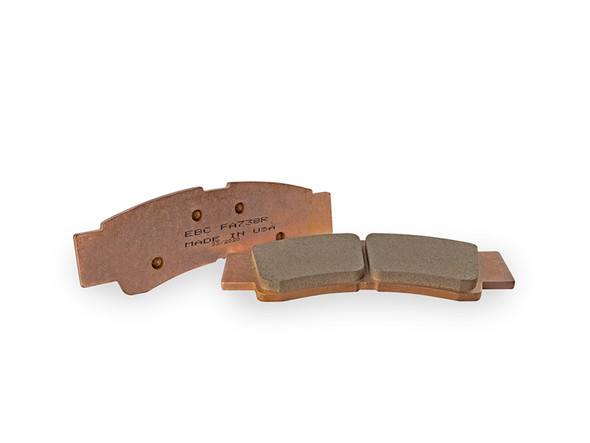
EBC 22-23 CFMOTO CF 400 ATR-2L/2S Gen 2 Front Left/Right R Series Sintered Brake Pads - FA726R
EBC Powersports
MSRP: $54.66$51.65How do I know if these EBC R Sintered Brake Pads will fit my vehicle?Confirm precise fitment for your specific make, model, and year before purchasing these high-performance EBC R Sintered Brake Pads.Should I install these brake pads myself?Professional...MSRP: $54.66$51.65 -

EBC 16-22 Honda SXS 1000 Pioneer 2 Seater Rear Right SV Brake Pads - FA704SV
EBC Powersports
MSRP: $40.89$40.38Designed primarily for ATV use in contaminated riding conditions the EBC SV series pads are a high density version of our successful R series pad blend. Being higher in density, these pads last longer than anything else in the EBC family and will stand...MSRP: $40.89$40.38
Performance brake pads are the single most critical friction interface in any braking system — compound chemistry, thermal threshold, and bite profile determine whether a car stops short or fades under pressure, and Motor Sport Mayhem stocks 2,669 options across 53 brands to cover everything from daily commuters to full competition builds. Choosing the wrong pad doesn't just compromise lap times; it compromises safety, accelerates rotor wear, and can cause catastrophic brake fade at the worst possible moment.
Our Top Picks for Brake Pads - Performance
Every product below was selected based on engineering merit, verified in-stock availability, and real-world performance across street, track, and race applications.
ALC Front Brake Kits
Alcon | $3,450.00
A 376mm six-piston front upgrade system engineered for maximum clamping force and thermal capacity in high-demand truck applications.
- Alcon's motorsport-derived caliper design dramatically increases pad contact area and clamping consistency over factory setups
ABR Caliper Rebuild Kits
All Balls Racing | $73.99
Complete caliper rebuild kits that restore hydraulic seal integrity and piston bore tolerances to factory specification for powersports applications.
- Degraded caliper seals cause uneven pad wear and brake pull — these kits eliminate both failure modes at low cost
AMS Brake Lines
AMS | $144.95
Stainless steel braided brake lines that eliminate hydraulic expansion under high-temperature braking, delivering a firm, consistent pedal feel.
- Rubber OEM lines expand under pressure and mask pad performance — stainless lines transmit 100% of pedal input to the caliper
ART ABS Kits
Artec Industries | $98.99
ABS tone ring conversion kits that maintain electronic brake modulation compatibility when upgrading to larger axle assemblies in off-road builds.
- Retaining ABS function on converted axles preserves brake pad longevity and prevents lockup on loose terrain
BKM Brake Rotors
BikeMaster | $264.99
Precision-ground powersports rotors with tight thickness variation tolerances to eliminate pulsation and maximize pad-to-rotor contact consistency.
- Lateral runout below 0.10mm ensures even pad wear and eliminates the judder that destroys pad compound uniformity over time
BKC Brake Caliper
Bikers Choice | $399.99
Direct-replacement rear calipers machined to OEM dimensional specs, ensuring correct pad alignment and hydraulic port positioning without modification.
- Correct caliper geometry is mandatory for even pad wear — misaligned calipers create tapered pad contact and premature failure
BX Brake Master Cylinders
BLOX Racing | $124.80
Performance master cylinders with optimized bore diameter for improved pedal ratio and fluid displacement, directly enhancing pad clamping response.
- A correctly sized master cylinder bore is what converts pad compound capability into actual stopping force at the pedal
BMR Brake Kits for Conversions - D&S
BMR Suspension | $1,339.95
Complete drilled-and-slotted rotor and caliper conversion kits engineered to maximize brake pad outgassing clearance and thermal dissipation on performance platforms.
- Slotted and drilled surfaces sweep debris and gas from the pad face, maintaining consistent friction coefficients under repeated hard stops
BRB Big Brake Kits
Brembo | $1,995.00
Brembo GT series big brake kits with two-piece cast iron rotors and multi-piston calipers purpose-built to accommodate high-friction track compounds without fade.
- Larger rotor diameter increases thermal mass, allowing aggressive pad compounds to operate within their optimal temperature window lap after lap
BRE OE Equivalent Rotors
Brembo OE | $1,798.75
OE-specification Brembo disc brake kits that restore factory braking geometry and pad compatibility on OEM Brembo-equipped platforms to exact original tolerances.
- OEM Brembo-sourced replacement kits ensure pad backing plate thickness and shim fitment match the original caliper specification exactly
How to Choose the Right Brake Pads - Performance
The defining variable in any performance brake pad is compound chemistry — specifically the friction coefficient (mu) at operating temperature, the thermal ceiling before fade, and the rotor compatibility of the binding agent. A pad that performs brilliantly at 400°F can turn glassy and useless at 600°F, while a pad rated for 1,400°F will feel wooden and inconsistent during a cold street commute. Compound selection, not brand or price alone, determines whether a pad is the right tool for the job.
Key Specifications
Friction coefficient is expressed as a two-letter FMSI edge code (such as FF, GG, or HH) stamped on the pad's edge, where each letter represents the mu value cold and hot respectively. Higher letters mean higher friction — EE pads are mild street compounds, while HH pads are aggressive race compounds that require significant heat to activate. Matching the edge code to your actual operating temperature range is non-negotiable; running a race-spec HH compound on a street car produces poor cold bite and unnecessary rotor wear.
Compound categories broadly break into organic/non-asbestos organic (NAO), low-metallic, semi-metallic, ceramic, and full-race carbon-metallic. NAO and ceramic formulas run quieter and cleaner, making them appropriate for street and mild performance use, while semi-metallic and carbon-metallic compounds transfer heat more aggressively to the rotor — a benefit on track but a liability on street-driven vehicles where caliper piston seal life matters. The binding resin in the compound sets the thermal ceiling: phenolic resins hold up to approximately 700°F, while copper-free metallic compounds with advanced binders can survive sustained temperatures above 1,200°F.
Bedding procedure is mandatory on any performance pad and is where most buyers fail. An unbedded pad operates with mismatched surface topography between pad and rotor, producing uneven material transfer, vibration, and dramatically reduced initial bite. Proper bedding involves a series of progressively harder stops from moderate speed, allowing the pad compound to deposit an even transfer layer across the full rotor face before the first hard application. Skipping this step wastes the compound's engineered friction characteristics from day one.
Backing plate construction and shim design directly affect NVH and caliper piston fatigue. A rigid steel backing with a multi-layer chamfered shim dampens the harmonic frequency that causes brake squeal and isolates heat transfer from the pad compound to the caliper piston seal. Pads without adequate shim systems in performance applications accelerate piston seal degradation and create the high-frequency squeal that indicates uncontrolled vibration at the pad-to-caliper interface. When evaluating brake pads alongside your broader brakes, rotors, and pads selection, always confirm shim and hardware inclusion before purchase.
Brake Pad Compound Selection by Operating Temperature Range
| Application | Typical Pad Temp Range | Recommended Compound Type | FMSI Edge Code Target |
|---|---|---|---|
| Daily Street Driving | 100°F – 400°F | Ceramic or NAO | EE – EF |
| Street Performance / Spirited Driving | 200°F – 650°F | Low-Metallic or Ceramic Performance | EF – FF |
| Autocross / Track Day (Occasional) | 400°F – 900°F | Semi-Metallic or Carbon-Metallic Street/Track | FF – FG |
| HPDE / Club Racing | 600°F – 1,100°F | Carbon-Metallic Track Compound | GG – GH |
| Endurance / Sprint Racing | 800°F – 1,400°F | Full Race Carbon-Metallic or Sintered | HH |
| Heavy Towing / Hauling | 300°F – 700°F | Semi-Metallic High-Load | FF – FG |
Price Guide
Entry ($0.20–$138): This tier covers OE-replacement and entry-level performance compounds suitable for daily driving and mild street use — adequate thermal capacity for normal traffic braking, acceptable rotor compatibility, and quiet NVH characteristics. Buyers in this range should not expect track-ready friction coefficients or meaningful fade resistance above 500°F.
Mid-range ($138–$600): The sweet spot where most performance enthusiasts land — compounds in this range offer genuine dual-use capability, acceptable cold bite, and thermal thresholds above 900°F that handle spirited street driving, autocross, and occasional track days without fade. Material quality, backing plate construction, and included hardware all improve meaningfully at this price point, which is why brands like Hawk Performance, StopTech, and Wilwood are heavily represented here.
Premium ($600–$3,743.73): This tier includes full big brake kit systems, race-specification pads with carbon-metallic compounds, and OEM-grade replacement packages for exotic platforms — products justified by sustained track use, competition regulations requiring specific friction codes, or factory brake system replacement costs on high-performance vehicles. The price reflects engineered system integration, precision manufacturing tolerances, and compounds developed to survive repeated thermal cycling above 1,000°F without physical degradation.
Who Is This For?
Performance brake pads serve a spectrum of drivers from the daily commuter wanting improved modulation to the club racer chasing consistent lap times — the usage data across our catalog reflects that breadth clearly.
Street Performance — 8.3/10
Street performance is the highest-rated use case in this catalog, and the score reflects how well modern performance compound engineering bridges the gap between daily drivability and genuine stopping power. Upgraded street pads deliver lower pedal effort, shorter stopping distances from highway speeds, and measurably better feel without the cold-bite penalty or rotor aggression of full race compounds. This is the core use case driving the majority of performance pad purchases, and it's where the mid-range price tier delivers the best return on investment.
Track / Autocross — 7.8/10
Track and autocross applications score 7.8/10 because the compound options available in this catalog span from entry-level track-day pads to full competition-specification friction materials — coverage is strong, but buyers need to match compound temperature range to their specific event type carefully. Autocross runs generate far less heat than circuit lapping, meaning the compound that works perfectly for a 60-second autocross run will be dangerously under-temped on a 20-minute HPDE session. Selecting pads by operating temperature first, then by friction coefficient, is the correct methodology for this application.
Racing Competition — 7.5/10
Full competition builds score 7.5/10 — strong coverage, but race-spec pads at this level require careful system integration with matched rotors, calipers, and brake ducting to function within their design temperature window. Carbon-metallic and sintered compounds used in competition generate rotor surface temperatures that can exceed 1,200°F, which mandates two-piece floating rotor assemblies and high-temperature caliper piston seals to prevent hydraulic failure. Pairing competition pads with an appropriate slotted rotor or slotted and drilled rotor is standard practice at this level.
Easy DIY Install — 7.4/10
The 7.4/10 DIY score reflects the reality that most performance brake pad swaps are bolt-on procedures requiring basic hand tools and a caliper wind-back tool — no specialized equipment, no alignment, no calibration. Where complexity increases is in big brake kit installations that require bracket fabrication or wheel clearance verification, and in systems that integrate with electronic parking brake actuators requiring scan tool retraction. For the majority of pad-only swaps, the job is well within reach of any mechanically competent home builder.
Heavy Towing — 7.0/10
Towing applications score 7.0/10 because high-load braking generates sustained heat rather than spike heat — the opposite thermal profile of track use — which demands compounds with strong thermal conductivity and consistent friction coefficients across a wide temperature band rather than peak high-temperature performance. Semi-metallic compounds with high copper content have historically dominated this application for their heat transfer characteristics, though the industry is migrating toward copper-free formulas to meet environmental regulations without sacrificing load-bearing friction stability. Backing plate rigidity is equally important here, as the cyclic loading from trailer braking multiplies caliper piston pressure beyond what typical street use generates.
Trusted Brake Pads - Performance Brands We Carry
The brands that dominate this category earned their position through documented compound engineering, motorsport validation, and consistent manufacturing tolerances — not marketing spend. EBC built its reputation on a compound range that spans from street-friendly organic formulas to full sintered race compounds, with over 4,000 SKUs reflecting genuine breadth of application coverage. Hawk Performance's carbon-fiber-reinforced compound technology produces some of the most predictable and progressive friction characteristics available in the mid-to-track price tier, which is why the brand consistently appears on SCCA and NASA competitor sheets. Wilwood's position at an average of $637 reflects complete system engineering — their pads are developed in conjunction with their caliper and rotor geometry, not as aftermarket add-ons to someone else's hardware. Brembo needs no introduction as the OEM supplier to virtually every major European supercar manufacturer, and their OE-equivalent pads carry the same compound specifications and backing plate tolerances as what left the factory floor. StopTech approaches pad development from a systems engineering perspective, validating compounds against specific rotor metallurgy to ensure consistent torque output across the full thermal cycle rather than optimizing peak friction in isolation. DBA, with strong representation in the Australian touring car scene, brings race-validated compounds that perform particularly well in high-ambient-temperature conditions where thermal soak is a persistent challenge.
Frequently Asked Questions
Are aftermarket brake calipers any good?
Quality aftermarket brake calipers from engineered manufacturers are not only good — in many cases they outperform OEM units in thermal capacity, piston count, and material quality. The key differentiator is manufacturing tolerance: a caliper with sloppy bore honing will generate uneven pad pressure and accelerate wear regardless of brand. Reputable aftermarket calipers are machined to tighter bore roundness specifications than OEM in many cases, use higher-durometer piston seals, and offer greater design flexibility such as additional piston stages for progressive bite. The risk lies in budget-tier calipers from unknown sources where pressure testing and seal validation are not performed — at that level, hydraulic failure under hard braking is a genuine possibility.
Are Akebono brakes better than OEM?
Akebono is an OEM supplier — they manufacture the original brake pads installed on millions of vehicles from multiple manufacturers, so in many cases an Akebono replacement pad is literally the same compound that came on the car from the factory. Their ceramic compound technology produces genuinely low dust output and excellent NVH characteristics, which is why they're favored for comfort-oriented applications. Where Akebono competes favorably against generic OEM replacements is in consistency and quality control — their manufacturing process holds tighter friction coefficient tolerances across production batches than many Tier-2 OEM suppliers. For street and comfort-focused driving, Akebono is an excellent choice; for track use, you'll need to step into purpose-built performance compounds with higher thermal ceilings.
Are black coated rotors worth it?
Black coated rotors — typically zinc or Geomet-coated — are worth it specifically for corrosion resistance on the non-swept hat and vane surfaces, not for any friction performance benefit on the braking surface itself. The coating on the rotor face wears away within the first few brake applications, so claims of friction improvement from coating are unfounded. The real value is preventing the cosmetic and structural surface rust that forms overnight on bare cast iron rotors, which can cause initial brake judder, pad contamination, and uneven bedding on first use. For vehicles that sit between weekends or in humid climates, coated rotors are a practical choice that preserves the rotor surface integrity through the critical initial bedding window.
Are aftermarket master cylinders good?
Aftermarket performance master cylinders are a meaningful upgrade when the bore diameter is correctly matched to the caliper piston area in the brake circuit — get that math wrong and you'll either have a rock-hard pedal with poor modulation or a spongy low-effort pedal that can't generate adequate line pressure. The bore diameter determines fluid displacement per unit of pedal travel, directly affecting pedal ratio feel and the maximum hydraulic pressure achievable at the caliper. Quality aftermarket units use billet aluminum bodies for rigidity and heat dissipation, and stainless or hard-anodized bore surfaces that resist the corrosive effects of glycol-based brake fluid over time. On any performance build, upgrading to a correctly specified aftermarket master cylinder is one of the highest-leverage pedal feel improvements available without touching the pads or rotors.
Are ABS tone rings magnetic?
Yes — passive ABS tone rings are ferromagnetic steel and work by interrupting the magnetic field of a stationary sensor as the ring's teeth pass by, generating a frequency signal that the ABS module reads as wheel speed. Active systems, which are increasingly common on modern vehicles, use a magnetized encoder ring with alternating north-south pole segments paired with a Hall-effect sensor — these are not ferromagnetic in the traditional sense, but the encoder ring itself is permanently magnetized. The distinction matters when upgrading axles or hubs, because passive sensors and active sensors are not interchangeable — installing a passive-spec tone ring on a system with an active Hall-effect sensor will produce no signal, causing an ABS fault and disabling the system entirely. Always verify sensor type before selecting a tone ring or axle shaft upgrade for any ABS-equipped application.
Building something specific? Our performance specialists can help you select the right Brake Pads - Performance for your application — street, track, or full race build.