
Suspension Arm Bushings
- Product
- Qty in Cart
- Quantity
- Price
- Subtotal
-
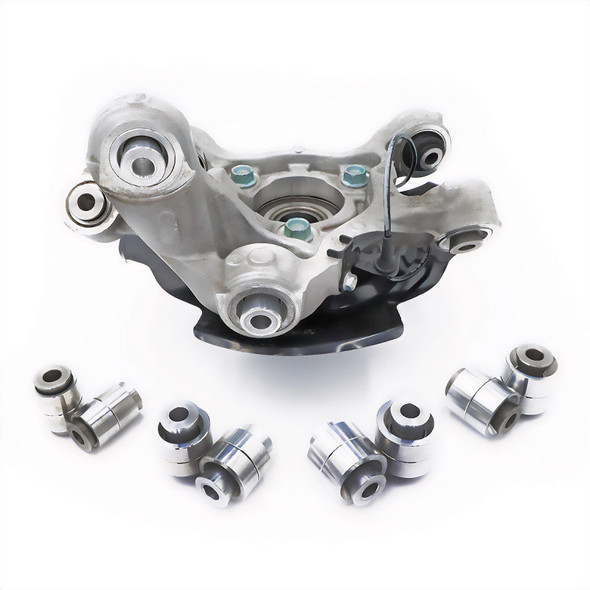
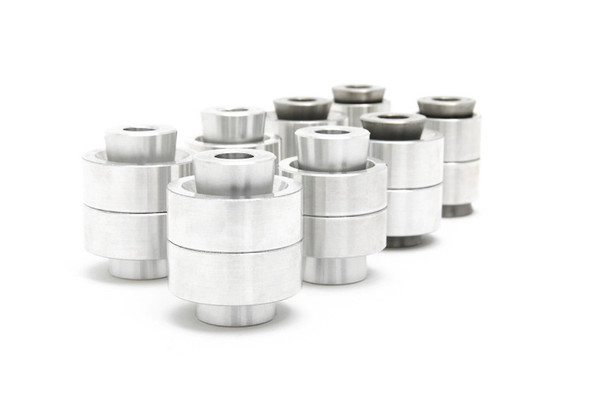
SPL Parts 2016+ Mazda Miata (ND) Rear Knuckle Bushings - SPL RKB ND
SPL Parts
MSRP: $655.00$589.50What are knuckle bushings?Knuckle bushings are critical suspension arm bushings that connect the steering knuckle to the control arm, ensuring precise wheel articulation.Are these bushings a direct bolt-on replacement?Professional installation is...MSRP: $655.00$589.50
Suspension arm bushings are the pivot points that connect your control arms, trailing arms, and subframes to the chassis — and they are the single most overlooked factor in handling precision, tire wear, and suspension geometry consistency. Motor Sport Mayhem stocks 55 in-stock suspension arm bushing products across 109 brands, ranging from $1.14 to $13,544, covering everything from OEM-replacement rubber to race-spec spherical bearings.
Our Top Picks for Suspension Arm Bushings
Every product below was selected based on performance engineering, real-world fitment results, and value across street, track, and off-road applications.
AEM IND Strut Bars
AEM Induction | $346.99
Triangulated strut brace design reduces chassis flex at the shock towers, directly improving the load path through upper suspension arm pivot points.
- Reduces bushing deflection under hard cornering by stiffening the surrounding chassis structure
AFE Coilover Systems
aFe | $3,729.00
Single-adjustable damping paired with pillow-ball top mounts eliminates the compliance inherent in rubber suspension arm bushings for repeatable geometry at all four corners.
- Featherlight aluminum construction minimizes unsprung mass while maintaining precise suspension pivot geometry
ALF Wireless Air Control Systems
Air Lift | $1,363.99
Wireless air management allows real-time ride height adjustment, directly affecting the load and angular stress applied to suspension arm bushings across the full travel range.
- Reduces static bushing preload at ride height extremes, extending bushing service life on air suspension builds
ABR Steering Racks
All Balls Racing | $209.62
Rebuilt to OEM tolerances with upgraded internal seals and bushings, this unit restores the steering axis pivot precision that worn rack bushings destroy over time.
- All Balls Racing is an established OEM-quality supplier for off-road suspension pivot and bushing components
PA Alta Adj Control Arms
Alta | $339.15
Adjustable rear control arms with upgraded bushing interfaces allow precise camber and toe correction that stock rubber-bushed arms physically cannot achieve.
- Polyurethane bushing material at pivot ends delivers significantly reduced deflection versus OEM rubber for improved alignment stability
ANT Micro-Start Tire Inflator
Antigravity Batteries | $24.99
Correct tire pressure is foundational to suspension arm bushing longevity — improper inflation shifts lateral and longitudinal loads directly into control arm pivot points.
- Compact, portable inflation tool for maintaining the precise tire pressures that protect bushing service life between track sessions and trail runs
ARB BP51 Coilovers
ARB | $4,580.69
Bypass-style internal floating piston damping with precise shaft tolerances keeps suspension arm bushings operating within their designed angular range even under extreme articulation.
- ARB's BP51 platform is engineered around correct suspension kinematics, reducing the side-loading stress that accelerates bushing failure on lifted off-road platforms
ART Coils
Artec Industries | $351.99
Properly positioned coil buckets maintain correct suspension arm angles through full travel, which is critical to preventing bumpstop-induced angular overload on control arm bushings.
- Frame-mounted coil bucket geometry directly determines the working angle range demanded from lower control arm bushings on long-travel off-road setups
AST 5100 Series Coilovers
AST | $4,554.00
Competition-grade coilover system with spherical top mounts eliminates rubber compliance entirely, demanding that all remaining suspension pivot bushings be upgraded to match the system's geometric precision.
- AST's 5100 series is built to FIA motorsport tolerances, making it a benchmark for understanding what suspension arm bushing deflection actually costs at the limit
AWE Chassis Bars
AWE Tuning | $435.00
Drivetrain stabilizer with polyurethane mount material directly reduces the torque-induced chassis flex that forces suspension arm bushings to operate outside their designed deflection range.
- Poly mount compound is calibrated to reduce drivetrain movement without transmitting NVH frequencies that make full-hardness bushings unacceptable on street builds
How to Choose the Right Suspension Arm Bushings
The difference between a quality suspension arm bushing and a cheap one comes down to three variables: material durometer, bore tolerance, and void geometry. OEM rubber bushings are engineered to absorb NVH through intentional deflection — which means your suspension geometry is constantly moving under load. Aftermarket bushings attack this compliance directly, and the material you choose dictates how much geometry control you gain versus how much road harshness you absorb. Getting this balance wrong in either direction produces a car that either wanders at speed or jackhammers over expansion joints.
Key Specifications
Material is the first decision. Rubber bushings offer the most compliance and noise isolation but degrade fastest under heat and ozone exposure, typically exhibiting measurable deflection after 60,000–80,000 miles in normal service. Polyurethane bushings — the dominant material in performance applications — are available in durometers from 60A (near-rubber compliance) up to 95A (near-solid feel), and they resist oil, heat, and compression set far better than rubber. Shore hardness directly determines how much suspension arm deflection you will feel through the steering and chassis, so application matters enormously when selecting durometer.
Bore tolerance is the specification most buyers ignore, and it is the one that determines whether an aftermarket bushing actually improves handling or just changes the compliance medium. A bushing with a bore that is 0.002" too loose will allow the inner sleeve to rotate rather than the elastomer to twist, which creates metal-on-metal contact and rapid failure. Quality manufacturers hold inner bore tolerances to ±0.001" or tighter on press-fit designs. On bolt-through designs, the inner sleeve must be clamped solidly at torque spec — a loose inner sleeve is the primary cause of premature bushing failure regardless of material.
Void geometry — the shape and placement of cavities molded into the bushing — controls the directional stiffness ratio. A well-engineered bushing is intentionally softer in the vertical axis (to absorb road impact) and stiffer in the fore-aft axis (to resist braking and acceleration loads). This is why swapping a voided OEM rubber bushing for a solid polyurethane blank of the same outer dimensions often produces harsher ride without a proportional improvement in handling — the void geometry that tuned directional compliance has been removed. Premium bushing manufacturers publish axial versus radial stiffness figures; budget units do not.
Spherical bearings, also called rod ends or heim joints, sit at the top of the stiffness hierarchy and are the correct choice for dedicated track or race builds where NVH is irrelevant. They provide zero deflection in any axis, which means suspension geometry is entirely determined by the physical control arm geometry and not by bushing compliance. The tradeoff is accelerated wear in street use due to road grit ingestion and the absence of any vibration isolation, which transmits every road irregularity directly into the chassis. For coilover builds running aggressive alignment, pairing spherical bearings at the control arm pivots with spherical top mounts creates a fully rigid suspension geometry envelope — appropriate for racing competition, not daily commuting.
Suspension Arm Bushing Material Selection by Application
| Material Type | Durometer Range | Best Application | Expected Service Life |
|---|---|---|---|
| OEM Rubber | 40A–55A | Daily driving, comfort-priority street use | 60,000–100,000 miles |
| Performance Rubber | 55A–65A | Street performance, mild tracking | 80,000–120,000 miles |
| Polyurethane (Soft) | 60A–70A | Street/track dual use, moderate NVH tolerance | 100,000+ miles |
| Polyurethane (Hard) | 80A–95A | Track/autocross, weekend racing, aggressive street | 80,000–100,000 miles track-use |
| Delrin / Nylon | Solid (N/A Shore) | Race cars, time attack, no street use | Season-dependent, inspect frequently |
| Spherical Bearing | Zero deflection | Competition racing, dedicated track builds | 1–3 seasons depending on conditions |
Price Guide
Entry ($1.14–$200): Individual replacement bushings and basic polyurethane sets live here — correct choice for restoring worn pivot points to OEM spec or making a first-generation upgrade from degraded rubber to poly on a budget street build. Quality varies sharply in this range; prioritize brands with published durometer specs over generic catalog units.
Mid-range ($200–$500): This is where the majority of performance enthusiasts land, and for good reason — complete polyurethane bushing kits, adjustable control arms with upgraded bushing interfaces, and entry-level spherical bearing sets all fall in this window. The improvement in handling precision over worn OEM rubber is significant and measurable in alignment stability and steering feedback.
Premium ($500–$13,544): Full spherical bearing control arm sets, billet-machined adjustable arms with race-spec rod ends, and complete suspension geometry correction kits for modified platforms justify the investment when alignment precision directly translates to lap times or competition results. This tier is where dedicated track builds, time attack cars, and serious off-road race platforms operate.
Who Is This For?
Suspension arm bushings serve a wider range of builders than almost any other suspension component — from a daily driver chasing NVH reduction to a racing competitor demanding zero-deflection geometry.
Racing Competition — 8.1/10
This category scores highest for racing competition because geometry control is non-negotiable at that level. Every degree of camber gain or toe change caused by bushing deflection under hard braking directly affects corner entry balance and lap time consistency. Race-spec spherical bearings and billet control arms in this category are purpose-built to eliminate that variable entirely, giving engineers a static geometry baseline to work from.
Track / Autocross — 8.0/10
Track and autocross applications score nearly as high as full racing because the handling feedback demanded by competitive drivers requires bushings that do not mask chassis behavior. A 70A–80A polyurethane bushing set is the typical entry point for this application — firm enough to reduce alignment wander under lateral load while still tolerant of the street driving that most track-day cars also see. Upgraded suspension pivot points at the control arm level are one of the highest-return modifications available for autocross competition.
Street Performance — 7.7/10
Street performance rates at 7.7/10 because polyurethane bushing upgrades produce immediately noticeable improvements in steering response and straight-line tracking stability without requiring any other suspension changes. The challenge in this application is selecting the right durometer — too firm and the car becomes fatiguing to drive, too soft and the upgrade is imperceptible over stock rubber. Most street performance builds benefit from bushing kits in the 70A–80A range paired with fresh alignment after installation.
Weekend Off-Roading — 7.7/10
Off-road applications score equally to street performance but for different reasons — articulation range and resistance to mud, water, and debris ingestion matter more than pure stiffness here. Polyurethane bushings outperform rubber in off-road environments because they resist compression set from the constant high-angle articulation that destroys OEM rubber over time. The correct bushing for off-road use must also be compatible with the increased control arm angles produced by lift kits, which place OEM-style voided bushings outside their designed working range.
Daily Driving Comfort — 6.2/10
Daily driving comfort scores lower not because bushings are irrelevant, but because the comfort-priority application is best served by OEM-equivalent rubber replacements rather than performance upgrades. Fresh rubber bushings on a high-mileage platform restore NVH isolation that has been lost to fatigue, producing a comfort improvement without the stiffness penalty of polyurethane. If the primary goal is ride quality, replacing severely worn rubber with fresh OEM-spec material is often more effective than upgrading to a harder compound.
Trusted Suspension Arm Bushings Brands We Carry
The brands that dominate this category earn their position through material engineering, not just marketing. Energy Suspension has been the benchmark for polyurethane bushing kits in North America for decades, with an average price point of $81.36 that reflects their focus on accessible, high-volume fitment coverage. Whiteline brings Australian motorsport engineering heritage to the category, publishing directional stiffness data that most competitors do not, with an average price of $205.44 reflecting their engineered-void approach to bushing design. Superpro operates on a similar technical philosophy to Whiteline, supplying polyurethane components to professional motorsport series and translating that engineering directly to catalog fitments at an average of $170.54. Bilstein approaches the pivot point equation from the damper side, with their suspension system engineering informing how companion bushing components must perform to maintain damper geometry through full travel. Eibach rounds out the technical tier with spring and control arm products that pair directly with bushing upgrades, recognizing that ride height change fundamentally alters the working angle and load demands placed on every control arm bushing in the system.
Frequently Asked Questions
Are aftermarket control arms actually worth upgrading?
Aftermarket control arms are worth the investment when OEM geometry is the limiting factor — which it is on any vehicle that has been lowered, lifted, or subjected to high mileage bushing fatigue. OEM control arms are designed around a single ride height and compliance budget set by the manufacturer's NVH targets, not handling targets. Aftermarket arms typically offer corrected geometry for modified ride heights, adjustability for camber and toe that OEM designs do not provide, and upgraded bushing interfaces that reduce pivot deflection. For track use or aggressive street driving, the combination of corrected geometry and reduced bushing compliance produces handling improvements that shock and spring upgrades alone cannot achieve.
Are aftermarket control arms as good as OEM quality, or are they a downgrade?
Quality aftermarket control arms from established manufacturers are engineered to meet or exceed OEM structural specifications, with the added benefit of geometry correction that OEM designs by definition do not include. The risk of substandard quality exists at the budget end of the market — arms without published material certifications or weld inspection standards. Reputable brands in this category use DOM steel tubing or 6061-T6 aluminum with wall thicknesses matched to the application's load requirements, and they publish testing documentation. The bushing interfaces on quality aftermarket arms are typically superior to OEM because they are designed with performance material compatibility in mind rather than being optimized purely for rubber compounds.
Are adjustable sway bar drop links worth adding to a bushing upgrade?
Adjustable drop links are a logical complement to any bushing upgrade because they address the same problem from a different angle — sway bar end link geometry changes when ride height is modified, and incorrect drop link length places the sway bar bushing in a pre-loaded, twisted state even at static ride height. This pre-load means the sway bar begins resisting body roll before it should, producing an unpredictable response threshold. Adjustable drop links restore the sway bar to its neutral, unloaded position at ride height, allowing the bar rate to work as intended through the full suspension travel range. When paired with upgraded sway bar bushings, the result is a more linear, predictable roll response that bushing work alone cannot produce.
Are aftermarket bump stops worth replacing when doing a bushing upgrade?
Bump stops are underrated components that directly protect control arm bushings from damage at full compression — when the suspension bottoms out against a degraded or missing bump stop, the entire impact load transfers into the control arm pivot bushings in a single high-energy event. Aftermarket bump stops, particularly foam cell or hydraulic designs used in lifted applications, tune the load curve at full compression rather than simply providing a hard stop. Replacing bump stops during a bushing upgrade is sound preventive engineering because the same heat, ozone, and compression cycles that degrade bushings also harden and crack rubber bump stops. The labor overlap makes it inefficient to do one without the other.
Are aftermarket lower control arm bushings a good upgrade even on a street car?
Lower control arm bushing upgrades produce measurable real-world improvements on street cars, particularly in steering response precision and alignment stability under hard braking. The lower control arm carries the majority of braking and cornering loads in a typical front suspension layout, meaning its bushing deflection directly translates to toe and camber change at the tire contact patch during the moments that matter most. A 70A–75A polyurethane replacement for a worn OEM rubber lower control arm bushing reduces this deflection significantly while remaining tolerable on daily-driven roads. The key is selecting the correct durometer for the application and ensuring proper lubrication during installation — dry polyurethane bushings squeak against their sleeves and give the material an undeserved reputation for NVH harshness that correct installation prevents.
Building something specific? Our performance specialists can help you select the right Suspension Arm Bushings for your application — street, track, or full race build.