
Wastegates
- Product
- Qty in Cart
- Quantity
- Price
- Subtotal
-


Turbosmart WG50 Gen V Pro-Gate 50 CG - 5psi Black - TS-0554-1202
Turbosmart
MSRP: $672.99$605.69Does the TS WG50 Pro-Gate fit my specific vehicle?Confirm fitment with your vehicle's exact specifications before purchasing this wastegate to ensure proper installation and optimal performance.How...MSRP: $672.99$605.69 -


Turbosmart WG40HP Gen-V Comp-Gate High Pressure 45mm - 35 PSI Black - TS-0553-1312
Turbosmart
MSRP: $705.99$635.39Will this wastegate fit my vehicle?Confirm fitment with your vehicle application before proceeding; professional installation is recommended for optimal wastegate performance.How easy is it to...MSRP: $705.99$635.39 -


Garrett GVW-45 45mm Wastegate Kit - Black - 908828-0003
Garrett
MSRP: $788.54$620.56Are Garrett GRT Wastegate Kits compatible with my specific vehicle?Garrett GRT Wastegate Kits require users to confirm exact vehicle fitment using provided application guides before purchase and...MSRP: $788.54$620.56 -


Garrett GVW-45 45mm Wastegate Kit - Red - 908828-0001
Garrett
MSRP: $788.54$620.56Are Garrett GRT Wastegate Kits compatible with my specific vehicle model?Confirm fitment with your vehicle using our detailed compatibility guide for precise wastegate integration and optimal...MSRP: $788.54$620.56 -
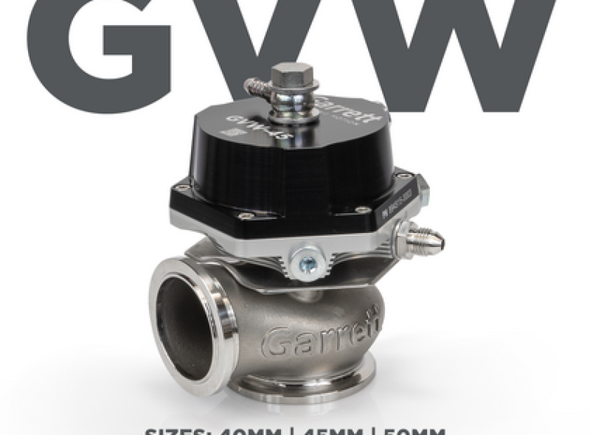

Garrett GVW-40 40mm Wastegate Kit - Black - 908827-0003
Garrett
MSRP: $769.05$605.21What is the installation process for the GRT Wastegate Kits?GRT Wastegate Kits demand professional installation to ensure optimal performance and correct integration with your vehicle's turbocharger...MSRP: $769.05$605.21 -


Garrett GVW-40 40mm Wastegate Kit - Red - 908827-0001
Garrett
MSRP: $769.05$605.21Is this wastegate compatible with my vehicle?Garrett GRT Wastegate Kits require precise confirmation of fitment with your specific vehicle model before installation.Can I install this wastegate...MSRP: $769.05$605.21
A wastegate is the primary boost pressure regulation device in any turbocharged system, controlling exhaust gas flow past the turbine wheel to prevent overboosting and deliver consistent, tunable boost curves. Motor Sport Mayhem stocks 140 wastegates across 48 brands — from entry-level internal actuators to race-spec external units — covering street performance, drag racing, and full competition builds.
Our Top Picks for Wastegates
Each product below was selected based on engineering quality, real-world performance results, and value across a wide range of forced induction applications.
ADD Intercooler Upgrade Kits
Addictive Desert Designs | $1,499.99
A purpose-built intercooler upgrade engineered to reduce charge air temperatures under sustained boost demand in high-output applications.
- Direct-fit design eliminates boost leak points common with generic universal kits
AEM Water/Meth Systems
AEM | $699.95
Water-methanol injection acts as a chemical intercooler, dropping intake temps and suppressing detonation to allow higher boost thresholds on aggressive tunes.
- Internal MAP-referenced progressive control ties injection rate directly to boost pressure
AFE Bladerunner I/C & Tubes
aFe | $2,036.00
Full intercooler and charge tube package engineered to maximize core efficiency and minimize pressure drop on high-output diesel builds.
- Bar-and-plate core construction handles sustained high-EGT and elevated boost pressure better than tube-and-fin equivalents
ABR Solenoids
All Balls Racing | $41.33
A precision-rebuilt solenoid solution for restoring reliable electrical actuation in boost and valve control systems at an accessible price point.
- OE-spec tolerances ensure consistent duty cycle response critical to repeatable boost control
PA Alta Tensioner Stop
Alta | $99.45
Adjustable tensioner stop limits supercharger belt deflection under high boost loads, preventing belt slip and maintaining consistent drive pressure.
- Direct bolt-on fitment addresses a known weak point in positive-displacement supercharger drive systems
AMS Intercoolers
AMS | $2,178.27
Front-mount intercooler kit with integrated bumper beam delivers maximum core volume and structural integrity without compromising crash safety standards.
- Race-derived core sizing supports significantly higher power targets while maintaining street drivability and consistent thermal management
ATS 4000 Turbo Kits
ATS Diesel | $3,549.99
A complete stage 2 compound turbo system engineered for diesel applications demanding aggressive spool, high flow capacity, and thermal durability under tow and competition loads.
- Aurora-series compound configuration sequences turbine stages to broaden usable boost range from idle through redline
AWE Intercoolers
AWE Tuning | $3,545.00
Precision-engineered intercooler kit designed specifically for factory turbocharged platforms where packaging constraints demand dense, high-efficiency core design.
- Drop-in fitment with verified heat-soak recovery times faster than OEM — critical for back-to-back track sessions
GBE Techni-Cooler Systems
Banks Power | $1,829.00
Complete charge air cooling system engineered to handle elevated boost and EGT levels on heavy-duty diesel platforms under sustained load conditions.
- High-density core with reinforced end tanks is rated for the pressure cycles that kill OEM intercoolers in towing and competition use
BDD Turbos
BD Diesel | $3,918.95
A direct-replacement performance turbocharger engineered for maximum airflow and thermal durability on late-model diesel platforms pushing well beyond stock power levels.
- Billet compressor wheel and upgraded bearing pack are built to survive the heat cycles that destroy factory turbine housings at elevated boost
How to Choose the Right Wastegate
The wastegate's job is deceptively simple — bypass exhaust gas around the turbine to cap boost pressure — but the engineering difference between a budget unit and a race-spec gate is enormous. Failures typically come from three sources: seat leakage caused by poor material tolerances, spring fatigue from thermal cycling, and diaphragm rupture from sustained overboost pressure. The best wastegates use stainless steel or Inconel valve seats, multi-layer stainless diaphragms rated for continuous high temperatures, and precision-ground valve stems with near-zero side-play to prevent seat wear. Port size, spring rate, and whether you're running an internal (integrated into the turbine housing) or external (plumbed separately in the exhaust) configuration are the three decisions that shape everything else.
Key Specifications
Internal wastegates are factory-standard on most OEM turbo systems and remain practical for street builds where packaging matters. The actuator is bolted directly to the turbine housing and controlled by boost pressure acting against a spring-loaded diaphragm. Their limitation is limited flow capacity — at elevated boost or with large turbine housings, an internal gate simply can't bypass enough exhaust volume to maintain stable boost control, which is why serious performance builds step to external units.
External wastegates mount separately in the exhaust manifold or turbine inlet piping, using a dedicated flange and discharge port that routes bypassed exhaust gases either back into the downpipe or straight to atmosphere. This configuration provides dramatically better flow area, more precise spring rate selection, and the ability to run multiple wastegates on large single or twin-turbo applications. Port sizes typically range from 38mm to 60mm for performance applications, with larger diameters used as turbine housing volume increases. Undersizing an external wastegate for a given turbine will result in boost creep — boost climbing uncontrollably past the target — which is dangerous and a common mistake in budget builds.
Electronic wastegate actuators replace the pneumatic spring-diaphragm system with a servo motor that takes direct commands from the ECU, enabling precise boost targeting across the entire RPM range, map-switchable boost profiles, and closed-loop boost correction. This is the direction most factory turbo systems have moved since the mid-2010s, and aftermarket electronic actuators allow tuners to recalibrate or upgrade actuation force to support higher boost targets on OEM-style housings. Compatibility with your ECU's PWM frequency and actuator position feedback protocol matters — these are not universal swap-in components.
Material quality is the spec most buyers overlook. Valve bodies should be cast or billet stainless — not cast iron, which corrodes and warps under repeated thermal cycling. Diaphragms on quality units are multi-layer stainless or high-grade silicone reinforced with polyester or Kevlar fabric, rated to hold vacuum and pressure at temperatures exceeding 300°F continuously. Springs are application-specific: a 7 psi spring is not a starting point you adjust — it is your base boost pressure, and adding a boost controller only raises pressure above that baseline. Selecting the correct spring rate for your target boost and then using a boost controller for fine adjustment is the correct approach.
Wastegate Sizing Guide by Target Boost and Application
| Application Type | Recommended Gate Size | Typical Spring Rate | Gate Style |
|---|---|---|---|
| Street / Low-boost OEM replacement | Internal or 38mm external | 5–8 psi | Internal pneumatic or external single-port |
| Street performance / Mild tune (12–18 psi) | 38–44mm external | 10–14 psi | External single-port with boost controller |
| High-performance street / Track (18–28 psi) | 44–50mm external | 14–18 psi | External dual-port for boost controller range |
| Competition / Drag racing (28–40 psi) | 50–60mm external | 18–24 psi | External dual-port, Inconel valve, stainless body |
| Pro-level compound or high-EGT diesel | 60mm+ external or dual wastegate | 24–35 psi | External dual-port, race-grade diaphragm |
| Electronic actuator replacement | OEM port size matched | N/A — servo-controlled | Electronic PWM actuator, ECU-mapped |
Price Guide
Entry ($3.42–$350): Actuator rebuild kits, replacement diaphragms, boost solenoids, and OEM-spec internal actuator replacements live in this range. Correct for restoring factory function on a street car or sourcing individual components for a custom build — not where you shop for a primary external wastegate on a tuned application.
Mid-range ($350–$1,500): This is where the majority of serious street and track builds land. Quality external wastegates from established brands — stainless construction, dual-port capability, rated spring options, and real boost control range — are available throughout this tier. Most enthusiasts running 15–30 psi on a modified street or track car have everything they need here without overspending on race-only features.
Premium ($1,500–$13,288.86): Full turbo system kits, compound diesel turbo configurations, electronic actuator systems, and race-homologated external wastegates with Inconel internals occupy the top of the range. The cost is justified for applications where boost control failure has engine or safety consequences — endurance racing, diesel competition, or any build where the turbo alone cost five figures.
Who Is This For?
Wastegates are relevant across every level of forced induction use — from a commuter car running a stock turbo upgrade to a pro-level drag build pushing 50+ psi — and the usage data reflects that breadth.
Engine Performance — 8.7/10
Engine performance is the highest-rated use case in our data at 8.7 out of 10, and it makes complete sense: a wastegate that leaks, creeps, or fails to hold target boost will undermine every other engine modification you've made. Consistent boost control is directly tied to consistent combustion, ignition timing, and fuel delivery. Whether you're chasing dyno numbers or protecting a freshly built motor, the wastegate is the pressure regulator that makes the rest of the tune work.
Racing Competition — 8.2/10
At 8.2 out of 10 for racing competition, wastegates prove their value on the track where boost consistency lap after lap defines results. Heat soak, back-pressure changes from exhaust layout, and varying atmospheric conditions all demand a wastegate with tight tolerances and a diaphragm that doesn't fatigue. Race applications consistently require external units with dual-port capability so the boost controller can both raise and lower pressure from the base spring rate — precision that a single-port unit simply cannot deliver.
Drag Racing — 8.0/10
Drag racing scores 8.0 out of 10, with the specific demand being a wastegate that can transition from low-speed spool to full-boost hold within fractions of a second and then survive a repeat pass without thermal degradation. Large external wastegates are standard on purpose-built drag cars because the exhaust flow volume at peak power exceeds what any internal gate can manage. Many drag applications also run the wastegate vented to atmosphere rather than recirculated to reduce back-pressure in the turbine housing.
Street Performance — 8.0/10
Street performance also rates 8.0 out of 10, driven by the large volume of daily-driven turbocharged vehicles running upgraded boost levels. On the street, durability and low maintenance matter as much as peak performance — a wastegate that requires respringing every season or leaks after temperature cycling is a liability. Street builds benefit from actuators or external gates with broad spring rate availability so boost can be adjusted when the tune changes without replacing the entire gate.
Track / Autocross — 8.0/10
Track and autocross use scores 8.0 out of 10, where the emphasis is on repeatable boost delivery through back-to-back sessions without heat soak degrading actuation response. Autocross in particular puts the turbo and wastegate through rapid spool-up and spool-down cycles, which stresses diaphragm materials differently than steady-state highway driving. Units with heat-shielded actuator housings and temperature-rated diaphragm compounds perform measurably better in this environment over a full event day.
Trusted Wastegate Brands We Carry
The wastegate market is anchored by a small group of manufacturers who have earned their reputation through verifiable engineering, materials testing, and documented race results. Turbosmart built their entire brand identity around boost control hardware and offers one of the broadest spring rate and port configuration catalogs in the industry, backed by genuine motorsport development. Garrett and BorgWarner are both OEM turbocharger suppliers to major automakers, and their actuator and wastegate components carry the same dimensional tolerances and material specs used in original equipment applications. HKS brings decades of Japanese motorsport development to their wastegate lineup, with a strong track record in high-revving, high-boost applications where valve seat precision is critical. Go Fast Bits focuses on pneumatic and electronic boost control components where simplicity and response speed matter, making them a strong choice for street performance builds. Brands like ATS Diesel and BD Diesel have developed wastegate and turbo system solutions specifically around the thermal and mechanical demands of high-output diesel platforms, where EGT management is a separate engineering challenge on top of boost control. This combination of OEM-heritage engineering, motorsport-developed products, and application-specific specialists means there's a purpose-built solution in our catalog for every build level in the forced induction space.
Frequently Asked Questions
Are boost controllers worth it on a turbocharged build?
Yes, but only when paired with a wastegate that has the appropriate spring rate and port configuration to work with one. A boost controller — whether manual or electronic — manipulates the pressure signal reaching the wastegate actuator to raise or lower boost from the base spring pressure. Without a properly sized wastegate, adding a boost controller can cause boost creep or inconsistent response because the gate can't flow enough exhaust to maintain stable control. Electronic boost controllers connected to the ECU offer closed-loop correction, map-switching, and boost-by-gear capability that manual units cannot match. For any build running more than a few psi above the factory boost target, a quality boost controller and properly specced wastegate are a package investment, not optional upgrades.
Are boost solenoids universal or application-specific?
Boost solenoids are not universal — they differ in port size, flow rate, operating frequency, and connector type in ways that directly affect compatibility with both the wastegate plumbing and the ECU controlling them. The solenoid's duty cycle frequency must match what the ECU outputs; a mismatch causes hunting, over-boost, or no boost correction at all. Port diameter determines how quickly pressure bleeds from the reference signal line — too small and the wastegate responds sluggishly, too large and you lose fine control resolution. When selecting a replacement or upgrade solenoid, match the operating frequency (commonly 10–32 Hz), confirm the port size matches your reference line diameter, and verify the connector matches your ECU harness or plan for a pigtail adapter.
Are aftermarket turbos worth it over upgrading the factory unit?
An aftermarket turbo is worth it when the OEM turbine and compressor wheels are the flow limitation in your build — which happens earlier than most people expect on factory setups. OEM turbos are sized for emissions compliance, packaging, and longevity at stock power levels, not for the top end of a modified engine's airflow demand. Upgrading to a properly sized aftermarket unit with a larger compressor map expands the usable boost range without pushing the compressor into surge or choke, both of which are destructive. The critical caveat is that a new turbo requires a recalibrated wastegate spring rate, updated actuator or external gate, and a retune — the turbo itself is only one part of a system change. Pairing an aftermarket turbocharger with complementary engine components and a proper supporting fuel and boost control system is what separates a successful build from a broken one.
Are blow-off valves bad for your engine?
A correctly specified blow-off valve is not harmful to the engine — in fact, on a turbocharged system, it protects the compressor wheel from surge damage when the throttle closes suddenly under boost. The concern historically raised is on mass-airflow sensor (MAF) equipped vehicles, where a vent-to-atmosphere BOV releases metered air that the ECU has already accounted for, causing a momentary rich condition and potential rough idle or stall. Recirculating bypass valves (often called diverter valves) send that air back into the intake pre-compressor, keeping the fueling math correct. On speed-density or MAP-only tune setups, a vent-to-atmosphere configuration is generally fine. The real risk to engine health comes from a faulty or undersized BOV that allows compressor surge — the repetitive pressure reversal that loads and unloads the compressor wheel rapidly, fatiguing the shaft bearings and eventually causing failure.
Are boost pipes and charge pipes the same thing?
The terms are used interchangeably in the aftermarket, but technically they describe the same physical component — the plumbing that carries pressurized, turbocharged air from the compressor outlet through the intercooler and into the intake manifold. Some builders draw a distinction by calling the section between the turbo and intercooler inlet the "boost pipe" and the section from the intercooler outlet to the throttle body the "charge pipe," but there is no industry-standard definition. What matters more than terminology is pipe diameter relative to your power target, wall thickness adequate to resist expansion under boost, and coupler quality — the silicone couplers and clamps at each junction are the most common failure points in the entire pressurized intake system. Pipe sizing should follow airflow requirements: undersized pipes create pressure drop that costs both power and turbo response, while oversized pipes on small turbos increase the pressurized volume the turbo must fill on each spool event, slowing response.
Building something specific? Our performance specialists can help you select the right Wastegates for your application — street, track, or full race build.