
Catalytic Converter Direct Fit
- Product
- Qty in Cart
- Quantity
- Price
- Subtotal
-

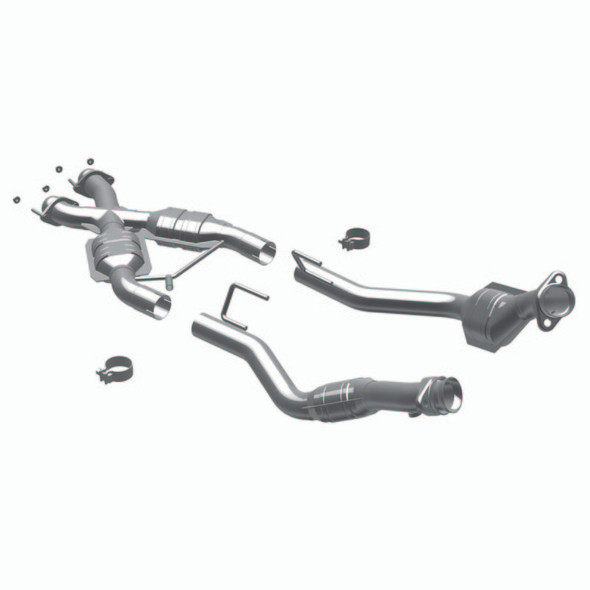
MagnaFlow Direct Fit Catalytic Converter 86-93 Ford Mustang 5.0L CA - 337338
Magnaflow
$2,423.00Does this catalytic converter have a CARB EO number?This Magnaflow Direct Fit catalytic converter does not have a CARB EO number and is not legal for sale or use in California or other states...$2,423.00
A direct fit catalytic converter is a bolt-in emissions control device engineered to match your vehicle's factory flange dimensions, sensor bungs, and substrate cell density — delivering legal compliance, reduced back pressure, or both depending on substrate specification. Motor Sport Mayhem stocks 120 direct fit catalytic converters across 64 brands, ranging from budget OEM-replacement units to high-cell-density motorsport catalysts built for maximum exhaust flow and thermal durability.
Our Top Picks for Catalytic Converter Direct Fit
Each of these units was selected based on engineering quality, real-world fitment reliability, and measurable performance value across street, tow, and competition applications.
AFE Exhaust Cat Back
aFe | $2593.00
Mandrel-bent stainless construction with a stepped diameter transition that actively improves exhaust scavenging velocity on high-displacement truck engines.
- Stepped 3-in to 3.5-in tubing maximizes mid-range torque without sacrificing top-end flow
AKR Slip-On Line – Titanium
Akrapovic | $5768.53
Grade 1 titanium construction slashes exhaust system weight while delivering the acoustic signature and flow characteristics demanded by track-day and circuit competition use.
- Titanium substrate housing resists heat fatigue under sustained high-rpm race conditions
AMS Downpipes
AMS | $2249.95
Purpose-built downpipes for turbocharged applications reduce turbine outlet back pressure, which directly lowers boost threshold and improves spool response on forced-induction platforms.
- Street-configuration design retains catalytic substrate for daily-driven turbocharged builds
ATS Exhaust Manifolds
ATS Diesel | $894.99
Pulse-flow manifold geometry preserves exhaust gas energy upstream of the turbocharger, directly improving turbo spool and EGT management on heavy-duty diesel platforms.
- Ductile iron construction withstands the extreme thermal cycling unique to diesel tow applications
AWE Cat-Back SwitchPath
AWE Tuning | $3895.00
SwitchPath technology allows on-demand sound level adjustment, giving drivers a quiet street mode and an unrestricted track mode from a single catalytic cat-back system.
- Dual-mode valve architecture eliminates the need for a separate race exhaust on track weekends
GBE Torque Tube Systems
Banks Power | $569.00
Full torque tube exhaust systems reduce restriction across the entire exhaust path, not just at the catalytic converter, making them uniquely effective for off-road and towing applications.
- Engineered for direct bolt-on fitment with no cutting or welding required on supported platforms
BBK Full Header & Cat
BBK | $1499.99
Long-tube header and high-flow catted mid-pipe combination addresses exhaust restriction at both the cylinder head and the catalytic converter simultaneously for the largest single-install power gain in this format.
- Silver ceramic coating reduces radiant heat transfer to surrounding chassis components under sustained high-load driving
BDD Exhaust Brakes
BD Diesel | $1685.95
Exhaust brake systems create controlled back pressure downstream of the turbine to generate engine braking force, a critical safety and drivetrain preservation feature for heavy diesel tow builds.
- Universal 4-inch format with integrated air compressor accommodates a wide range of heavy-duty diesel exhaust configurations
BIG EXO Aluminum ATV Dual Full System
Big Gun | $944.22
Aluminum-bodied dual full exhaust system delivers significant weight savings over OEM steel units on ATV platforms where unsprung and total vehicle mass directly affect handling and acceleration.
- Full system design extracts the maximum flow benefit by eliminating restriction from header to tip in a single kit
BKM Exhaust Bungs B
BikeMaster | $12.99
Purpose-designed exhaust bungs and packing kits are the overlooked consumable that prevents exhaust leaks at sensor ports and packing voids from undermining the performance of an otherwise well-specified exhaust system.
- Correct bung sizing ensures accurate O2 sensor placement for proper closed-loop fueling on catalytic-equipped builds
How to Choose the Right Catalytic Converter Direct Fit
A direct fit catalytic converter lives or dies on three variables: substrate cell density measured in cells per square inch (CPSI), substrate material (ceramic vs. metallic), and housing construction (aluminized steel vs. 409 vs. 304 stainless). OEM-replacement units typically run 400–600 CPSI to meet emissions thresholds, while high-flow performance units drop to 100–200 CPSI, significantly reducing exhaust back pressure at the cost of some catalytic conversion efficiency. The housing weld quality and flange machining tolerance determine whether you get a leak-free, rattle-free install — or spend Saturday chasing an exhaust leak with a smoke machine.
Key Specifications
Cell density is the primary performance variable. A 400 CPSI unit generates measurably more back pressure than a 200 CPSI unit at equivalent flow rates, and that pressure differential translates directly to power lost at the crank. For naturally aspirated street builds, a 200–300 CPSI high-flow unit is the practical sweet spot — enough conversion efficiency to keep an O2 sensor happy, with a meaningful reduction in restriction versus stock. For turbocharged applications, the catalytic converter sits downstream of the turbine, and its restriction directly affects turbine outlet pressure, which in turn raises turbine inlet pressure and retards spool. This is why downpipe cats on boosted platforms are particularly impactful.
Substrate material determines thermal durability. Ceramic substrates handle normal street and occasional track use well but can crack under severe thermal shock — rapid cool-down from track temperatures is the primary failure mode. Metallic substrates tolerate more aggressive heat cycling and flow better at very high exhaust temperatures, making them the correct choice for sustained competition use. If your build sees track days more than a few times per year, specify a metallic substrate unit regardless of what the price differential looks like.
Housing material matters for longevity. Aluminized steel housings are adequate for moderate climates and dry-use vehicles, but they rust through in 5–8 years in salt-belt environments. Grade 409 stainless is the standard step up — corrosion resistant and sufficient for most performance street use. Grade 304 stainless is reserved for premium systems and race applications where weld integrity under sustained thermal stress is non-negotiable. If you are pairing a new catalytic converter with a full cat-back exhaust, match material grades throughout the system to avoid galvanic corrosion at the junctions.
Flange fitment on a direct fit unit must precisely match the OEM bolt pattern, gasket surface, and sensor bung locations — both upstream and downstream O2 sensor bungs need to be in the correct position for the ECU to manage closed-loop fueling accurately. A mislocated bung, even by an inch, can introduce enough sensor error to trigger a Check Engine light or cause persistent fuel trim corrections that partially negate your flow gains. Always verify bung count and location against your application before ordering, particularly on turbocharged platforms that may run multiple pre-cat and post-cat sensors.
Catalytic Converter Cell Density vs. Application Guide
| Cell Density (CPSI) | Substrate Type | Best Application | Emissions Compliance |
|---|---|---|---|
| 400–600 CPSI | Ceramic | OEM replacement, daily driver, emissions testing required | CARB / Federal legal (vehicle-specific) |
| 300 CPSI | Ceramic | Mild street performance, occasional spirited driving, retains O2 sensor function | Varies by state — typically 49-state legal |
| 200 CPSI | Ceramic or Metallic | Performance street, weekend track use, NA and mild boost applications | Off-road / race use in many jurisdictions |
| 100 CPSI | Metallic | High-output street/strip, regular track days, turbocharged performance builds | Race / off-road use only |
| 50–75 CPSI | Metallic | Full competition, road racing, dedicated race vehicles with tuned ECU | Race use only — no street legal claim |
| Catless / Test Pipe | N/A | Closed-course competition only, fully tuned standalone ECU management required | Not street legal in any U.S. jurisdiction |
Price Guide
Entry ($3.99–$500): This range covers OEM-grade ceramic replacements, individual exhaust bungs, packing hardware, and budget-friendly single-substrate units designed primarily for emissions compliance rather than performance gain. If your goal is passing inspection or returning a deteriorated stock cat to factory function without spending real money, this tier delivers exactly that — nothing more.
Mid-range ($500–$2,000): The performance-focused sweet spot. This is where you find 200–300 CPSI high-flow units in 409 or 304 stainless, downpipe-integrated catalysts for turbocharged platforms, and full manifold-back systems that address multiple restriction points in one purchase. Most street performance builds, diesel upgrades, and track-prep exhaust upgrades live in this range, and the real-world power and sound improvements here are measurable on a dynamometer.
Premium ($2,000–$11,935.89): This tier is for builders who are exhausting every available tenth — titanium substrate housings, full race-line slip-on and full systems from specialist manufacturers, multi-stage valve systems with mode switching, and complete exhaust architectures for high-horsepower competition platforms. The engineering justification is real at this level, but only if the rest of the drivetrain and tune are developed to use it. Pairing an $11,000 exhaust system with a stock tune and stock cold air intake leaves significant performance money on the table.
Who Is This For?
Direct fit catalytic converters serve a broader range of builders than most exhaust components — from daily drivers restoring OEM emissions function to full competition vehicles chasing every fraction of exhaust flow.
Street Performance — 7.9/10
Street performance leads the usage matrix at 7.9 out of 10, and for good reason: a high-flow direct fit cat is one of the most cost-effective exhaust modifications available for a daily-driven performance vehicle. Replacing a restrictive factory catalyst with a 200–300 CPSI unit reduces exhaust back pressure without requiring any other exhaust modifications, and the gains compound when paired with a cat-back system and performance intake. The direct-fit format means no cutting, no welding, and a complete install in an afternoon for most applications.
Engine Performance — 7.9/10
Engine performance scores an equally strong 7.9 out of 10, reflecting how directly exhaust restriction affects engine output. The catalytic converter is typically one of the highest-restriction points in the entire exhaust path, and reducing that restriction allows the engine to expel exhaust gases more efficiently, which improves volumetric efficiency on the intake stroke. On turbocharged platforms, the relationship is even more direct — lower back pressure downstream of the turbo reduces turbine outlet pressure, which lowers turbine inlet pressure and allows more energy extraction from the exhaust pulse, resulting in faster spool and higher peak boost at equivalent waste gate settings.
Exhaust Note / Sound — 7.7/10
Sound scores a solid 7.7 out of 10, which surprises builders who assume the catalytic converter is acoustically neutral. In reality, cell density has a measurable effect on exhaust tone — higher-flow, lower-CPSI units allow more exhaust pulse energy to pass through unimpeded, resulting in a fuller, more pronounced exhaust note at mid and high RPM without requiring muffler changes. Pairing a high-flow cat with the right muffler specification lets you dial in a specific sound character that a muffler change alone cannot achieve.
Easy DIY Install — 7.8/10
The direct fit format scores 7.8 out of 10 for ease of installation specifically because it eliminates the fabrication work associated with universal catalytic converters. Factory flange dimensions, pre-installed sensor bungs, and correct overall length mean the installation reduces to unbolting the OEM unit, transferring any heat shields if required, and torquing the replacement in place. A floor jack, basic hand tools, and penetrating oil for corroded fasteners are the only practical requirements on most applications — no welding equipment, no pipe bender, no custom gasket fabrication.
Track / Autocross — 7.2/10
Track and autocross applications score 7.2 out of 10, reflecting the regulatory reality that many competitive classes require catalytic converters to remain in place for technical inspection compliance. Within that constraint, a metallic-substrate high-flow unit is the correct solution — it satisfies the letter of the rulebook while maximizing flow and withstanding the thermal stress of repeated heat-cool cycles during a competition day. Builders running open or unlimited classes where cats are not required will see better absolute performance from a test pipe, but for classed competition, a properly specified direct fit high-flow cat is the performance-legal answer.
Trusted Catalytic Converter Direct Fit Brands We Carry
The brands that define this category earn their reputation through substrate sourcing, housing fabrication quality, and fitment accuracy across thousands of applications. Magnaflow is the reference standard for direct fit high-flow catalysts — their stainless steel housings and consistent CPSI specifications have made them the default choice for performance shops for two decades. aFe brings motorsport-derived flow engineering to street and truck applications, prioritizing measurable back pressure reduction alongside precise OEM fitment. BBK is the benchmark for catted header and mid-pipe combinations on domestic V8 platforms, with American-manufactured stainless construction and decades of dyno-validated header geometry. AWE Tuning dominates the premium European and sports car segment, engineering full systems around specific platform exhaust architectures rather than adapting generic components. Akrapovic represents the pinnacle of titanium exhaust engineering, with race program pedigree that feeds directly into their street and track product lines. Banks Power owns the diesel performance and towing exhaust space, with flow engineering optimized for high-EGT, high-torque diesel applications that generic exhaust brands rarely address with the same depth.
Frequently Asked Questions
Do aftermarket exhaust tips actually do anything for performance?
Exhaust tips are cosmetic components — they have no effect on back pressure, exhaust velocity, or engine output in any measurable way. The performance work is done upstream by the headers, catalytic converter, and muffler; by the time exhaust gases reach the tip, system pressure has already equalized with atmosphere. Tips do affect sound slightly on some configurations, primarily by altering the exit resonance of an open exhaust note, but the effect is minor and inconsistent across applications. If you want performance, invest in the catalyst and muffler; if you want looks, buy the tip.
Are aftermarket intake manifolds worth the investment?
On the right application, yes — aftermarket intake manifolds deliver genuine gains by optimizing runner length, plenum volume, and port cross-section for a specific RPM target or forced induction configuration. Factory intake manifolds are engineered for a balance of idle quality, emissions compliance, packaging constraints, and broad power curve — none of which prioritizes peak performance. A performance manifold tuned for higher RPM or higher boost will show measurable torque and horsepower improvements on a dynamometer, but the gains are application-specific and most pronounced on high-output or boosted builds. For normally aspirated engines in mild street tune, the gains are real but modest relative to the cost — explore engine components holistically before committing to manifold work alone.
Are Akrapovic exhausts actually worth the price premium?
For the right application, Akrapovic systems justify their price through three specific advantages: titanium and carbon fiber construction that cuts exhaust system weight by 40–60% versus comparable stainless systems, flow engineering developed directly from their MotoGP and World Superbike racing programs, and acoustic engineering that produces a calibrated exhaust note rather than just a loud one. On a track vehicle where every kilogram matters and where sustained thermal stress at high RPM is a routine condition, the material quality gap between Akrapovic and mid-tier alternatives is real and measurable. On a street car driven conservatively, the performance justification is harder to make — but for drivers who use their vehicles hard and value the quality of the engineering, the premium is defensible.
Are axle-back exhausts actually worth doing?
Axle-back systems are the most accessible exhaust modification — they replace only the muffler and tip section behind the rear axle, requiring no cutting and delivering a sound and aesthetic change with minimal installation complexity. The performance impact is real but limited, because the catalytic converter and mid-pipe upstream remain as restriction points. If your primary goal is sound improvement and your budget doesn't support a full cat-back, an axle-back is a legitimate first step. Builders chasing measurable power gains will get more return from a high-flow catalytic converter upgrade first, then adding the axle-back for sound character — the cat is where the restriction is.
Are BBK headers made in the USA, and are they stainless steel?
BBK Performance manufactures their headers in the United States, which is a meaningful distinction in a category where offshore production has driven down both material consistency and dimensional accuracy. Their long-tube and shorty header lines are constructed from stainless steel — typically 304 grade — with silver ceramic coating options available for additional thermal management on applications where heat management around the header is a concern. The combination of domestic manufacturing, stainless construction, and decades of application-specific fitment development is why BBK headers have remained a credible choice for domestic performance builds rather than being displaced by cheaper alternatives. Verify the specific coating and material grade on the exact unit you are purchasing, as construction specs can vary across their product line.
Building something specific? Our performance specialists can help you select the right Catalytic Converter Direct Fit for your application — street, track, or full race build.