
Main Stud & Bolt Kits
- Product
- Qty in Cart
- Quantity
- Price
- Subtotal
-
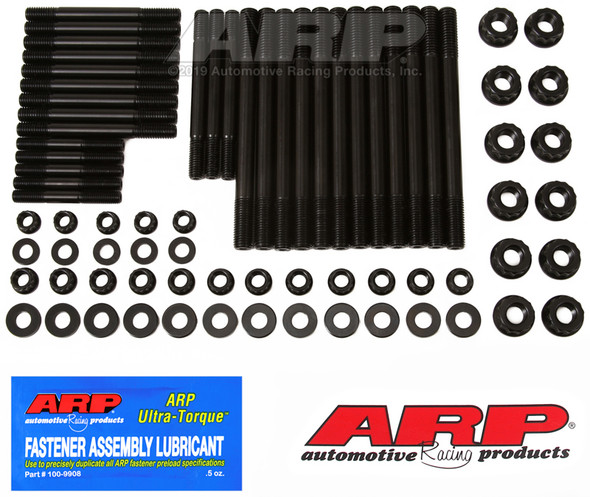
ARP 2005+ Ford 2.5L B5254 5 Cyl Main Stud Kit - 251-5801
ARP
MSRP: $395.11$371.52ARP 2005+ Ford 2.5L B5254 5 Cyl Main Stud KitMSRP: $395.11$371.52 -
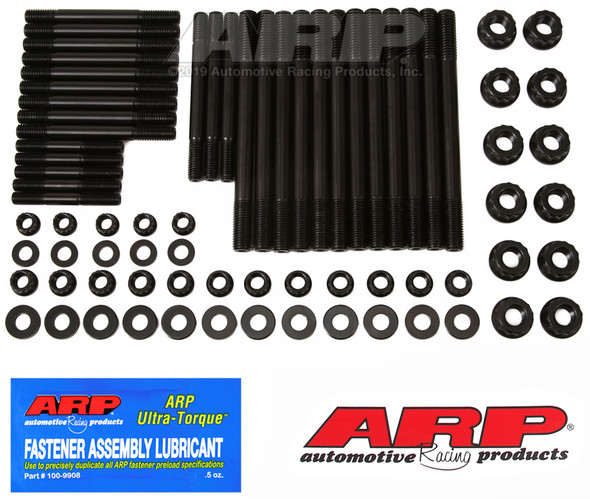
ARP Volvo 2.5L B5254 5cyl. 00+ Main Stud Kit - 219-5801
ARP
MSRP: $395.11$371.52What is a main stud kit?A main stud kit replaces factory main bolts with high-strength studs, ensuring superior clamping force for ultimate crankshaft security in performance engines.Are ARP Main...MSRP: $395.11$371.52 -

ARP Ford 5.0L Coyote Main Stud Kit - 156-5803
ARP
MSRP: $347.73$326.96What is the primary benefit of installing ARP Main Stud Kits?ARP Main Stud Kits deliver superior crankshaft security, ensuring enhanced engine block integrity under extreme engine loads and high...MSRP: $347.73$326.96
Main stud and bolt kits are the foundational fasteners that hold an engine's bottom end together under combustion loads, and selecting the wrong hardware is one of the most common causes of catastrophic engine failure in high-performance builds. Motor Sport Mayhem stocks 74 in-stock main stud and bolt kits across 161 brands, covering everything from street-driven daily builds to full-competition drag and circuit race engines, with pricing from $1.19 to $11,495.95.
Our Top Picks for Main Stud & Bolt Kits
Every product below was selected based on demonstrated performance, engineering quality, and proven real-world results across street and competition applications.
ACL Race Series Main Bearings
ACL | $329.72
Tri-metal race bearing construction with extra oil clearance specification engineered to sustain higher loads than OEM bearings under sustained high-RPM operation.
- Extra oil clearance variant allows higher-viscosity oil to maintain film integrity under boost and high thermal loads
ACT Pilot Bearing
ACT | $17.00
A precision pilot bearing designed to support input shaft alignment and reduce wear at the crankshaft interface during clutch engagement events.
- Critical replacement component when upgrading clutch systems to prevent crankshaft bore wear
Action Clutch Race Pedal Stop
Action Clutch | $89.69
A universal race pedal stop that limits clutch pedal travel to protect drivetrain components during aggressive shifting in competition environments.
- Adjustable stop position prevents over-depression that stresses throw-out bearings and input shaft hardware
AEM K-Type Thermocouple Kit
AEM | $430.95
A four-pack K-type thermocouple kit for precise thermal monitoring of critical engine fastener zones and coolant passages during data-logging sessions.
- Accurate temperature data at fastener locations informs torque retorque intervals in sustained race applications
Aeromotive Fuel Pump Wiring Kit
Aeromotive | $358.52
A 60-amp deluxe wiring kit that ensures clean, dedicated power delivery to high-demand fuel system components supporting high-horsepower builds.
- Eliminates voltage drop that causes fuel pump lean-out events that can destroy main bearings and lower-end hardware
aFe PFADT Subframe Mount Set
aFe | $660.00
A competition-grade polyurethane subframe mount set that reduces chassis flex and improves drivetrain alignment under hard acceleration loads.
- Firmer subframe mounting reduces powertrain movement that can induce side-loading on main bearing surfaces
Air Lift WirelessAir Harness
Air Lift | $97.23
A second-generation wireless harness for air suspension management systems, providing clean integration without running cables through the cabin.
- Plug-and-play wiring design minimizes install time and reduces risk of shorts that compromise system reliability
All Balls Racing CVT Belt
All Balls Racing | $200.40
A heavy-duty CVT drive belt engineered to handle the high-torque demands of performance off-road applications without the slip and heat degradation of OEM belts.
- Reinforced cord construction handles sustained power increases that exceed OEM belt design thresholds
AlphaRex LUXX LED Tail Lights
AlphaRex | $395.00
Full LED sequential tail light assemblies with a black-red finish that deliver improved rear visibility and significantly reduced current draw over incandescent OEM units.
- Plug-and-play harness design eliminates load resistor requirements on most applications for clean integration
Alta Lightened Crank Pulley
Alta | $129.20
A lightened underdrive crank pulley that reduces rotational mass at the crankshaft snout to free up measurable power and improve throttle response.
- Reduced rotating mass directly at the crank snout decreases parasitic load on main bearing surfaces during acceleration
How to Choose the Right Main Stud & Bolt Kits
The single most important factor separating adequate main hardware from genuinely race-worthy fasteners is material specification and heat treatment — OEM main bolts are typically medium-carbon steel with a single-use torque-to-yield design, while performance studs are manufactured from alloys such as 8740 chrome-moly or AMS 2300-grade steel, then heat-treated to tensile strengths exceeding 190,000 psi. A bolt that stretches beyond its elastic limit during a single torque cycle cannot reliably clamp the main cap to the block on the next startup, which is exactly how spun bearings begin.
Key Specifications
Thread engagement length and thread form are the first specs to verify before purchasing any main stud or bolt kit. A stud that bottoms out in a blind hole before the nut achieves full clamping load delivers zero clamping force regardless of how accurate your torque wrench reads. Always cross-reference the stud's usable thread length against your specific block deck's threaded depth — this is particularly critical on aftermarket blocks where blind hole depths may differ from OEM castings. Rolled threads, formed after heat treatment rather than cut beforehand, provide superior fatigue resistance because the metal grain structure follows the thread form rather than being severed.
Clamping load consistency is directly tied to fastener surface finish and lubrication method. A dry torque specification will dramatically over-stress a fastener if the builder applies thread lubricant without adjusting the torque value accordingly — most manufacturers publish separate dry, engine-oil, and moly-lube torque specs, and using the wrong one can mean the difference between 80% and 120% of target clamping load. For multi-cap block configurations, stud kits offer a significant advantage over bolts because the stud remains stationary in the block while the nut torques down, eliminating thread galling and ensuring consistent load readings across all cap positions.
Material grade markings matter and should be verified, not assumed. Grade 8 bolts are a minimum acceptable standard for main cap hardware on a street build, but competition applications typically demand proprietary alloy specifications that exceed SAE Grade 8 by a significant margin. Undercut shanks — where the shank diameter is slightly reduced between the threads — are a deliberate design feature that allows the fastener to stretch more uniformly along its entire length, improving fatigue life under cyclic loading. Any fastener showing signs of corrosion, galling, or deformation on the shank should be replaced regardless of how few heat cycles it has seen.
For forced induction and high-compression applications, the relationship between stud stretch and main bore distortion becomes critical — overly stiff studs on thin-web blocks can distort the main bore enough to reduce bearing clearance and restrict oil film thickness. This is why experienced engine builders measure main bore diameter before and after torquing the cap hardware, and why matching fastener spec to block stiffness is as important as matching it to power level. Consult your block manufacturer's published stud torque recommendations before defaulting to a generic torque value from a generic kit's instruction sheet.
Main Stud Tensile Strength & Application Guide by Power Level
| Horsepower Target | Minimum Tensile Strength | Recommended Material | Typical Application |
|---|---|---|---|
| Up to 350 hp | 120,000 psi | Medium-carbon steel (Grade 8 equivalent) | Mild street build, light bolt-ons |
| 350–600 hp | 150,000 psi | 8740 chrome-moly, heat treated | Street/strip, light forced induction |
| 600–900 hp | 170,000 psi | 8740 chrome-moly, AMS 2300 spec | High-boost street/track, drag racing |
| 900–1,400 hp | 190,000 psi | Aerospace-grade alloy, double heat treat | Full race drag, time attack |
| 1,400–2,000 hp | 210,000 psi+ | Custom billet alloy, mag particle inspected | Pro drag, top-level circuit race engines |
| 2,000+ hp | Custom spec per build | Engineer-specified per block material | Pro Mod, Top Fuel, purpose-built race only |
Price Guide
Entry ($1.19–$130): Individual replacement fasteners, single-bolt replacements, and pilot bearings fall in this range — appropriate for targeted repairs or mild builds where OEM hardware is being upgraded one component at a time rather than as a full kit. Quality varies significantly at this price point, so verifying material grade markings is non-negotiable.
Mid-range ($130–$500): This is where the majority of complete main stud kits for performance street and light competition engines live, and it's where most enthusiasts building turbocharged or supercharged street engines should be shopping. At this price, you're typically getting heat-treated alloy studs with proper thread specifications, published torque data, and consistent quality control across the full set.
Premium ($500–$11,495.95): Full race-spec hardware kits, billet fastener sets for exotic engine configurations, and comprehensive engine hardware packages for competition-class builds occupy this tier. The cost is justified when the block and rotating assembly investment alone runs into five figures — the fastener cost becomes a rounding error relative to the risk of losing a $15,000 engine to a $40 bolt failure.
Who Is This For?
Main stud and bolt kits serve a broad spectrum of builds, from high-mileage street refreshes to purpose-built competition engines, and the usage data across our catalog reflects just how wide that range actually is.
Engine Performance — 8.5/10
Engine performance is the highest-scoring use case in our catalog at 8.5 out of 10 across 185 products, and that's no surprise — main fastener quality directly determines how much cylinder pressure the bottom end can contain before the main caps begin to walk or the clamping load degrades. Upgraded main hardware is a prerequisite, not an option, for any engine build targeting significantly more power than the OEM design envelope. Whether the power adder is forced induction, aggressive camshaft profiles, or increased compression, the bottom end fasteners are always the last line of defense.
Racing Competition — 8.2/10
Scoring 8.2 out of 10 across 190 products, racing competition applications demand fasteners that maintain consistent clamping load through thousands of heat cycles and sustained high-RPM operation that street engines never experience. Main studs in a competition engine must survive repeated disassembly and inspection without yielding, which is why professional engine builders specify studs over bolts for cap hardware — studs can be re-torqued multiple times to the same spec without concern for thread galling or hole damage in the block. Inspection intervals are also shorter in competition, making serviceability part of the fastener specification conversation.
Track / Autocross — 8.2/10
Tied with racing competition at 8.2 out of 10 across 180 products, track and autocross use cases impose a unique stress profile on main hardware — repeated hard acceleration and deceleration cycles combined with elevated oil temperatures that reduce viscosity and thin the main bearing film. Builds targeting regular track days benefit significantly from upgraded fasteners even at relatively modest power levels because the accumulated thermal cycling that a track car sees in a single season would take years to accumulate on a pure street driver. Consistent clamping load retention across that thermal range is what separates dedicated performance hardware from OEM replacements.
Drag Racing — 8.2/10
Also scoring 8.2 out of 10 across 146 products, drag racing subjects main fasteners to the single most violent torque pulse in motorsport — a full-power launch applies instantaneous crankshaft loads that can temporarily exceed sustained dyno figures by a significant margin, and every launch event reloads the main cap hardware from zero. Drag-specific builds often run tighter main bearing clearances and higher oil viscosities, placing even greater demands on fastener clamping accuracy. Two-step launch control and transbrake applications amplify these loads further, making aerospace-grade fastener material a genuine engineering requirement rather than marketing language.
Street Performance — 7.6/10
Street performance scores a solid 7.6 out of 10 across 196 products — the largest product count in the matrix — reflecting the broad base of enthusiasts building more powerful street engines who need reliable hardware without full race-spec cost. For a street build with moderate forced induction or naturally aspirated power increases, mid-tier heat-treated alloy studs are a genuine upgrade over OEM torque-to-yield bolts and will outlast multiple engine rebuilds. The street performance use case also includes the widest variety of engine configurations and displacement ranges, which is why this category carries the largest raw product count.
Trusted Main Stud & Bolt Kits Brands We Carry
The brands that dominate this category have earned their positions through engineering rigor and documented race results, not catalog depth alone. ARP has set the benchmark for performance fastener metallurgy for over five decades, manufacturing studs to aerospace material specifications with documented tensile and proof load data for every part number. ACL brings decades of OEM supplier experience to race bearing and lower-end hardware, with their tri-metal and bi-metal bearing alloys used by factory race programs worldwide. GSC Power Division focuses specifically on valvetrain and bottom-end hardware for high-output Asian-market engines, with material specs tuned for high-boost and high-RPM race applications. Brian Crower approaches engine hardware from a complete rotating assembly engineering perspective, ensuring that fastener specifications are matched to the pistons, rods, and camshafts in their broader product ecosystem. King Engine Bearings supplies OEM and performance replacement bearings to professional racing teams globally, with material science research that feeds directly into their race series product lines. Wiseco and Manley Performance round out the upper end of the catalog, both bringing competition-proven hardware developed through direct involvement in professional motorsport programs at the national and international level.
Frequently Asked Questions
Are ACL or King bearings better?
Both ACL and King Engine Bearings are genuinely excellent products used in professional race engines, and the honest answer is that application determines which is the better choice rather than one brand being universally superior. ACL's race series uses a tri-metal construction with a specific overlay alloy optimized for high-RPM operation and excellent conformability to minor surface irregularities in the journal. King's HP and XP lines are engineered around tighter tolerance control and are particularly well-regarded in applications where bearing clearances are held to the tight end of the specification. In practice, the quality of the machining, clearance selection, and oil system design will affect longevity more than the difference between these two brands — both are legitimate choices for serious builds when installed correctly.
Are ACL race bearings any good?
ACL race series bearings are genuinely competition-grade components used in professional racing programs, not just rebranded OEM parts with a race label applied. The tri-metal construction — typically a steel backing with an intermediate layer and a performance overlay — provides the combination of load capacity and surface conformability that high-output engines require. The extra oil clearance variants are particularly valued by engine builders running higher-viscosity oils or operating in sustained high-temperature environments like endurance racing. For the price point, ACL race bearings represent strong value for performance street and club racing builds, and they have the race results to back up the specification claims.
Are ACL race bearings coated?
Standard ACL race series bearings use a multi-layer metal construction rather than an applied DLC or polymer coating — the performance characteristics come from the alloy composition and layer thicknesses rather than a surface treatment. Some specific ACL product lines do incorporate overlay coatings designed to improve break-in characteristics and protect against brief oil starvation events, but this varies by product line and application. The overlay layer on tri-metal bearings is itself a functional coating in the metallurgical sense — it's a soft, conformable alloy deposited onto the intermediate layer to provide initial surface compatibility with the journal. Always verify the specific construction of the bearing set you're purchasing rather than assuming all race series bearings share the same construction.
Are aftermarket head gaskets good?
Quality aftermarket head gaskets from established manufacturers are not only good — for high-performance applications they are substantially better than OEM gaskets, which are engineered around cost targets, emissions compliance, and factory torque specifications rather than maximum sealing performance under boost. Multi-layer steel (MLS) head gaskets from performance manufacturers use precision-stamped layers with embossed fire rings that provide localized sealing pressure around each cylinder bore, far exceeding what a composite OEM gasket can achieve. The critical variable is proper surface finish on the mating surfaces — MLS gaskets require a smoother surface finish than composite gaskets, typically 50–60 Ra or better, and attempting to reuse a lapped-flat but rough-finished deck with an MLS gasket will produce premature failure regardless of gasket quality. When the head and block are properly prepared, a quality aftermarket head gasket will comfortably outlast the OEM unit in a boosted application. For anything beyond a mild street build, aftermarket head gaskets paired with appropriate engine components represent the correct engineering choice.
Are aftermarket ignition coils okay?
Aftermarket ignition coils from reputable performance manufacturers are not only acceptable — in high-output applications they are the correct specification choice over OEM units that were designed for stock fuel and ignition timing maps. Higher-energy coils deliver a longer spark duration and higher peak voltage, which becomes critical when cylinder pressure is elevated by boost or compression and the spark plug gap sees resistances that stock coils cannot reliably overcome. The risk with budget aftermarket coils is inconsistent winding quality and insufficient internal insulation for sustained high-temperature underhood environments, which leads to intermittent misfires that are difficult to diagnose and damaging to catalytic converters and exhaust components. Reputable brands publish dwell time, primary resistance, and output voltage specifications — if a coil's technical data sheet doesn't include these values, the product should be avoided on a serious build. On a forced induction engine making significant power, coil pack failure mid-pull is one of the fastest ways to wash a cylinder wall with unburned fuel and destroy main bearings through oil dilution.
Building something specific? Our performance specialists can help you select the right Main Stud & Bolt Kits for your application — street, track, or full race build.