
Head Stud & Bolt Kits
- Product
- Qty in Cart
- Quantity
- Price
- Subtotal
-

ARP Up To 03 Dodge Neon SRT-4 Head Stud Kit - 141-4202
ARP
MSRP: $156.63$147.28Do I need a torque wrench to install these head studs?ARP head stud kits require precise torque specifications achievable only with a calibrated torque wrench for optimal engine sealing.Can I install...MSRP: $156.63$147.28 -
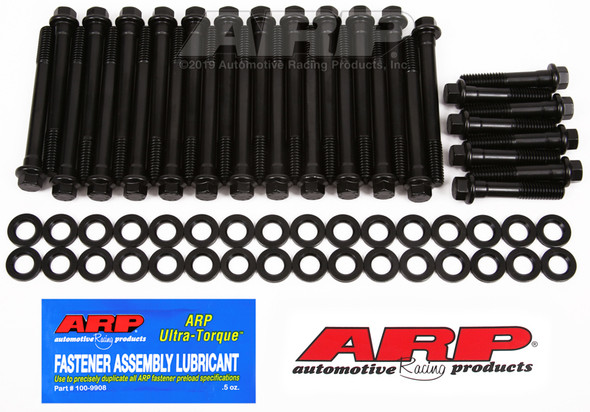
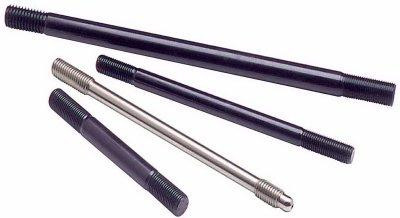
ARP BB Chevy Head Bolt Kit - 135-3601
ARP
MSRP: $98.12$92.26What is the purpose of ARP head bolt kits?ARP head bolt kits provide superior clamping force for a leak-free seal under extreme engine pressure, ensuring optimal performance and reliability.How do I...MSRP: $98.12$92.26 -


ARP 2004 And Later Small Block Chevy GENIII LS 12pt Head Bolt Kit - 134-3710
ARP
MSRP: $151.31$142.27Do ARP Head Bolt Kits require special tools?ARP Head Bolt Kits often require specialized tools for proper installation, and professional installation is recommended to ensure optimal performance.What...MSRP: $151.31$142.27 -

ARP SB Chevy LS6 Hex Head Bolt Kit - 134-3610
ARP
MSRP: $151.31$142.27Will these head bolts fit my vehicle?Confirm vehicle fitment before purchasing to ensure a perfect match for your specific engine application and desired performance.Do I need special tools to...MSRP: $151.31$142.27 -

ARP SB Chevy LS1/LS6 5.7L/6.8L Hex Head Bolt Kit - 134-3609
ARP
MSRP: $231.97$218.12Will these head bolts fit my vehicle?Confirm specific vehicle fitment for your SB Chevy LS1 LS6 5.7L 6.8L application before purchase.Can I install these myself?Professional installation is...MSRP: $231.97$218.12 -
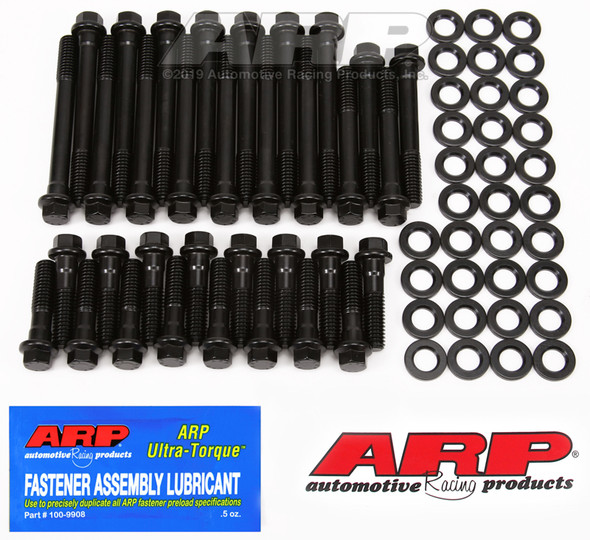
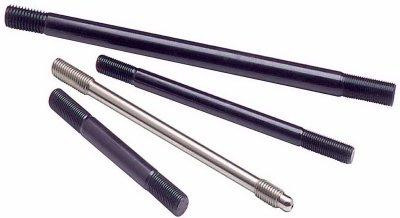
ARP Chevrolet Small Block 1/2 Hex Head Bolt Kit - 134-3601
ARP
MSRP: $98.12$92.26Do I need to check if the ARP Head Bolt Kit is compatible with my specific vehicle?Confirming vehicle fitment for your ARP Head Bolt Kit ensures precise installation and optimal performance for your...MSRP: $98.12$92.26 -
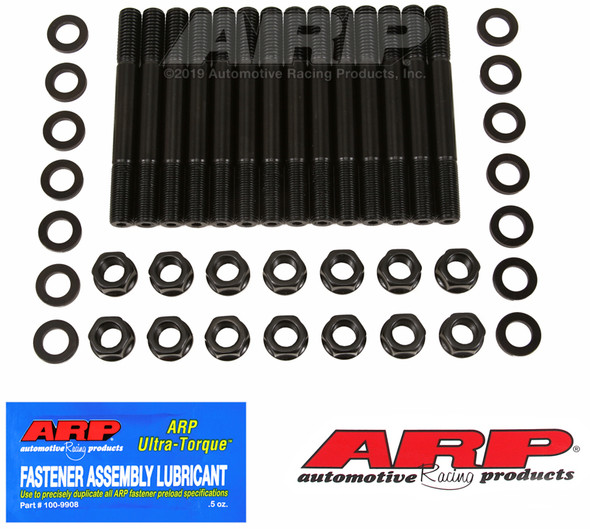

ARP Chevy 4-Cylinder Hex Head Stud Kit - 131-4001
ARP
MSRP: $131.85$123.98Are ARP head studs a direct replacement for OEM head bolts?ARP head studs are engineered for superior clamping force and often replace OEM head bolts with enhanced material strength and precise...MSRP: $131.85$123.98 -

ARP Nissan SR20DET Head Stud Kit - 102-4701
ARP
MSRP: $209.73$197.20Are ARP Head Studs specifically designed for the Nissan SR20DET engine?ARP Nissan SR20DET Head Stud Kits are meticulously engineered to ensure precise fitment and optimal performance for your...MSRP: $209.73$197.20
Head stud and bolt kits are the critical fasteners that clamp your cylinder head to the block, maintaining head gasket seal under combustion pressure, thermal cycling, and boost loads that will destroy an inferior fastener within hours of hard use. Motor Sport Mayhem stocks 180 head stud and bolt kits across 161 brands, ranging from affordable OE-replacement hardware to full billet racing studs engineered for four-figure horsepower applications.
Our Top Picks for Head Stud & Bolt Kits
Every product below was hand-selected based on proven performance, engineering quality, and consistent results across street and competition builds.
ACL Race Series Main Bearings
ACL | $329.72
Tri-metal construction with extra oil clearance specification delivers reliable clamping support for high-output engine builds.
- Extra oil clearance specification designed for forced induction and high-RPM applications demanding tighter tolerances
ACT Pilot Bearing
ACT | $17.00
Precision-fit pilot bearing supports proper crankshaft-to-drivetrain alignment essential when upgrading fastener hardware.
- OE-spec dimensional tolerance ensures consistent fitment across high-performance drivetrain assemblies
AON Clutch Components
Action Clutch | $89.69
Adjustable pedal stop provides consistent clutch engagement reference critical when assembling a high-clamp drivetrain package.
- Universal fitment design with race-grade hardware construction for repeatable pedal feel under competition conditions
AEM Wiring Connectors
AEM | $430.95
K-type thermocouple sensors allow precise thermal monitoring at the cylinder head during dyno tuning and head stud torque validation.
- Four-pack configuration supports multi-cylinder head temperature logging during break-in and high-load testing
AER Wiring Kits
Aeromotive | $358.52
High-current fuel pump wiring kit ensures the fuel system keeps pace with upgraded engine output enabled by proper head fastener sealing.
- 60-amp rated deluxe wiring handles sustained high-demand fueling in boosted and naturally aspirated race builds alike
AFE PFADT Mount Set
aFe | $660.00
Solid transmission mount set reduces powertrain flex that can induce head gasket stress in high-torque performance applications.
- Polyurethane bushing construction delivers measurably stiffer powertrain location without excessive NVH on street builds
ALF Wiring Harness
Air Lift | $97.23
Second-generation wireless harness integrates cleanly into engine bay builds where routing clearance around head fasteners is a priority.
- Pre-terminated connectors and heat-resistant sheathing simplify installation in high-temperature engine bay environments
ABR CVT Belts
All Balls Racing | $200.40
Heavy-duty CVT belt complements engine top-end fastener upgrades by ensuring drivetrain efficiency matches the power being produced.
- HD-rated carcass construction handles the torque spikes common in performance off-road and competitive UTV applications
ARX Tail Light Converters
AlphaRex | $395.00
LED tail light assemblies round out a complete truck build that starts with a properly torqued and sealed engine top end.
- Direct-fit LUXX Series design requires no wiring modification and delivers a significant visual upgrade over incandescent OE units
PA Alta Crank Pulley
Alta | $129.20
Lightened crank pulley reduces rotating mass at the front of the engine, complementing head fastener upgrades on forced-induction builds.
- Reduced rotational inertia improves throttle response and reduces parasitic load on supercharged and turbocharged applications
How to Choose the Right Head Stud & Bolt Kits
The single biggest mistake builders make is treating head fasteners as a commodity purchase — the difference between a properly specified stud kit and a cheap bolt set is the difference between a head gasket that holds at 30 psi of boost and one that lifts on the first hard pull. Material grade, thread engagement depth, tensile strength, and torque-to-yield design all determine whether your fasteners maintain clamping load through thousands of heat cycles or relax and allow combustion gases to migrate across the gasket surface. Studs are categorically superior to bolts in performance applications because they thread into the block once and remain stationary during head installation, allowing the nut to apply purely rotational clamping force without introducing torsional stress into the fastener shank — a critical advantage on aluminum block and head combinations where thread galling is a real failure mode. Understanding these fundamentals before you buy will prevent a costly rebuild.
Key Specifications
Material grade is the first specification to verify. Entry-level head bolts are typically manufactured from medium-carbon steel to SAE Grade 5 or Grade 8 equivalent, which is adequate for naturally aspirated stock-displacement engines operating within OE power limits. Performance applications demand alloy steel fasteners — 8740 chromoly is the industry benchmark, offering a tensile strength of approximately 190,000 PSI and excellent fatigue resistance across repeated thermal cycles. For extreme applications including nitrous, high-boost forced induction, or engines with very high compression ratios, H11 tool steel or aerospace-grade 625+ alloys provide tensile strengths exceeding 220,000 PSI and are the correct choice despite the significant price premium.
Thread engagement and stud length are equally critical and often overlooked. Insufficient thread engagement into the block — anything under 1.5 times the stud diameter as a rule of thumb — creates a stress concentration point that will pull threads under sustained detonation or overpressure events. Stud length above the deck must be appropriate for the specific head, head gasket thickness, and nut configuration being used. Running a stud that bottoms out in the nut before the head is fully clamped is an installation error that destroys head gaskets without any obvious external evidence until combustion gas blow-by appears in the coolant. Always verify stud protrusion against the fastener manufacturer's specification for your exact gasket stack height.
Torque-to-yield bolts — the type used on most modern OEM engines — are designed for single use and should never be reused after removal. These bolts are intentionally stretched beyond their elastic limit during installation to achieve precise clamping loads, and reuse introduces unpredictable yield behavior that can result in either under-clamping or fastener failure. If your engine uses TTY head bolts from the factory, upgrading to a reusable stud kit is the correct approach before any power modification, as the OE bolts were designed for stock combustion pressure and cannot be safely spec'd for boosted or high-compression applications. The one-time replacement cost of a quality stud kit is trivial compared to a warped head or blown gasket on a built engine.
Lubrication and installation procedure are non-negotiable variables that affect actual clamping force regardless of the quality of the hardware. Thread lubricant reduces the friction coefficient between stud and nut, allowing a greater percentage of applied torque to convert to actual clamping load rather than being lost to friction — the same torque value applied to a dry fastener versus a properly lubricated one can produce up to 30 percent different actual clamp loads. Most performance stud manufacturers specify their own moly lube or engine oil for final torque values; substituting a different lubricant invalidates those specs. Always clean threads in the block, chase them if necessary with a thread chaser (not a tap, which removes material), and follow the manufacturer's torque sequence — typically a three-stage incremental process — to ensure even load distribution across all fasteners.
Head Stud Torque Specification Guide by Application Type
| Application Type | Recommended Material | Typical Torque Range | Stud vs. Bolt Recommendation |
|---|---|---|---|
| Stock N/A Street Engine (OE Power) | Grade 8 / Medium Carbon Steel | 65–85 ft-lb | OE TTY bolts acceptable; studs preferred for future serviceability |
| Mild Performance Street (up to +30% over stock power) | 8740 Chromoly Alloy Steel | 80–100 ft-lb | Studs strongly recommended; TTY bolts not reusable |
| Forced Induction Street / Track (10–20 psi boost) | 8740 Chromoly, 180,000+ PSI tensile | 100–120 ft-lb | Studs required; MLS head gasket mandatory |
| High-Boost Competition (20–35 psi boost) | 8740 / H11 Tool Steel, 190,000+ PSI tensile | 120–145 ft-lb | Studs required; verify thread engagement depth exceeds 1.5× diameter |
| Nitrous / Extreme Compression Race Engine | H11 Tool Steel / 625+ Alloy, 220,000+ PSI tensile | 140–175 ft-lb | Studs mandatory; ARP Ultra-Torque or equivalent lube required |
| Pro Drag / All-Out Race (1000+ HP) | Aerospace Alloy / Custom Billet | Per manufacturer spec | Studs mandatory; torque plate honing and professional installation required |
Price Guide
Entry ($1.19–$130): This range covers individual replacement bolts, single-position hardware, and OE-equivalent fasteners for stock or mildly modified naturally aspirated engines where combustion pressures remain within factory parameters. You get functional hardware for routine maintenance and basic engine assembly, but material grades are not specified for sustained high-load or high-temperature performance use. Appropriate for daily drivers being kept stock or returned to OE specification after a head gasket service.
Mid-range ($130–$500): This is where the majority of serious street performance and amateur track builders land, and for good reason — this bracket covers premium alloy steel stud kits with proper tensile ratings, moly lube inclusion, and the engineering documentation needed to torque correctly for forced induction and modified naturally aspirated applications. Quality in this range is meaningfully better than entry-level hardware: tighter thread tolerances, better surface finish, and traceable material certifications that matter when you're clamping a multi-layer steel gasket at 15 psi of boost. Most enthusiast builds from mild boost to serious track use are fully covered here.
Premium ($500–$11,495.95): Premium head fastener kits in this range are specified for professional race engines where power levels, combustion pressures, and operating temperatures exceed what standard chromoly hardware can safely sustain. Complete professional engine fastener packages, billet stud sets for exotic applications, and full engine hardware kits including main studs, rod bolts, and associated hardware fall here. The cost is justified for dedicated race engines, high-boost competition builds, and applications where fastener failure means a destroyed engine rather than a trailered car — the economics favor the premium hardware by an enormous margin over one rebuild.
Who Is This For?
Head stud and bolt kits serve a remarkably broad range of builders, from weekend autocrossers upgrading a mildly boosted street car to professional engine builders assembling purpose-built competition engines — the usage matrix reflects real demand across all of these applications.
Engine Performance — 8.5/10
Head fasteners score highest in the pure engine performance category, and that makes absolute sense — they are a foundational component of any engine build where combustion pressure is being increased beyond OE specification. No other upgrade to your top end matters if the head isn't staying sealed against the block under load. Whether you're increasing compression ratio, running a larger turbo, or adding a supercharger, upgraded head fasteners are a prerequisite that enables every other engine performance modification to function as intended.
Racing Competition — 8.2/10
Competition engines operate at sustained high loads that accelerate fastener fatigue far beyond what street use produces — extended WOT runs, repeated heat cycling, and the mechanical stress of racing conditions demand hardware engineered specifically for this environment. A high score of 8.2/10 reflects the critical nature of head fasteners in any class of racing where engines are built and not simply maintained. Scrutineers and experienced engine builders treat premium head stud kits as non-negotiable in purpose-built race engines regardless of displacement or fuel type.
Track / Autocross — 8.2/10
Track and autocross builds that push street engines hard benefit significantly from upgraded head fasteners because repeated heat cycles — cold start, warm up, hard track session, cool down — are among the most demanding conditions a head gasket sealing system faces. The 8.2/10 score reflects the reality that many track cars are also street driven, making a reliable, properly clamped head a daily concern as well as a performance one. MLS gaskets combined with quality stud kits are the standard recipe for any street-track dual-purpose build that sees regular hard use.
Drag Racing — 8.2/10
Drag racing imposes uniquely severe instantaneous cylinder pressure loads — particularly in forced induction applications where a single pass can subject the head gasket to pressure spikes far exceeding sustained road course loads. The 8.2/10 score in drag racing is consistent with the category's reputation as a critical upgrade for any turbocharged or supercharged drag application. Stud stretch, thread pull-out, and gasket lift are all failure modes that end a race day instantly, and properly specified head hardware is the cheapest insurance available against all three.
Street Performance — 7.6/10
A score of 7.6/10 for street performance reflects the fact that a meaningful percentage of street performance applications don't require upgraded head fasteners — a mildly tuned naturally aspirated engine on a stock head gasket will often be fine with quality OE-equivalent bolts. The score rises sharply once boost, increased compression, or aggressive camshaft profiles enter the build, at which point upgraded fasteners transition from a recommendation to a requirement. Street performance builders should upgrade head hardware any time they're also upgrading the head gasket, running more than 10 psi of boost, or planning a tune that substantially increases peak cylinder pressure.
Trusted Head Stud & Bolt Kits Brands We Carry
ARP (Automotive Racing Products) is the category benchmark and has been for decades — their 8740 chromoly and H11 tool steel stud sets are used in professional racing at every level, and their material specifications and torque data are referenced throughout the industry. GSC Power Division brings race-proven engineering to complete engine fastener packages with a strong following in the import performance community, particularly for high-boost and high-revving applications. Brian Crower is respected for precision-machined fastener and valvetrain components that meet the tolerances demanded by professional engine builders, while Supertech Performance has built a reputation for delivering performance-grade hardware at competitive price points that make quality accessible for a wider range of builds. ACL and King Engine Bearings, while primarily bearing specialists, round out complete engine assembly hardware programs that complement head fastener kits as part of a comprehensive bottom-end and top-end build — their engineering pedigree carries directly into the fastener and sealing categories.
Frequently Asked Questions
Are aftermarket head gaskets worth using with upgraded head studs?
Yes, and in virtually every performance application they are the correct choice rather than the OE gasket. Multi-layer steel (MLS) aftermarket head gaskets offer superior recovery across thermal cycles compared to composite OEM gaskets, and their harder surface requires the higher clamping loads that upgraded stud kits deliver — running an MLS gasket with OE bolt torque specs will result in an under-clamped gasket that leaks. The combination of an MLS gasket and a premium stud kit is the standard approach for any engine build targeting more than 10–15 percent above stock power. Fire ring thickness and bore size must be matched correctly to your specific application, and cylinder head deck surfaces should be verified flat within 0.002 inches before assembly to ensure proper sealing across the full gasket surface.
What is the difference between head studs and head bolts, and which is better for performance?
Head bolts thread directly into the block and are torqued by rotating the bolt itself, which introduces torsional stress into the fastener shank alongside the tensile clamping load — this combined stress state reduces the effective clamping force and can cause galling in aluminum threads. Head studs thread into the block dry to a snug-finger-tight specification, then the head and nut are installed, with all torque applied only to the nut — this means the stud shank sees pure tensile load with no torsional component, allowing a higher percentage of torque to convert into actual clamping force. For performance applications, studs are categorically preferred because they also improve head alignment during installation, allow accurate torque-to-clamp-load conversion with proper lubrication, and are fully reusable across multiple rebuilds without thread degradation. The practical advantage over bolts increases proportionally with combustion pressure, making studs non-negotiable for any boosted or high-compression application.
How important is it to re-torque head fasteners after initial installation?
Re-torquing is critical with composite head gaskets, which compress and relax significantly during initial heat cycles — failure to re-torque after the first heat cycle on a composite gasket will result in reduced clamping load and eventual seepage or blow-out under load. Multi-layer steel gaskets are less susceptible to initial compression relaxation but still benefit from a re-torque check after the first full heat cycle on a fresh build. The specific re-torque procedure varies by manufacturer; some stud kit suppliers specify a re-torque after the first 500 miles of street driving or after the first sustained load run on a race engine. Always follow the fastener manufacturer's break-in and re-torque procedure rather than skipping it — the 30 minutes of labor required is cheap insurance on an engine that may have taken 60 hours to assemble.
Can head studs be reused after removal, and how do you inspect them?
Unlike torque-to-yield head bolts — which must be discarded after a single use — properly installed and not over-stressed alloy steel head studs are reusable across multiple rebuilds, which is one of the key advantages of upgrading from OE TTY hardware. Inspection involves measuring the shank diameter at mid-length against the original specification: more than 0.001–0.002 inch of stretch relative to the unthreaded shank diameter indicates the stud has been stressed beyond its elastic limit and should be replaced. Thread condition should be inspected visually for galling, deformation, or corrosion, and any stud that shows thread damage, visible bending, or measurement out of spec should be replaced regardless of perceived condition. The cost of replacing two or three studs in a set is negligible compared to pulling a head on an assembled engine, and most professional builders replace a full set rather than mixing used and new fasteners to ensure consistent clamping loads across all positions.
What thread lubricant should be used when installing head studs?
Thread lubricant selection directly affects actual clamping force because torque-to-clamp-force calculations assume a specific friction coefficient — substituting a different lubricant can shift actual clamp load by 20–30 percent from the published torque specification even if the wrench clicks at the correct number. Most performance stud manufacturers publish separate torque values for their specified lubricant (typically a moly-based paste), engine oil, and dry installation — always use the correct value for the actual lubricant being applied. Moly-based lubricants such as the product most commonly supplied with premium stud kits reduce friction coefficient to approximately 0.12–0.14 and are the standard choice for high-load race applications. Engine oil is an acceptable substitute when specified by the manufacturer for that lubricant type and produces reliable results in street performance applications; anti-seize compounds are generally not recommended for head studs because their friction coefficient varies inconsistently across the torque range and can produce unpredictable actual clamp loads.
Building something specific? Our performance specialists can help you select the right Head Stud & Bolt Kits for your application — street, track, or full race build.