
Crankshaft Dampers
- Product
- Qty in Cart
- Quantity
- Price
- Subtotal
-
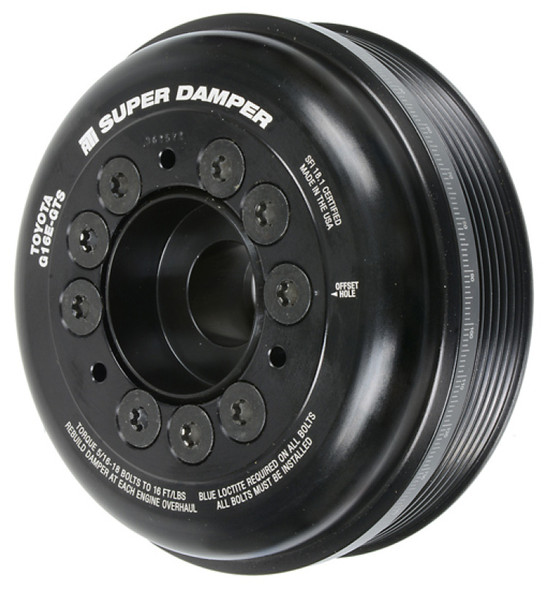
ATI Damper - 5.885in - Aluminum - Toyota G16E-GTS - 3-Ring - ATI917381
ATI
$399.90ATI Damper - 5.885in - Aluminum - Toyota G16E-GTS - 3-Ring$399.90 -
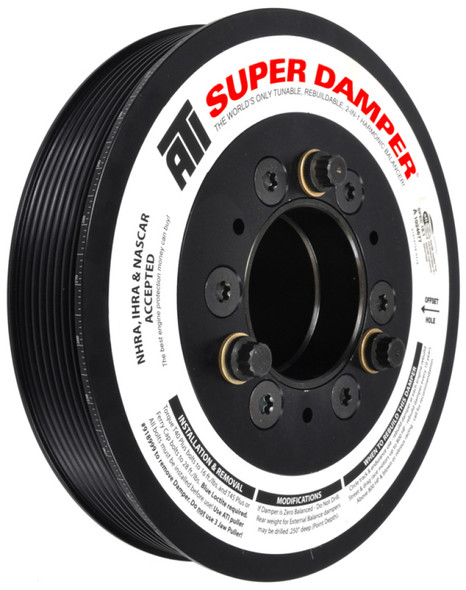
ATI Damper - 7.48in - Alum - 8 Grv - Dodge - 2009+ - 5.7L / 6.4L Hemi Truck - 3 Ring - ATI918452
ATI
$461.15What is the main function of a crankshaft damper?Crankshaft dampers absorb harmful torsional vibrations, safeguarding critical engine components and promoting smoother operation for enhanced longevity.Do I need special tools to install the...$461.15 -


Fluidampr 92-10 Toyota 1UZ-FE/2UZ-FE/3UZ-FE SOHC/DOHC Steel Internally Balanced Damper - 570801
Fluidampr
MSRP: $588.83$501.13Which Lexus and Toyota vehicles is the Fluidampr crankshaft damper designed for?This Fluidampr crankshaft damper fits 1990-2010 Lexus GS400/GS430/GX470 and multiple Toyota 4Runner, Land Cruiser, and Sequoia models.What level of technical expertise is...MSRP: $588.83$501.13 -

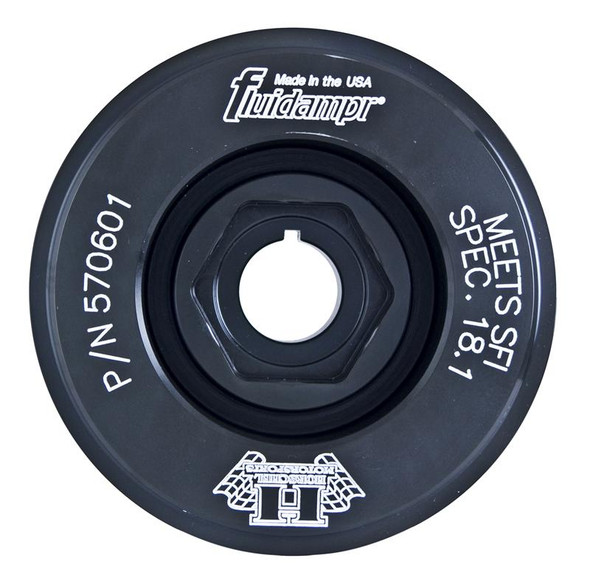
Fluidampr Honda K Series Steel Internally Balanced Damper - 570601
Fluidampr
MSRP: $568.14$482.92What vehicles are compatible with the Fluidampr FDR Dampers?Fluidampr FDR Dampers fit 2002-2025 Acura ILX, Integra, RDX, and various Honda Accord, Civic, and CR-V models.What is the installation process for the Fluidampr FDR Damper?Professional...MSRP: $568.14$482.92 -

ATI Damper - 7.074in - Alum - 6 Grv - Scion/Subaru/Toyota - 4U-GSE - FA20 2.0L - 10 Percent UD - ATI918482L
ATI
$414.04What is a crankshaft damper?A crankshaft damper is a crucial engine component designed to absorb harmful torsional vibrations, protecting critical engine parts from excessive stress.Do I need to replace my crankshaft damper?Replacing your crankshaft...$414.04 -

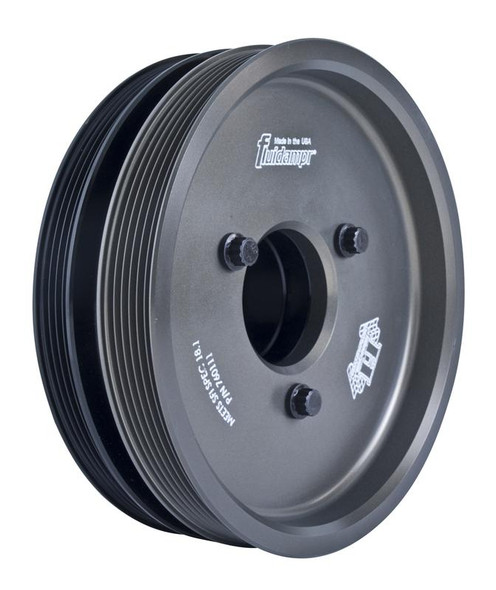
Fluidampr Chevy LS3/L99/Camaro w/ Stock Pulley Steel Internally Balanced Damper - 760111
Fluidampr
MSRP: $579.36$492.46What is a Crankshaft Damper?A Crankshaft Damper is a crucial engine component designed to absorb and dissipate harmful torsional vibrations, thereby protecting the crankshaft.Do I need a professional to install this Crankshaft Damper?Professional...MSRP: $579.36$492.46 -

ATI Damper - 7.48in - Alum - 6/4 Grv - LS3 Camaro - 10-15 - Gen 3 Vortec Truck - LS - ATI918628
ATI
$467.49What are the main benefits of installing an ATI Crankshaft Damper?APP Dampers deliver smoother engine operation and enhanced longevity by absorbing harmful vibrations, reducing stress on critical engine components.Can I install this damper...$467.49 -
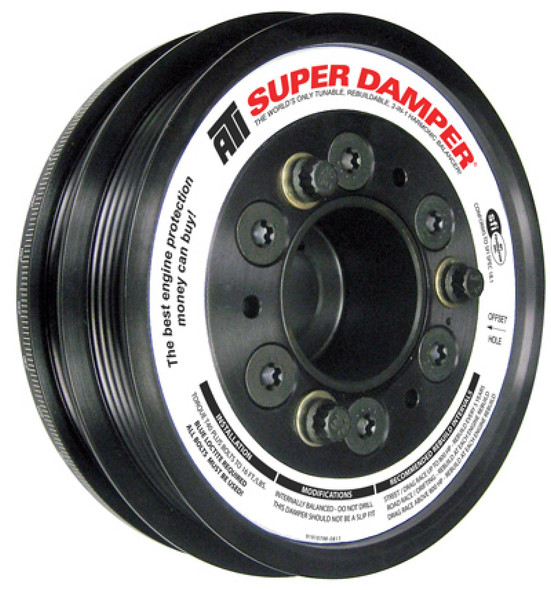
ATI Damper - 6.10in - Alum - 4 & 5 Grv - Acura Nsx 3.0L - 600 HP or Less - 1Pc - ATI917757
ATI
$445.00What is the primary function of a crankshaft damper?A crankshaft damper's primary function is to absorb torsional vibrations, protecting critical engine components and ensuring smoother operation across all RPMs.Can I install an ATI damper...$445.00 -

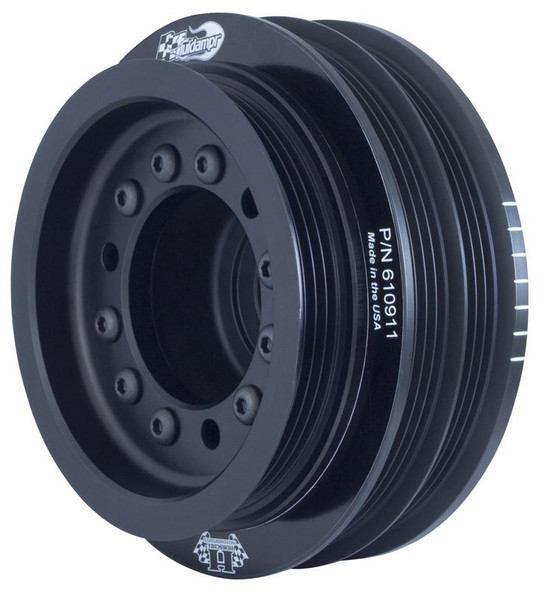
Fluidampr Nissan RB26DET Phase-2 BCNR33 GT-R / BNR-34 GT-R Steel Internally Balanced Damper - 610911
Fluidampr
MSRP: $568.14$482.92How do I find the right Fluidampr for my vehicle?Confirm exact vehicle fitment using our dedicated application guide before ordering to ensure proper installation and optimal performance of your Fluidampr crankshaft damper.Are Fluidampr crankshaft...MSRP: $568.14$482.92 -
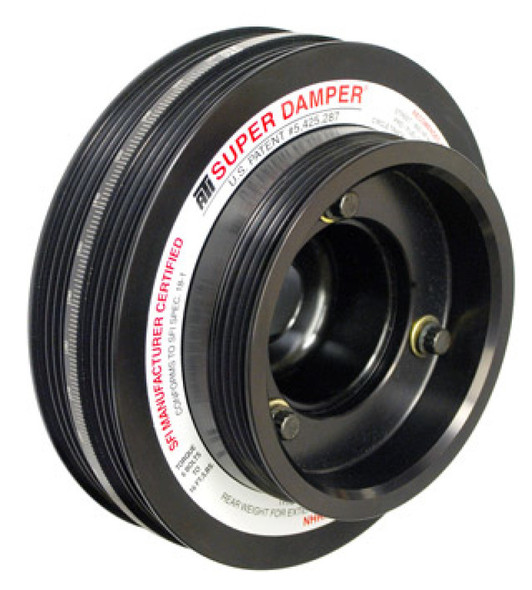
ATI Damper - 6.78in - Alum - 6/4 Grv - Nissan V6 350Z VQ35 - Street - 2 Ring - ATI918588
ATI
MSRP: $418.27$410.65What is a crankshaft damper?A crankshaft damper is a precision-engineered component designed to absorb destructive torsional vibrations from the crankshaft, ensuring smoother engine operation and longevity.How do I install the ATI Crankshaft...MSRP: $418.27$410.65 -

ATI Damper - 5.67in - Alum - (2) 4 & 5 Grv - Nissan - SR20 Rwd - Street - 1Pc - ATI918582
ATI
$418.27Will this crankshaft damper fit my specific vehicle?Crankshaft dampers require precise fitment confirmation; consult your vehicle's application guide before proceeding with installation.Can I install this crankshaft damper myself?Professional...$418.27 -

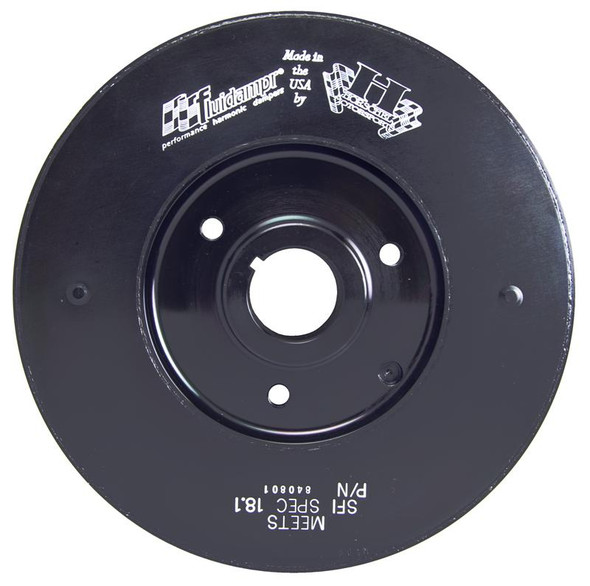
Fluidampr Toyota 2JZ I-6 Steel Internally Balanced Damper - 840801
Fluidampr
MSRP: $589.56$501.13What is a crankshaft damper?A crankshaft damper is a crucial engine component designed to absorb torsional vibrations generated by the crankshaft's rotation, ensuring smoother operation and longevity.How do I install a Fluidampr crankshaft...MSRP: $589.56$501.13
A crankshaft damper — also called a harmonic balancer — absorbs and dissipates torsional vibration energy generated by combustion impulses acting on the crankshaft, preventing resonance-induced fatigue failure in both street and race engines. Motor Sport Mayhem stocks 125 crankshaft dampers spanning entry-level OEM-replacement units to full race-spec billet assemblies, covering a price range from $1.19 to $11,495.95 across 161 brands.
Our Top Picks for Crankshaft Dampers
Every product below was hand-selected based on verified performance data, engineering quality, and real-world results across street, track, and competition builds.
ACL Race Series Main Bearings
ACL | $329.72
ACL's Race Series bearings use a tri-metal construction with a copper-lead overlay that tolerates elevated oil temperatures and increased dynamic loads found in modified rotating assemblies.
- Extra oil clearance specification supports high-rpm operation and aftermarket oil pump upgrades without sacrificing film thickness
ACT Pilot Bearing
ACT | $17.00
ACT pilots are manufactured to tighter dimensional tolerances than OEM replacements, ensuring correct input shaft alignment that directly affects crankshaft end-loading and rotational smoothness.
- Precision-fit construction eliminates the radial play that causes vibration harmonics to telegraph back through the rotating assembly
Action Clutch Race Pedal Stop
Action Clutch | $89.69
A properly set pedal stop reduces clutch disc travel variation, which directly limits the torsional shock loads fed back into the crankshaft snout on aggressive engagement.
- Universal fitment with adjustable geometry accommodates a wide range of pedal box configurations in dedicated race builds
AEM K-Type Thermocouple Kit
AEM | $430.95
Accurate thermal monitoring of oil and coolant temps is essential to diagnosing the overheating conditions that accelerate elastomeric damper compound degradation.
- K-type thermocouple accuracy to within ±1°C allows precise identification of thermal events that compromise rotating assembly components including damper bonding layers
Aeromotive Fuel Pump Wiring Kit
Aeromotive | $358.52
Stable fuel delivery eliminates lean combustion events — a leading cause of destructive detonation spikes that overload crankshaft dampers beyond their rated torsional absorption capacity.
- 60-amp relay-based wiring eliminates voltage drop to the pump, ensuring consistent fuel pressure that protects the entire rotating assembly from combustion anomalies
aFe PFADT Series Transmission Mount Set
aFe | $660.00
Stiffer drivetrain mounts reduce rotational compliance in the driveline, which directly reduces the amplitude of torsional oscillations that harmonic dampers must manage at the crankshaft snout.
- Polyurethane durometer rating is tuned for performance use without transferring excessive NVH into the cabin — critical for street-driven builds running upgraded dampers
Air Lift WirelessAir Harness
Air Lift | $97.23
Clean, properly routed wiring harnesses prevent electrical interference that can corrupt crankshaft position sensor signals, causing ignition timing errors that induce abnormal torsional loading.
- Second-generation design includes shielded conductors and sealed connectors suited to the high-vibration, high-heat engine bay environment
All Balls Racing CVT Belt
All Balls Racing | $200.40
In CVT-equipped powersports applications, belt condition directly determines the torsional load profile seen by the crankshaft — a worn or incorrect belt amplifies harmonic stress on the damper assembly.
- High-tensile aramid fiber construction maintains consistent belt stiffness across the full RPM and temperature operating range of competition powersports engines
AlphaRex LUXX Series LED Tail Lights
AlphaRex | $395.00
LED lighting upgrades reduce alternator electrical load, which decreases the accessory belt tension variation and parasitic torque spikes that affect damper operating conditions on belt-driven systems.
- Direct-fit OEM connector design eliminates wiring modifications that could introduce grounding issues and erratic electrical loads into the charging system
Alta Lightened Crank Pulley
Alta | $129.20
Alta's lightened crank pulley reduces rotational inertia at the crankshaft snout, freeing measurable power while maintaining the harmonic control necessary to protect the rotating assembly.
- Billet aluminum construction with precision-machined balancing ensures the reduced-mass design does not introduce new resonance frequencies into the crankshaft system
How to Choose the Right Crankshaft Damper
The single most important decision when selecting a crankshaft damper is matching the damper's tuned frequency to your engine's actual torsional resonance point — a mismatch here means the damper absorbs vibration at the wrong frequency, offering almost no protection against the specific harmonic modes your rotating assembly produces under load. OEM elastomeric dampers are tuned at the factory for stock displacement, stock compression, and stock firing intervals; any significant engine modification shifts those resonance frequencies and can render the original damper undersized or incorrectly tuned. Failure modes are severe: an inadequate or degraded damper allows torsional oscillations to compound, leading to crankshaft fatigue cracking, accessory drive failures, and timing system destruction at high rpm.
Key Specifications
Damper construction falls into three principal categories: elastomeric, viscous, and fluid-filled. Elastomeric designs bond an inertia ring to a hub via a rubber compound; they are lightweight and cost-effective for mild street builds but degrade with heat cycles and are not rebuildable. Viscous dampers use a precision-clearanced housing filled with silicone fluid, providing broad-spectrum damping across a wider frequency range — this is the preferred architecture for purpose-built race engines running aggressive cam profiles and high cylinder pressures. Fluid-filled units occupy a middle ground, offering better frequency coverage than elastomeric types with lower cost than full viscous designs.
Inertia ring mass is the primary tuning variable. A heavier ring shifts the damper's resonant frequency downward and provides greater vibration absorption capacity, but it adds rotating mass that costs throttle response. For naturally aspirated high-revving builds, a lighter ring tuned to the upper RPM harmonic is often more effective than a heavy unit optimized for low-frequency dampening. Forced induction engines — particularly high-boost applications — generate significantly higher peak cylinder pressures and correspondingly more severe torsional impulses; these builds almost always require a heavier, wider-bandwidth damper than the equivalent naturally aspirated configuration.
Hub material and fit tolerances are non-negotiable in performance applications. A damper with a loose crankshaft snout fit will fret the mating surface, destroy the keyway, and introduce the very vibration it is meant to suppress. Billet steel or billet aluminum hubs machined to tight interference fit tolerances — typically 0.001" to 0.003" press fit depending on snout diameter — are standard in race-grade components. Verify SFI 18.1 certification for any drag racing application; this specification governs burst containment and ensures the inertia ring cannot separate and become a projectile in the event of catastrophic failure. For engine components that work alongside your damper — bearings, gaskets, timing components — fitment and material compatibility are equally critical.
Accessory drive integration deserves careful attention. Many performance dampers incorporate underdrive pulley geometry that reduces alternator, power steering pump, and water pump speeds by 10–25%, recovering meaningful horsepower at the wheels by reducing parasitic losses. Verify that your cooling system and charging system can tolerate the reduced drive speed at idle and low-load conditions before committing to an aggressive underdrive ratio — a marginal cooling system will overheat at extended idle with significant underdrive, and an undersized alternator may not maintain charge voltage in stop-and-go traffic. This consideration connects directly to your cooling system specification.
Crankshaft Damper Selection by Engine Output and Application
| Engine Output Range | Recommended Damper Type | Inertia Ring Mass Target | Key Requirement |
|---|---|---|---|
| Stock–250 WHP (Street) | OEM-replacement elastomeric | OEM equivalent | Correct resonant frequency match to stock tune |
| 250–400 WHP (Street/Track) | High-performance elastomeric or fluid-filled | +10–15% over OEM | Heat-resistant elastomer compound; underdrive option viable |
| 400–600 WHP (Track/Competition) | Fluid-filled or entry viscous | Medium-heavy; application-specific | SFI 18.1 certification recommended; billet hub required |
| 600–900 WHP (High-Boost/Race) | Viscous — full race spec | Heavy; wide-frequency tuning | SFI 18.1 mandatory; rebuildable design preferred |
| 900+ WHP (Pro/All-Out Race) | Purpose-built viscous or custom-tuned | Application-engineered | Custom resonance tuning; mandatory periodic rebuild intervals |
| Powersports/CVT Applications | Integrated damper/pulley assembly | Manufacturer-specified | Belt drive compatibility and clutch engagement profile matching |
Price Guide
Entry ($1.19–$130): This tier covers OEM-replacement elastomeric units, pilot bearings, and accessory components that support the damper system. Correct for restoring factory vibration control on stock or mildly modified engines — not appropriate for any build exceeding OEM power output by more than 15–20%.
Mid-range ($130–$500): The sweet spot for most performance street and track builds. You gain access to billet hubs, improved elastomer compounds, fluid-filled designs, and SFI-certified units. Underdrive pulley integration is common at this price point, delivering real power gains alongside improved durability over OEM. The majority of enthusiast and club-racing builds are correctly served here.
Premium ($500–$11,495.95): Full viscous race dampers, custom-tuned competition units, and top-tier billet assemblies engineered for sustained high-rpm abuse. The cost is justified by rebuildable construction, dyno-verified frequency tuning, and the burst containment engineering required by sanctioning bodies. Pro drag, endurance racing, and high-boost competition engines cannot safely operate without this level of hardware.
Who Is This For?
Crankshaft dampers serve every power level from daily-driven street cars to full professional race builds, with the correct specification varying dramatically across those applications.
Engine Performance — 8.5/10
Crankshaft dampers score highest in the pure engine performance category because protecting rotating assembly integrity is a prerequisite for any power output target. An under-rated or degraded damper sets a hard ceiling on reliable engine performance regardless of how much money is spent on other components. Every horsepower gained through compression, cam timing, or boost increases torsional load on the crankshaft, making the damper specification more critical — not less — as power climbs.
Racing Competition — 8.2/10
Competition use demands SFI-certified, viscous or fluid-filled designs capable of sustained operation at the rpm and cylinder pressure levels that destroy OEM elastomeric units within a single race weekend. Most sanctioning bodies mandate SFI 18.1 compliance in open-engine classes, making certification a non-negotiable spec rather than a marketing point. Rebuild intervals must be tracked and followed — a viscous damper operating beyond its service life provides false confidence while delivering degraded protection.
Track / Autocross — 8.2/10
Track and autocross applications cycle engines through repeated wide-open-throttle to deceleration transitions, generating the aggressive torsional transients that stress dampers far more than steady-state highway driving. Heat soak between sessions accelerates elastomeric compound degradation, making inspection frequency higher than in pure street use. An upgraded damper rated for sustained track use is a sound investment for any vehicle that sees regular circuit or autocross duty.
Drag Racing — 8.2/10
Drag racing imposes the most severe single-event torsional loads of any motorsport application — the combination of aggressive clutch engagement, maximum cylinder pressure at launch, and high-rpm shifts creates impulse loading that can fail an inadequate damper in a single pass. SFI certification is mandatory at virtually all sanctioned drag events, and the burst containment geometry of SFI-rated units is what separates legal from illegal hardware at tech inspection. Frequent inspection for hub fretting, inertia ring wobble, and fluid seal integrity is standard practice in any serious drag program.
Street Performance — 7.6/10
Street performance builds score slightly lower in this category not because dampers matter less, but because street engines rarely sustain the extreme thermal and mechanical stress cycles of purpose-built race powerplants. That said, any street engine modified beyond approximately 20% over stock power output benefits measurably from an upgraded damper — the factory unit was not engineered for the modified resonance profile. High-performance elastomeric and entry-level fluid-filled designs offer the right balance of vibration control, accessory drive compatibility, and cost for the street performance segment.
Trusted Crankshaft Damper Brands We Carry
The brands that dominate this category earned their position through demonstrable engineering depth, not marketing spend. ACL brings decades of OEM and racing bearing supply experience to rotating assembly components, with metallurgical specifications that exceed OEM in every measurable dimension. Brian Crower operates at the top of the high-performance rotating assembly market, with engineering resources that allow application-specific tuning rather than generic catalog solutions — their average product price reflects the custom engineering cost built into every component. Wiseco has supplied rotating assembly components to professional motorsport for over 75 years, with forging and machining tolerances validated across multiple racing disciplines. GSC Power Division brings specialized expertise in high-output Asian-market engine platforms, covering applications that mainstream suppliers frequently ignore. Manley Performance is the benchmark for forged and billet rotating assembly components in American motorsport, with an engineering team that has supplied components to professional drag, road racing, and circle track programs for decades. Gates rounds out the damper ecosystem with belt drive and tensioner components that directly affect accessory drive loading on the damper assembly, providing OEM-quality and performance-grade options across a wide application range.
Frequently Asked Questions
Are two-piece or three-piece crankshafts better for high-performance builds?
Three-piece crankshaft assemblies — where the crankshaft, main bearing journals, and counterweights are assembled from separate forgings — allow manufacturers to use optimal materials for each function and simplify production of complex geometries, but they introduce joint integrity as a failure mode under extreme torsional loading. Two-piece and single-piece billet cranks eliminate assembly joints entirely, delivering superior torsional rigidity and fatigue resistance for high-horsepower applications where peak cylinder pressures and rpm would stress joint fasteners beyond their reliable service range. For naturally aspirated or moderate forced-induction street builds, a quality three-piece forging from a reputable manufacturer is entirely adequate. Full-race applications — particularly those exceeding 700–800 WHP or running sustained high-rpm operation — benefit from billet one-piece construction where the additional material and machining cost is justified by the elimination of joint failure risk.
Are ACL or King engine bearings better for performance use?
Both ACL and King manufacture bearings to exceptionally tight tolerances and both supply to professional motorsport, so the comparison is genuinely application-dependent rather than a clear hierarchy. ACL's Race Series uses a tri-metal construction with a copper-lead overlay and additional overlay coating that excels in high-rpm applications where oil film stability at elevated temperatures is the primary concern. King's performance bearings are known for their pMax Black and HP Series coatings that provide exceptional scuff resistance during the critical break-in period and under oil starvation transients — a meaningful advantage in race engines that may experience brief lubrication interruptions under lateral g-loading. The correct choice depends on your specific engine's oil system design, the type of racing, and whether break-in oil starvation or sustained high-temperature operation is the dominant stress mode for your application.
Are ACL Race Series bearings any good, and are they coated?
ACL Race Series bearings are among the most widely validated aftermarket engine bearings in motorsport, with documented use across professional drag, circuit, and time attack programs globally. The Race Series uses a tri-metal structure: a steel backing for dimensional stability, a copper-lead intermediate layer for load capacity, and a thin overlay of lead-tin or lead-indium that provides the initial conformability and corrosion resistance. The overlay layer effectively functions as a coating that protects the bearing surface during break-in and provides a sacrificial layer that protects the copper-lead substrate if oil film momentarily fails. ACL also offers an extra-oil-clearance variant that provides slightly more oil film thickness — beneficial for modified engines running high-flow oil pumps or elevated operating temperatures. Real-world results confirm that ACL Race Series bearings consistently outlast OEM units in modified applications when correct clearances and proper break-in procedures are followed.
Are aftermarket belt tensioners worth fitting alongside a new crankshaft damper?
Yes — fitting an upgraded belt tensioner when replacing or upgrading a crankshaft damper is sound practice because the tensioner directly controls accessory belt load variation, which affects the torsional stress seen at the damper hub. OEM tensioners use a spring-loaded arm with a finite service life; as the spring weakens, belt tension becomes inconsistent, causing the belt to slip under load and then snap tight — generating torsional impulses that add to the damper's workload. Aftermarket tensioners typically use stiffer spring rates, higher-quality pivot bearings, and more durable pulley materials compared to OEM, maintaining consistent belt tension across a wider range of accessory loads and rpm. For engines running upgraded alternators or additional belt-driven accessories, this is particularly important because the increased belt tension required to drive higher-output components amplifies the load variation problem if the tensioner is marginal.
Are aftermarket head gaskets a good idea when building an engine that needs a new crankshaft damper?
When an engine is already apart to the point of accessing the crankshaft snout and damper, inspecting and upgrading the head gasket is a logical step because both components share a common failure mode trigger: elevated cylinder pressure from power modifications. Aftermarket engine components such as multi-layer steel head gaskets from established manufacturers provide substantially higher clamp load capacity and superior sealing consistency compared to OEM composite designs, particularly under the thermal cycling and cylinder pressure spikes that accompany any significant power increase. The correlation to damper selection is direct: if you are upgrading to a performance damper because you have increased cylinder pressure, the head gasket specification should be revisited simultaneously — a blown head gasket on a modified engine will introduce catastrophic combustion pressure spikes that exceed what any damper is designed to absorb. MLS gaskets require a surface finish of Ra 50–125 microinch (50 Ra is optimal) to seal correctly, so machined surfaces should be verified before assembly.
Building something specific? Our performance specialists can help you select the right Crankshaft Dampers for your application — street, track, or full race build.