
Ring & Pinions
- Product
- Qty in Cart
- Quantity
- Price
- Subtotal
-
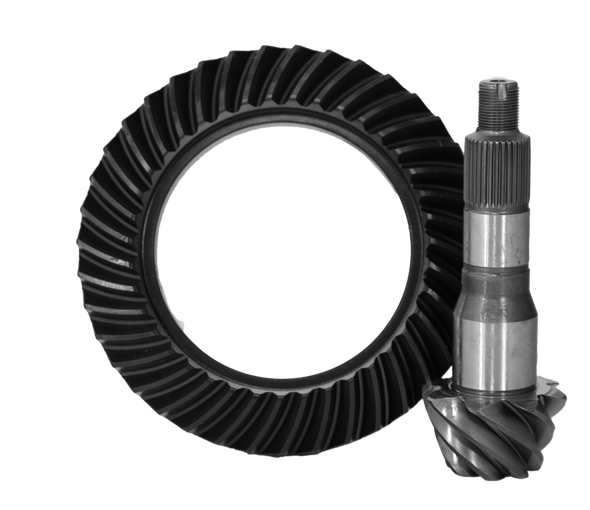
Revolution Gear & Axle 16-24 Toyota Tacoma 8.75in Rear Axle 5.29 Ratio Ring & Pinion Set - T8.75-529
Revolution Gear & Axle
$406.99How do I know if this ring and pinion set will fit my vehicle?Confirm precise fitment for your specific vehicle application by consulting our detailed compatibility guide before proceeding with installation.Is professional installation recommended for...$406.99
Ring and pinion gear sets are the final drive ratio component inside your differential — they determine how engine RPM translates to wheel speed, directly impacting acceleration, top speed, fuel economy, and the mechanical advantage available to your traction system. Motor Sport Mayhem stocks 58 ring and pinion sets spanning street, off-road, drag, and competition applications, with ratios and materials engineered to match every drivetrain demand.
Our Top Picks for Ring & Pinions
Every product below was selected based on performance engineering, real-world durability results, and value across a wide range of drivetrain applications.
ACT Mod-Twin Kits
ACT | $2104.00
A race-spec twin-disc clutch system engineered to handle extreme torque loads that standard clutch assemblies cannot survive under sustained competition conditions.
- Sprung mono-drive hub design absorbs drivetrain shock to protect ring and pinion mesh under high-torque launches
AON Clutch - Twin - 7.25in
Action Clutch | $1377.45
A 7.25-inch twin-disc race clutch paired with a chromoly flywheel for reduced rotational mass and maximum torque transfer to the final drive gear set.
- Chromoly flywheel reduces parasitic drivetrain inertia, allowing the ring and pinion to respond faster to throttle input
AFE Diff/Trans/Oil Covers
aFe | $430.00
A machined billet transmission pan that increases fluid capacity and thermal management for the gearbox feeding torque to your ring and pinion assembly.
- Increased fluid volume extends gear oil life and stabilizes operating temperature inside the differential housing
ABR Prop Shafts
All Balls Racing | $790.35
A heavy-duty prop shaft designed to reliably deliver torque from the transmission to the front differential ring and pinion without flex or vibration.
- Precision-balanced construction eliminates driveline vibration that accelerates ring and pinion wear over time
AMS Master Cylinder Conversion
AMS | $494.95
A clutch master cylinder conversion kit engineered for consistent hydraulic engagement that protects drivetrain components — including the final drive — from shock loading during shifts.
- Improved pedal feel and consistent bite point reduce abrupt torque spikes transmitted through the ring and pinion mesh
ARB Air Locker Kits
ARB | $2604.95
A pneumatically actuated locking differential system that delivers 100% torque distribution to both axle shafts on demand, while running fully open on pavement to protect gear tooth engagement.
- Air-actuated engagement eliminates the mechanical stress on the ring and pinion that comes from permanent or mechanical-auto locking systems
ART Easy Link Kit
Artec Industries | $1484.99
A geometry-adjustable 3-link suspension kit that controls axle housing movement and prevents pinion angle changes under load — critical for consistent ring and pinion contact patterns.
- Correct pinion angle geometry maintained under articulation reduces gear mesh stress and eliminates premature wear patterns
ATS Flex Plates
ATS Diesel | $804.99
An SFI-certified billet flexplate engineered to absorb torsional shock at the crankshaft before it propagates through the transmission and into the differential ring and pinion.
- SFI 29.3 certification confirms the billet construction meets minimum burst strength standards for high-torque diesel and performance applications
GBE Diff Covers
Banks Power | $425.00
A ram-air differential cover engineered to actively cool gear oil inside the housing — directly extending ring and pinion service life by controlling operating temperature under sustained load.
- Increased gear oil capacity combined with active airflow cooling reduces peak differential operating temps by a measurable margin during towing or off-road use
BBK Clutch Cable & Fwall Adjt
BBK | $169.99
An adjustable clutch cable and firewall adjuster kit that restores proper engagement geometry to eliminate the harsh drivetrain shock that prematurely damages ring and pinion gear teeth.
- Firewall adjuster allows precise cable tension calibration for consistent clutch release, reducing shock loading on the final drive assembly
How to Choose the Right Ring & Pinions
The ring and pinion gear set is one of the most mechanically stressed components in any vehicle's drivetrain — it operates under constant load, shock input, and thermal cycling, and a poor-quality or incorrectly installed set will fail catastrophically. What separates a quality ring and pinion from a budget casting is the steel alloy grade, heat treatment depth, tooth geometry tolerance, and backlash specification — all of which determine how long the gear set will survive under your specific power and load conditions.
Key Specifications
Gear ratio is the first specification to determine — numerically higher ratios (e.g., 4.56:1) produce stronger acceleration and more torque multiplication at the wheels, while numerically lower ratios (e.g., 3.08:1) favor highway cruising and fuel economy. The correct ratio depends on your tire diameter, transmission gear ratios, intended RPM range at cruise, and whether the vehicle is used primarily for acceleration or sustained high-speed running. Changing gear ratios without recalibrating the speedometer and considering transmission gear spacing is a common mistake that results in a mismatched powertrain and accelerated wear.
Material quality is non-negotiable in performance applications. OEM and quality aftermarket ring and pinion sets are machined from case-hardened alloy steel — typically 8620 or 9310 steel — with carburized case depths between 0.030 and 0.060 inches depending on application load rating. Cheaper castings use lower-alloy steel with shallow or inconsistent heat treat depth, which allows the hardened case to crack and spall under shock loading long before the gear set reaches its rated mileage. For any application above stock power levels or used in off-road environments with high shock loading, verified case depth and Rockwell hardness ratings matter.
Backlash — the measured clearance between the ring and pinion tooth faces — must be set within the manufacturer's specification during installation, typically between 0.005 and 0.010 inches for most passenger and light truck differentials. Too little backlash causes metal-to-metal contact at operating temperature (differentials run hot, causing thermal expansion), leading to rapid tooth destruction. Too much backlash produces gear clatter, poor contact pattern centering, and accelerated wear at the tooth edges. Proper installation requires a dial indicator, a solid pinion bearing preload, and verification of the tooth contact pattern using gear marking compound — this is not a bolt-on install.
For vehicles that have been lifted or have significant suspension geometry changes, pinion angle must be verified before and after installation. Incorrect pinion angle changes the contact pattern under load and can cause the ring and pinion to run on the wrong portion of the tooth face, drastically reducing service life. If you have modified suspension geometry, address pinion angle correction as part of the gear swap — not as an afterthought.
Ring & Pinion Gear Ratio Selection by Application
| Application | Typical Ratio Range | Tire Diameter Consideration | Notes |
|---|---|---|---|
| Stock street / fuel economy priority | 2.73:1 – 3.23:1 | Stock OE diameter | Lowest RPM at cruise; worst acceleration from stop |
| Street performance / daily driver balance | 3.42:1 – 3.73:1 | Up to +2 inches over stock | Best all-around compromise for power and drivability |
| Drag racing / strip use | 3.90:1 – 4.56:1 | Narrow drag radials, stock diameter | High RPM at launch; highway RPM significantly elevated |
| Off-road with oversized tires | 4.56:1 – 5.38:1 | 35–40+ inch tires | Re-gearing restores lost torque multiplication from tall tires |
| Rock crawling / extreme low-speed | 5.13:1 – 5.86:1 | 37–44 inch tires | Maximizes torque multiplication; very high highway RPM |
| Circle track / road course | Application-specific | Racing slick diameter | Calculated to hit peak power RPM at the end of longest straight |
Price Guide
Entry ($1.99–$180): This range covers individual installation components — shims, crush sleeves, pinion nuts, carrier bearings, and small hardware items. You are not buying a complete ring and pinion gear set at this price point; these are the consumable parts required for a proper installation or rebuild of an existing differential.
Mid-range ($180–$600): The majority of complete ring and pinion gear sets for common passenger and light truck differentials land in this range, including name-brand sets from established manufacturers with verified heat treat specifications. This is where most street performance and mild off-road builds will find their solution — quality gear steel, accurate tooth geometry, and full installation hardware.
Premium ($600–$4999.99): Premium pricing covers heavy-duty truck differentials, specialty axle housings, complete differential rebuild kits with lockers or limited-slip units included, race-spec gear sets in exotic alloys with tighter manufacturing tolerances, and complete traction pack systems. If you are running significant power, extreme off-road terrain, or a dedicated competition vehicle, the cost of premium gear sets is justified by the engineering margin built into the product and the catastrophic cost of a mid-race or trail-side failure.
Who Is This For?
Ring and pinion gear sets serve every segment of motorsport and off-road performance — from weekend off-roaders correcting for oversized tires to drag racers optimizing launch RPM and road course builders maximizing corner-exit drive.
Drag Racing — 8.1/10
Drag racing is the highest-rated use case for ring and pinion selection, and for good reason — gear ratio is one of the most powerful tuning variables available at the drag strip without touching the engine. Selecting a numerically higher ratio moves the engine's peak power band closer to the launch RPM window and increases rear wheel torque multiplication directly. The gear set in a drag application is also subjected to massive shock loads at launch, making steel alloy grade and case hardness depth critical specifications — not marketing numbers.
Racing Competition — 8.0/10
Across all forms of closed-course competition, the final drive ratio must be matched to the specific track layout, peak power RPM, and tire diameter to ensure the engine exits corners in its optimal power band. A ring and pinion change is frequently one of the fastest, most cost-effective tuning adjustments a race team can make between events. Competition-spec gear sets also demand tighter manufacturing tolerances and verified backlash specifications, since gear noise and heat that are acceptable on the street become reliability risks at sustained high RPM.
Track / Autocross — 7.8/10
Autocross and track day applications benefit from numerically higher gear ratios that improve corner-exit acceleration and make the power band more accessible at the lower speeds characteristic of tight technical layouts. Unlike drag racing, track use involves sustained thermal load cycles on the differential — meaning gear oil capacity, housing ventilation, and the quality of the gear steel all matter for long-term reliability through multiple sessions. Upgraded differential covers and thermal management components are common companion purchases in this application.
Street Performance — 7.7/10
Street performance builds score 7.7 — strong, but tempered by the real-world compromise between aggressive gear ratios and daily driveability. A numerically high ratio that transforms a car's acceleration on the on-ramp will also push highway cruising RPM into an uncomfortable or fuel-inefficient range. The sweet spot for most street builds is a ratio that improves off-the-line response and mid-range pull without destroying the driving experience at highway speeds — and that calculation depends entirely on the transmission's top gear ratio and your typical tire diameter.
Weekend Off-Roading — 7.7/10
Re-gearing for oversized tires is the single most common ring and pinion application in the off-road segment — when you add taller tires without changing the differential ratio, you effectively lower your final drive ratio and lose engine torque multiplication, making the vehicle feel sluggish and causing the transmission to hunt gears. Matching the ring and pinion ratio to the tire diameter restores the factory driving character while also improving trail-speed control. Pairing a gear swap with a locking differential system produces the most dramatic capability improvement for any off-road build.
Trusted Ring & Pinions Brands We Carry
The brands in this category have earned their positions through demonstrable engineering standards, race pedigree, or OEM-tier manufacturing specifications. Yukon Gear & Axle is one of the most widely carried axle and differential gear brands in the aftermarket, with application coverage spanning hundreds of axle housing configurations and verified heat treat specifications on every gear set. ARB has built a global reputation in locking differential systems through decades of off-road competition use and field reliability in some of the harshest environments on the planet. ACT and Clutch Masters both bring serious competition credentials to clutch and drivetrain components, with products that have been validated on the track before reaching the street. Banks Power approaches differential thermal management as an engineering problem — their differential cover designs are the result of real data on gear oil temperature and its effect on gear set longevity. Exedy supplies clutch and drivetrain components to OEM manufacturers in addition to the aftermarket, which means their manufacturing tolerances and quality control standards are held to a higher benchmark than typical aftermarket-only brands. Artec Industries adds fabrication-grade structural components that directly affect ring and pinion longevity by controlling the geometry of the axle housing under load.
Frequently Asked Questions
Are air lockers better than electronic lockers for off-road use?
Air lockers and electronic lockers both deliver 100% torque lockup to both axle shafts, but they differ in actuation mechanism and failure mode. Air lockers use a pneumatic system to engage a mechanical locking collar — when the air pressure drops or the solenoid fails, they default to open differential, which means you lose traction assistance but retain normal drivability. Electronic lockers use a motor or electromagnet to engage the locking mechanism and are generally simpler to package since they don't require an onboard compressor. In practice, air lockers are preferred by serious off-road competitors for their positive engagement feel and the flexibility of an onboard air supply for tire inflation, while e-lockers are popular for their cleaner installation and OEM integration on factory-equipped vehicles.
Are air lockers reliable for serious off-road use?
Air lockers have an extensive track record of reliability in extreme off-road use, including desert racing, rock crawling competition, and overlanding in remote environments — the technology has been proven over decades of real-world abuse. The components most likely to require attention over time are the air lines, fittings, and solenoid valves rather than the locking collar itself, which is a hardened mechanical component with minimal wear surfaces. Maintaining clean, dry air supply through a quality compressor and keeping the air line connections secure are the primary maintenance requirements. The differential housing and ring and pinion gear set underneath the locker must be in good condition — a locker installed in a worn or improperly shimmed differential will not correct underlying gear set issues.
Are aftermarket differential covers worth it?
Aftermarket differential covers are worth the investment when your driving conditions regularly stress the gear oil — towing, off-road use, track driving, or any application where the differential runs under sustained high load. The primary benefits are increased gear oil capacity, which dilutes heat and extends fluid change intervals, and improved housing rigidity, which reduces flex in the cover itself under shock loading. Many quality aftermarket covers also add a drain plug — something most OEM covers omit — which makes fluid changes cleaner and encourages more frequent maintenance. On a purely street-driven vehicle used lightly, the stock stamped steel cover is adequate, but for any serious build, the cost of a quality cover is trivial compared to the cost of a ring and pinion replacement caused by heat-degraded gear oil.
Are aftermarket wheel bearings as good as OEM for performance applications?
Quality aftermarket wheel bearings from established manufacturers meet or exceed OEM specifications in terms of load rating, radial runout tolerances, and heat treatment — the key is buying from a brand that publishes actual bearing specifications rather than relying on generic claims. Budget bearings from unknown sources use lower-grade steel and inconsistent heat treatment that results in premature wear, which manifests as play in the hub assembly and ultimately accelerates ring and pinion wear through misaligned axle shaft loading. For performance and competition applications, verified ABEC tolerance grade ratings and hardness specifications matter. Bearings in any rotating assembly are a precision component — buying on price alone is a false economy when the downstream cost is a differential rebuild.
Are aftermarket master cylinders better than stock for performance driving?
Aftermarket master cylinders designed for performance applications typically offer improved bore sizing for more precise hydraulic ratio tuning, better seal materials that resist fade under heat, and in some cases adjustable pushrod geometry for optimized pedal feel. On a stock vehicle, the factory master cylinder is engineered for a specific feel and engagement point that prioritizes comfort — when you upgrade clutch pressure plates, add a higher-torque drivetrain, or change pedal geometry, the factory master cylinder can become a limiting factor in engagement consistency. Consistent, predictable clutch engagement protects the entire drivetrain from shock loading — including the ring and pinion gear mesh — by reducing abrupt torque spikes during shifts and launches. For any performance build where the clutch system has been upgraded, verifying that the master cylinder displacement matches the slave cylinder volume and pressure requirements is a critical step that is frequently overlooked.
Building something specific? Our performance specialists can help you select the right Ring & Pinions for your application — street, track, or full race build.