
Brake Rotors - Slot & Drilled
- Product
- Qty in Cart
- Quantity
- Price
- Subtotal
-
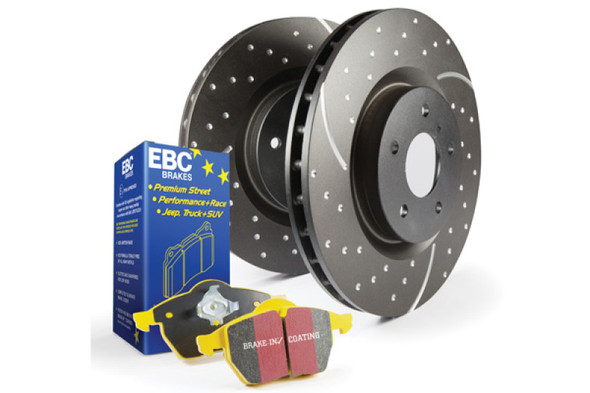

EBC S5 Brake Pad and Rotor Kit - S5KR1525
EBC
MSRP: $511.28$485.72Will these rotors fit my vehicle?EBC GD Sport Rotor Sets require confirmation of specific vehicle fitment using our online tool before purchase.Do I need special tools to install these rotors?Professional installation is strongly recommended for EBC GD...MSRP: $511.28$485.72 -


EBC S5 Brake Pad and Rotor Kit - S5KR1524
EBC
MSRP: $436.62$414.79What vehicles do the EBC GD Sport Rotor Sets fit?EBC GD Sport Rotor Sets fit 2012-2023 Subaru Crosstrek, Forester, and Impreza models, plus two additional Subaru vehicles.How difficult is it to install EBC GD Sport Rotor Sets?Professional installation is...MSRP: $436.62$414.79 -
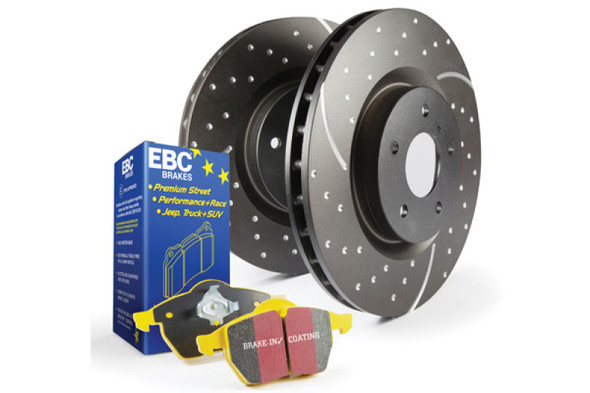

EBC S5 Brake Pad and Rotor Kit - S5KR1506
EBC
MSRP: $543.03$509.99Will EBC GD Sport Rotor Sets fit my 2018 Audi A7 Quattro?EBC GD Sport Rotor Sets are engineered to precisely fit your 2018 Audi A7 Quattro, ensuring seamless integration and optimal performance.What level of difficulty is involved in installing EBC GD...MSRP: $543.03$509.99 -


EBC S5 Brake Pad and Rotor Kit - S5KR1477
EBC
MSRP: $480.14$456.13Do EBC GD Sport Rotor Sets fit my 2011-2018 Audi A6 or A7 Quattro?EBC GD Sport Rotor Sets are engineered to precisely fit your 2011-2018 Audi A6 and A7 Quattro models.What is the recommended installation process for EBC GD Sport Rotor Sets?Professional...MSRP: $480.14$456.13 -


EBC S5 Brake Pad and Rotor Kit - S5KR1476
EBC
MSRP: $576.10$547.30Will these rotors fit my car?Confirm specific vehicle fitment via our compatibility checker to ensure these EBC GD Sport Rotors are a direct match for your application.Can I install these myself?Professional installation is recommended for these EBC GD...MSRP: $576.10$547.30 -


EBC S5 Brake Pad and Rotor Kit - S5KR1469
EBC
MSRP: $402.39$382.27What is the recommended break-in procedure for EBC GD Sport Rotor Sets?EBC GD Sport Rotor Sets feature a patented Brake-in coating, facilitating rapid pad seating for immediate optimal performance without complex procedures.Are EBC GD Sport Rotor Sets...MSRP: $402.39$382.27 -


EBC S5 Brake Pad and Rotor Kit - S5KR1467
EBC
MSRP: $490.08$464.38What is the main benefit of EBC GD Sport Rotor Sets?EBC GD Sport Rotor Sets deliver superior stopping power and reduced fade under extreme conditions, enhancing vehicle control significantly.What is the recommended installation process for EBC GD Sport...MSRP: $490.08$464.38 -


EBC S5 Brake Pad and Rotor Kit - S5KR1464
EBC
MSRP: $422.68$401.55Will these EBC GD Sport Rotor Sets fit my 2011-2016 Scion tC?These EBC GD Sport Rotor Sets are engineered specifically for a direct bolt-on fitment on your 2011-2016 Scion tC.What is the installation difficulty of the EBC GD Sport Rotor Sets?Achieving...MSRP: $422.68$401.55 -

EBC S5 Brake Pad and Rotor Kit - S5KR1458
EBC
MSRP: $399.60$379.62Do EBC GD Sport Rotor Sets fit my 2010 Nissan Frontier?EBC GD Sport Rotor Sets are engineered to precisely fit your 2010 Nissan Frontier, ensuring seamless integration and optimal performance.What is the recommended installation process for EBC GD Sport...MSRP: $399.60$379.62 -
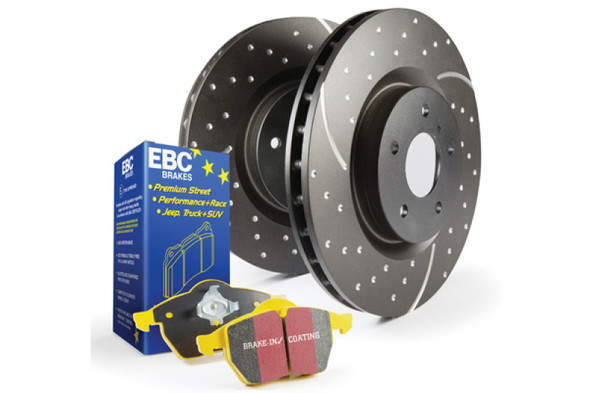

EBC S5 Brake Pad and Rotor Kit - S5KR1442
EBC
MSRP: $485.62$461.34Do EBC GD Sport Rotor Sets fit my 2015 Subaru BRZ?EBC GD Sport Rotor Sets are engineered to perfectly fit your 2015 Subaru BRZ, ensuring seamless integration and optimal performance.What is the installation difficulty for EBC GD Sport Rotor...MSRP: $485.62$461.34 -

EBC S5 Brake Pad and Rotor Kit - S5KR1439
EBC
MSRP: $396.60$376.77Do EBC GD Sport Rotor Sets fit my 2011-2018 Ford Escape and Focus?EBC GD Sport Rotor Sets are engineered for a precise bolt-on fitment on 2011-2018 Ford Escape and Focus models.How difficult is it to install EBC GD Sport Rotor Sets?Achieving enhanced...MSRP: $396.60$376.77 -


EBC S5 Brake Pad and Rotor Kit - S5KR1438
EBC
MSRP: $365.32$347.05What is the primary benefit of EBC GD Sport Rotor Sets for track driving?These sport rotor sets deliver superior stopping power and consistent pedal feel, crucial for sustained performance under extreme track conditions.How do EBC GD Sport Rotors ensure...MSRP: $365.32$347.05
Slotted and drilled brake rotors are the most direct hardware upgrade for improving fade resistance, heat dissipation, and pedal feel under repeated hard braking — and Motor Sport Mayhem stocks 1,176 options across 53 brands, from daily-driver upgrades starting under a dollar to full race-spec two-piece assemblies pushing nearly $3,800. Whether you're chasing consistent lap times at the track or simply want better bite and bite consistency from a heavily loaded street vehicle, the rotor design, metallurgy, and surface treatment you choose determines how your entire brake system performs under pressure.
Our Top Picks for Brake Rotors - Slot & Drilled
Every product below was selected based on demonstrated performance value, engineering quality, and proven real-world results across street, track, and competition applications.
ALC Front Brake Kits
Alcon | $3,450.00
A purpose-engineered front brake system pairing large-diameter slotted rotors with a multi-piston caliper for maximum clamping force and heat capacity in high-demand applications.
- Alcon's motorsport-derived rotor and caliper engineering delivers consistent stopping power under extreme thermal load
ABR Caliper Rebuild Kits
All Balls Racing | $73.99
Restoring caliper function to factory spec is often the most overlooked step when upgrading to slotted or drilled rotors, and this kit delivers exactly that at an accessible price point.
- Seals, pistons, and hardware are precision-matched to restore proper hydraulic pressure and prevent pad taper against new rotor surfaces
AMS Brake Lines
AMS | $144.95
Stainless steel braided brake lines eliminate the pedal sponginess caused by rubber line expansion, ensuring the full hydraulic force from your master cylinder reaches the caliper and rotor contact point.
- PTFE inner liner resists brake fluid degradation and maintains consistent pedal modulation even at elevated system temperatures
ART ABS Kits
Artec Industries | $98.99
When converting to disc brakes with slotted or drilled rotors, maintaining a functional ABS tone ring is critical for electronic brake system compatibility and off-road traction control.
- 52-tooth ring design ensures precise ABS signal resolution matched to factory ECU calibration on axle swap configurations
BKM Brake Rotors
BikeMaster | $264.99
A dedicated motorcycle rotor solution that brings slotted rotor benefits — gas and debris clearance, consistent pad sweep — to two-wheel performance applications.
- Precision-machined rotor surface with controlled runout spec keeps brake feel linear and eliminates pulsation at sustained high speeds
BKC Brake Caliper
Bikers Choice | $399.99
A direct OE-replacement caliper that pairs properly with slotted and drilled rotors in classic V-twin applications, restoring correct pad geometry and hydraulic feel.
- Black powdercoat finish resists rotor dust, road salt, and heat cycling that degrades bare aluminum calipers over time
BX Brake Master Cylinders
BLOX Racing | $124.80
A performance master cylinder with tighter bore tolerances delivers a firmer, more linear pedal response that's critical for properly modulating force across slotted and drilled rotor surfaces.
- Upgraded bore sizing is matched to performance caliper piston displacement, preventing pedal travel increase when running larger aftermarket calipers
BMR Brake Kits for Conversions - D&S
BMR Suspension | $1,339.95
A complete drilled and slotted rotor conversion kit designed for wheel-size upgrades, bundling matched rotors, calipers, and hardware into a single verified fitment package.
- 15-inch rotor diameter conversion dramatically increases swept area, reducing thermal load per square inch under sustained hard braking
BRB Big Brake Kits
Brembo | $1,995.00
Brembo's GT big brake kit pairs a two-piece slotted rotor with a multi-piston caliper, delivering motorsport-level thermal capacity and modulation in a street or track package.
- Two-piece rotor construction isolates the iron friction ring from the aluminum hat, reducing unsprung weight and thermal transfer to the hub bearing
BRE OE Equivalent Rotors
Brembo OE | $1,798.75
Factory-spec OE replacement disc brake kits from Brembo restore the exact rotor diameter, vane geometry, and surface finish that high-performance vehicles left the factory with.
- OE-sourced rotor metallurgy matches factory thermal cycling ratings, ensuring no compromise in fade resistance compared to the original equipment design intent
How to Choose the Right Brake Rotors - Slot & Drilled
The difference between a rotor that performs and one that warps, cracks, or glazes comes down to four variables: rotor metallurgy, surface geometry, dimensional tolerances, and thermal mass — and every buying decision in this category should start there. Cheap rotors are frequently cast from recycled gray iron with inconsistent carbon content, which produces uneven hardness across the friction surface and accelerates pad glazing. Quality units use G3000 or G3500 grade iron, which specifies carbon content, tensile strength, and Brinell hardness within a defined range to ensure predictable wear and fade resistance. Cross-drilled patterns reduce unsprung weight and aid initial bite but concentrate stress at the drill margins — look for chamfered or radius-finished drill holes, not sharp-edged bores, which are a known crack initiation point under track use.
Key Specifications
Rotor diameter is the single most impactful dimension for thermal capacity — a larger rotor increases swept area, spreading heat over more mass and surface, which directly delays fade onset. Minimum thickness specifications are not a suggestion: running a rotor below its discard spec reduces the thermal buffer enough to cause boiling brake fluid and catastrophic fade under hard use. Always measure thickness at multiple points around the rotor face to check for lateral runout-induced taper wear before assuming a rotor is still serviceable.
Slot geometry matters more than most buyers realize. Curved or angled slots actively sweep debris and outgassed pad material toward the rotor outer edge, while straight radial slots simply vent gas without the sweeping action. Slot depth and width must be matched to the pad compound in use — aggressive track compounds generate more gas and require more aggressive venting, while street pads paired with deep slots can cause uneven pad deposit patterns and vibration.
Vane design on the rotor hat determines internal airflow and is often overlooked entirely. Directional vanes — where left and right rotors are handed — move significantly more air through the rotor body than straight pillar vanes, and on high-heat applications this can mean 50–100°F lower rotor temperatures in sustained braking zones. Check whether a manufacturer specifies directional rotors and that you're ordering the correct side — installing a directional rotor backwards eliminates the cooling benefit entirely.
Coating choices affect both longevity and initial break-in. Zinc or geomet coatings on the hat and vanes prevent rust between the friction surfaces without affecting braking performance, while uncoated iron faces that have been treated with a temporary rust preventative will require proper bedding to remove that coating before the pad seats correctly. Black e-coat or powdercoated rotors need the friction surfaces to remain uncoated — any rotor with coating on the swept face is purely cosmetic until that coating burns off, which can create temporary pad contamination on the first several stops.
Slotted & Drilled Rotor Diameter vs. Vehicle Weight and Application
| Vehicle Weight (lbs) | Minimum Rotor Diameter (Front) | Recommended Rotor Diameter (Front) | Primary Application |
|---|---|---|---|
| Under 2,500 | 280mm (11.0") | 300–310mm (11.8–12.2") | Lightweight track car, autocross, sport compact |
| 2,500–3,500 | 300mm (11.8") | 320–330mm (12.6–13.0") | Street performance, occasional track, sport sedan |
| 3,500–4,500 | 320mm (12.6") | 345–355mm (13.6–14.0") | Performance SUV, muscle car, heavy sport coupe |
| 4,500–5,500 | 345mm (13.6") | 370–380mm (14.6–15.0") | Heavy-duty towing, large truck, high-HP application |
| 5,500–7,000 | 370mm (14.6") | 390–405mm (15.4–16.0") | Heavy truck, off-road performance, loaded towing |
| 7,000+ | 390mm (15.4") | 405mm+ (16.0"+) | Race truck, extreme off-road, high-GVWR commercial |
Price Guide
Entry ($0.20–$138): This range covers individual replacement components — tone rings, hardware kits, and single OE-style rotors for non-performance daily drivers. Quality is adequate for stock replacement but thermal capacity and surface finishing are minimal. Expect standard gray iron casting, no directional vanes, and basic rust protection. Suitable for vehicles that will never see track use or heavy repeated braking.
Mid-range ($138–$750): The majority of performance buyers land here, and for good reason — this is where G3000 iron, proper slot geometry, directional vane design, and quality surface coatings become standard. Brands like StopTech, EBC, PowerStop, and DBA all have strong representation in this band. You get genuine thermal performance improvement over OE, meaningful fade resistance for street-plus-occasional-track use, and enough rotor mass to handle real-world driving hard.
Premium ($750–$3,743.73): Two-piece rotor assemblies, full big brake kits, and motorsport-derived systems dominate this range. The cost is justified by aluminum hat construction reducing unsprung weight by 30–50% versus a one-piece casting, fully floating rotor rings that eliminate thermal distortion, and forged or billet caliper housings with verified thermal ratings for sustained competition use. Wilwood, Brembo GT, and Alcon are the names here — this is equipment built to a lap time specification, not a cost target.
Who Is This For?
Slotted and drilled rotors serve a wider range of applications than any other single brake hardware category, from commuter cars driven hard on mountain roads to purpose-built race vehicles logging consistent hot laps.
Street Performance — 8.3/10
This category scores highest for street performance because the combination of slotting and drilling delivers exactly what a spirited street driver needs: improved initial bite, consistent pedal feel, and reduced fade risk when braking repeatedly from highway speeds. The scored surface continuously deglazes the pad face, keeping coefficient of friction consistent across varied temperatures. For street performance, a mid-weight vented rotor with aggressive slot geometry and a quality zinc coating represents the ideal balance of stopping power and rotor life.
Track / Autocross — 7.8/10
Track use scores slightly lower than pure street performance not because slotted and drilled rotors underperform on track, but because dedicated circuit racers often migrate to slotted-only or fully floating two-piece designs that handle sustained thermal cycling better than drilled designs. For autocross — where thermal load is lower and weight matters — drilled and slotted combinations remain excellent, offering fast initial response and visual weight reduction. The key metric for track application is rotor thermal mass relative to vehicle weight and deceleration forces, which should always be calculated before selecting a rotor size.
Racing Competition — 7.5/10
At the competition level, slotted and drilled rotors are a starting point rather than an endpoint — serious race applications often require larger diameter, higher-specification iron, or full two-piece floating assemblies beyond what a combined drill-and-slot design can reliably provide. That said, within classed road racing, autocross, and rally applications where stock-adjacent rotor designs are required, drilled and slotted rotors at this score level outperform OE castings in every measurable braking metric. Always verify sanctioning body rules before selecting rotor design for a classed vehicle.
Daily Driving Comfort — 6.4/10
The lower score here reflects a real engineering trade-off: the same surface features that improve performance can introduce noise, vibration, and accelerated pad wear in pure daily driving conditions. Cold morning stops on drilled rotors can produce a temporary groan as the pad crosses hole edges before reaching operating temperature — not a safety issue, but a comfort compromise some daily drivers find unacceptable. For drivers who want better stopping without any NVH increase, a lightly slotted rotor without drilling often serves better for exclusively street use.
Easy DIY Install — 7.4/10
With 89 products specifically suitable for DIY installation and a 7.4/10 score, this category is more accessible to home installers than most performance brake upgrades. Single-piece slotted and drilled rotors are a direct bolt-on in the vast majority of applications — no machining, no caliper spacers, no bracket fabrication required. The main skill requirement is proper bedding procedure after installation: a correct 8–10 heat cycle bed-in is not optional and takes less than 30 minutes on any public road.
Trusted Brake Rotors - Slot & Drilled Brands We Carry
The brands that dominate this category do so through a combination of metallurgical consistency, engineering depth, and a verified record in competition environments. EBC — the largest brand in our catalog by product count — has built its reputation on proprietary iron blends and slot geometries that are independently tested across hundreds of vehicle platforms, with their rotor lineup spanning from street commuters to dedicated track builds. Brembo needs no introduction in motorsport circles: as an OEM supplier to factory GT racing programs and a Formula 1 brake partner, their rotor specifications are developed under conditions far beyond what any street car will see. Wilwood's catalog sits at the premium end with fully engineered big brake systems and two-piece floating rotor designs that reflect decades of oval track and road racing development. StopTech's cryo-treated and slotted rotors represent serious engineering investment in material performance, while DBA's T3 and 5000 series slot geometries are developed specifically for varied-temperature street and track conditions in the southern hemisphere's demanding endurance rally culture. PowerStop brings strong value-to-performance ratio in the mid-range segment, making drilled and slotted rotor upgrades accessible without sacrificing the G3000 iron and quality surface processing that fade-free street performance requires.
Frequently Asked Questions
Are aftermarket brake calipers any good?
Quality aftermarket calipers from established performance brands are not just as good as OEM — in many cases they're significantly better, with higher piston count, stiffer housing materials, and superior high-temperature seal compounds. The critical variables are housing material (cast iron or forged aluminum versus pot-metal castings used by discount brands), piston-to-bore clearance, and heat-rated seal compounds. A caliper with inadequate seal ratings will push fluid past the piston seals under sustained track heat, causing a soft pedal and progressive brake failure. Stick with brands that publish temperature ratings for their seal compounds, and always pair a new caliper with fresh performance brake pads for a proper system bed-in.
Are aftermarket master cylinders good?
A performance aftermarket master cylinder improves pedal feel and brake response primarily by matching bore diameter more precisely to the total piston displacement of the caliper system — something OEM units are not always optimized for when calipers have been upgraded. The bore diameter relationship to pedal ratio determines pedal travel and force multiplication: too large a bore with stock pedal geometry produces a hard pedal with insufficient clamping force, while too small creates excessive pedal travel. Quality units use aerospace-spec anodized aluminum bores with PTFE-compatible seals rated for DOT 4 and DOT 5.1 fluids. Cheap castings with inconsistent bore finish will cause pedal inconsistency and premature seal wear regardless of what fluid is used.
Are black coated rotors worth it?
Black coated rotors are worth it for one specific reason: they prevent the rust formation on non-swept rotor surfaces — the hat, vanes, and inner edge — that leads to cosmetic deterioration and, in severe cases, vane-to-hat corrosion that accelerates thermal fatigue. The coating on the friction surfaces burns off within the first one to three stops and has zero lasting effect on braking performance. Geomet coating is the current industry standard because it provides better corrosion resistance than zinc without the flaking risk of e-coat. If you're paying a significant premium solely for the black color on the swept surface, that premium isn't justified — but for rotor longevity and under-wheel appearance, a quality coating on the non-swept areas is genuinely worth the modest upcharge.
Are ABS tone rings magnetic?
Yes, passive ABS tone rings are ferromagnetic — they are typically stamped or machined from low-carbon steel specifically because the magnetic reluctance variation as each tooth passes the wheel speed sensor generates the AC voltage signal the ABS module reads. Active tone rings found on newer vehicles use a magnetic encoder ring — a rubber or plastic ring embedded with alternating north and south magnetic poles — which pairs with a Hall effect sensor rather than a variable reluctance sensor. Mixing a passive tone ring with an active sensor or vice versa will produce no signal or a corrupted signal, triggering ABS fault codes and disabling the system. Always verify sensor type before replacing a tone ring in any disc brake conversion or axle swap.
Are backing plates necessary on disc brake setups?
Backing plates on disc brake systems serve a different function than on drum brake setups — they act as dust and debris shields rather than structural brake components, and their necessity depends on the operating environment. In clean road conditions, removing a rust-damaged or bent backing plate causes no performance or safety issue and is a common practice in track builds to improve rotor cooling airflow. In off-road, rally, or high-debris environments, the backing plate prevents rock and mud intrusion between the pad and rotor, which can cause rapid pad and rotor scoring. If your vehicle operates in dusty, muddy, or gravel conditions, maintain or replace the backing plate — in a clean street or circuit environment, their removal is a practical and accepted modification.
Building something specific? Our performance specialists can help you select the right Brake Rotors - Slot & Drilled for your application — street, track, or full race build.